Disclaimer
The information contained in this document is believed to be accurate in all respects but is not warranted by Algo. The information is subject to change without notice and should not be construed in any way as a commitment by Algo or any of its affiliates or subsidiaries. Algo and its affiliates and subsidiaries assume no responsibility for any errors or omissions in this document. Revisions of this document or new editions of it may be issued to incorporate such changes. Algo assumes no liability for damages or claims resulting from any use of this manual or such products, software, firmware, and/or hardware.
No part of this document can be reproduced or transmitted in any form or by any means – electronic or mechanical – for any purpose without written permission from Algo.
For additional information or technical assistance in North America, please contact Algo’s support team:
1-604-454-3792
support@algosolutions.com
Important Safety Information
.png) Important Safety Information
Important Safety Information
This product is powered by a certified limited power source (LPS), Power over Ethernet (PoE); through CAT5 or CAT6 connection wiring to an IEEE 802.3af compliant network PoE switch. The product is intended for installation indoors. All wiring connections to the product must be in the same building. If the product is installed beyond the building perimeter or used in an inter-building application, the wiring connections must be protected against overvoltage / transient. Algo recommends that this product be installed by a qualified electrician.
If you are unable to understand the English language safety information, then please contact Algo by email for assistance before attempting an installation support@algosolutions.com.
Consignes de Sécurité Importantes
Ce produit est alimenté par une source d’alimentation limitée certifiée (alimentation par Ethernet); des câbles de catégorie 5 et 6 joignent un commutateur réseau à alimentation par Ethernet homologué IEEE 802.3af. Le produit est conçu pour être installé à l’intérieur. Tout le câblage rattaché au produit doit se trouver dans le même édifice. Si le produit est installé au-delà du périmètre de l’édifice ou utilisé pour plusieurs édifices, le câblage doit être protégé des surtensions transitoires. Algo recommande qu’un électricien qualifié se charge de l’installation de ce produit.
Si vous ne pouvez comprendre les consignes de sécurité en anglais, veuillez communiquer avec Algo par courriel avant d’entreprendre l’installation au support@algosolutions.com.
Información de Seguridad Importante
Este producto funciona con una fuente de alimentación limitada (Limited Power Source, LPS) certificada, Alimentación a través de Ethernet (Power over Ethernet, PoE); mediante un cable de conexión CAT5 o CAT6 a un conmutador de red con PoE en cumplimiento con IEEE 802.3af. El producto se debe instalar en lugares cerrados. Todas las conexiones cableadas al producto deben estar en el mismo edificio. Si el producto se instala fuera del perímetro del edificio o se utiliza en una aplicación en varios edificios, las conexiones cableadas se deben proteger contra sobretensión o corriente transitoria. Algo recomienda que la instalación de este producto la realice un electricista calificado.
Si usted no puede comprender la información de seguridad en inglés, comuníquese con Algo por correo electrónico para obtener asistencia antes de intentar instalarlo: support@algosolutions.com.
Wichtige Sicherheitsinformationen
Dieses Produkt wird durch eine zertifizierte Stromquelle mit begrenzter Leistung (LPS – Limited Power Source) betrieben. Die Stromversorgung erfolgt über Ethernet (PoE – Power over Ethernet). Dies geschieht durch eine Cat-5-Verbindung oder eine Cat-6- Verbindung zu einer IEEE 802.3af-konformen Ethernet-Netzwerkweiche. Das Produkt wurde konzipiert für die Installation innerhalb eines Gebäudes. Alle Kabelverbindungen zum Produkt müssen im selben Gebäude bestehen. Wenn das Produkt jenseits des Gebäudes oder für mehrere Gebäude genutzt wird, müssen die Kabelverbindungen vor Überspannung und Spannungssprüngen geschützt werden. Algo empfiehlt das Produkt von einem qualifizierten Elektriker installieren zu lassenv.
Sollten Sie die englischen Sicherheitsinformationen nicht verstehen, kontaktieren Sie bitte Algo per Email bevor Sie mit der Installation beginnen, um Unterstützung zu erhalten. Algo kann unter der folgenden E-Mail-Adresse erreicht werden: support@algosolutions.com.
安全须知
本产品由认证的受限电源(LPS),以太网供电(PoE),通过 CAT5 或 CAT6 线路联接至 IEEE 802.3at PoE+ or 802.3af 兼容的 PoE 网络交换机供电。本产品适用于室内或建筑物周 边安装。所有联接本产品的线路必须源自同一建筑物。本产品如需用于超出建筑物周边范 围或跨建筑物的安装,线路联接部分必须有过压和瞬态保护。Algo 建议本产品由专业电工 安装。
如果您对理解英文版安全须知有问题,安装前请通过电子邮件和 Algo 联 系,support@algosolutions.com 。
.png) EMERGENCY COMMUNICATION
EMERGENCY COMMUNICATION
If used in an emergency communication application, the 8039 IP Video Mullion Intercom should be routinely tested. SNMP supervision is recommended for assurance of proper operation. Contact Algo for other methods of operational assurance.
DRY INDOOR LOCATION ONLY
The 8039 IP Video Mullion Intercom is intended for dry indoor locations only. For outdoor locations Algo offers weatherproof speakers and strobe lights.
CAT5 or CAT6 connection wiring to an IEEE 802.3af (PoE) compliant network PoE switch must not leave the building perimeter without adequate lightning protection.
No wiring connected to the 8039 IP Video Mullion Intercom may leave the building perimeter without adequate lightning protection.
Overview
Introduction
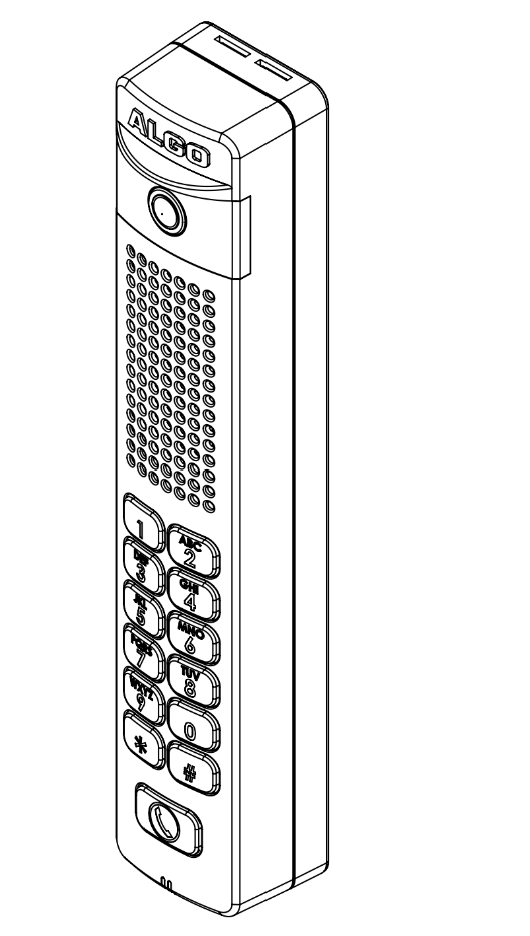
The 8039 SIP Video Intercom is ideal for secure business entrances, emergency intercom, and gated entrances. The Algo 8039 provides hands-free intercom capability with video, entrance security with door unlock control, rugged weatherproof design, and superior audio performance.
Fully compatible with SIP industry standards, the 8039 SIP Video Intercom will work with most hosted or enterprise SIP-based servers supporting third-party SIP endpoints.
The 8039 SIP Video Intercom is configured using central provisioning features or by accessing a web interface using browsers such as Google Chrome, Firefox, or Microsoft Edge.
8039 SIP Video Intercom
Mounting Plate
Optional 8063 IP Relay Controller
Setup and Installation
Installation
The 8039 SIP Video Intercom is weather-protected for outdoor installation. However, if network cabling extends beyond the perimeter of the building, then adequate lightning protection is required to protect the cabling and network switch from lightning surges. No lightning protection is required by UL or CSA if the 8039 is located on the outside wall of a building and the wiring is inside the perimeter of the building.
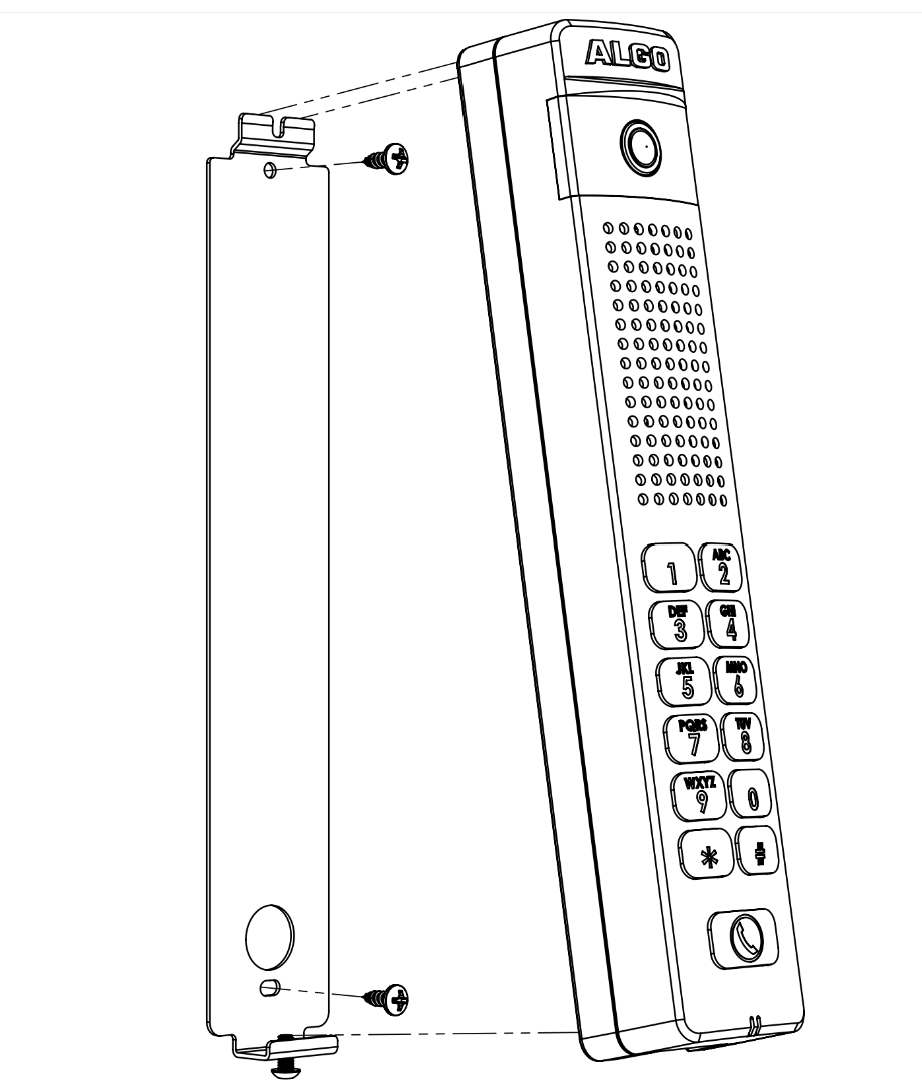
The 8039 is wall and door frame (mullion) mountable via the supplied mounting plate:
Secure the mounting plate to the wall or mullion door frame via two #8 screws.
Attach the 8039 to the mounting plate and secure the device in place with the attached security screw at the bottom of the mounting plate using the provided Allen wrench.
Getting Started - Quick Install & Test
Note
This guide provides important safety information that should be read thoroughly before permanently installing the product.
Connect the 8039 SIP Video Intercom to an IEEE 802.3af-compliant PoE network switch. The backlight keypad will turn on. After about 1 minute, a beep will signal the completion of the boot process.
After the boot is complete, press the call button on the 8039 to hear the IP address. (Once the SIP Server field is populated in the 8039 web interface, the call button will contact the preconfigured extension when pressed.) The IP address may also be discovered by downloading the Algo locator tool to find Algo devices on your network: www.algosolutions.com/locator
Access the 8039 SIP Video Intercom web page by entering the IP address into a browser (Chrome, Microsoft Edge, Firefox etc) and logging in using the default password algo.
Enter the IP address for the SIP server into the SIP Domain field under the BASIC SETTINGS → SIP tab.
Enter the SIP Extension, Authentication ID, and Password. Also enter the target Dialing Extension that the Intercom will call.
Note
The Authentication ID may also be called Username for some SIP servers, and in some cases may be the same as the SIP extension.
Press the Call Button on the 8039 Intercom, then answer the phone to communicate over the Intercom. Press the digit 6 on the phone keypad to activate the door control relay for three seconds (if applicable).
Programming and Configuration
The 8039 SIP Video Intercom is configurable using the web interface or provisioning features.
After boot up, the speaker will beep and the intercom will have obtained an IP address. If there is no DHCP server the 8039 SIP Video Intercom will default to the static IP address 192.168.1.111.
Before the 8039 is configured, the call button on the front can be pressed to play the IP address over the speaker. (Once the SIP Server field is populated on the 8039 web interface, the call button will contact the preconfigured extension when pressed.) The IP address may be discovered by downloading the Algo locator tool to find Algo devices on your network: www.algosolutions.com/locator
Enter the IP address (e.g 192.168.1.111) into a browser such as Google Chrome, Firefox, or Microsoft Edge . The web interface should be visible and the default password will be algo in lower case letters.
 Wiring Connections
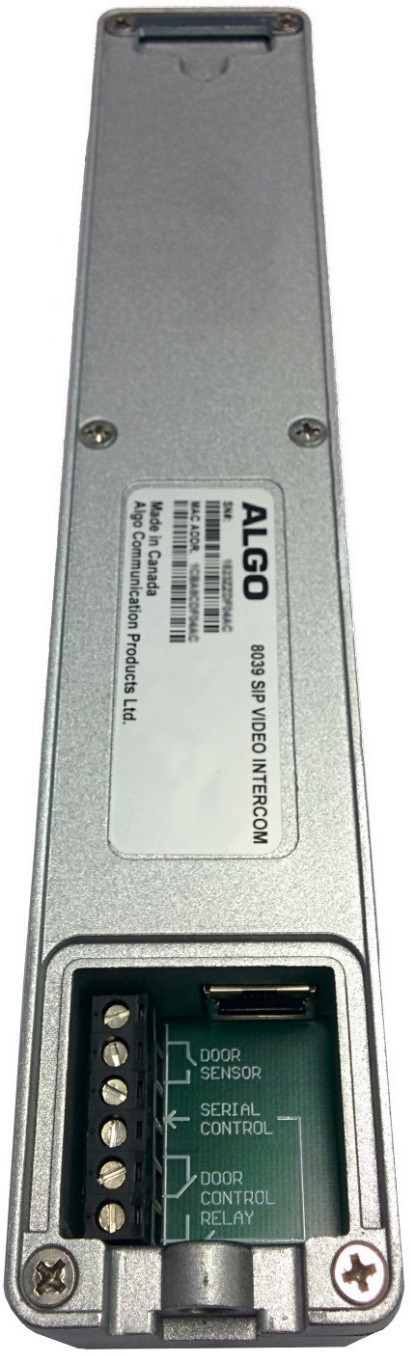
The speaker provides a RJ45 jack for network connection. A cable run from the switch can be terminated to a modular jack with connection by patch cord, or terminated with an RJ45 plug.
PoE (Power over Ethernet) must be 48V 350 mA IEEE 802.3af compliant whether provided by the network switch or injector.
There are two lights on the Ethernet jack:
Green light: On when Ethernet is working, flickers off to indicate activity on the port.
Amber light: Off when successful 100Mbps link is established. Typically on only briefly at power up.
Under normal conditions, the Amber light will turn on immediately after the Ethernet cable is first connected. This indicates that PoE power has been successfully applied. Once the device connects to the network, it will switch to the Green light instead, which will typically flicker indicating traffic on the network.
Provides both normally open and normally closed relay contacts.
Note
The 8063 IP Relay Controller can be used as an alternative more secure option for door opening control, by using a separate relay from the public-facing intercom.
Reserved for future use.
Door Sensor (Dry Contact Input)
An external call button can be connected as a normally open switch. When the relay is triggered, this will dial the pre-configured “Extension to Dial”.
Backlit Keypad and Call Button
The backlit keypad and call button will be steady during power up and will flash during a reset.
If enabled, when making a call, the call button light will flash rapidly, while the call is ringing at the far-end phone. Once the call is answered, the flashing will slow down.
The 8039 SIP Video Intercom can only be reset during a power up. To return all the settings to the factory default for the 8039, wait until all the backlit keys start flashing. Then press and hold the call button until the call button backlight begins a double flash pattern. Release the call button and allow the unit to complete its boot process. Do not press the call button until all the keys start flashing.
A reset will set all configuration options to factory default including the password.
Web Interface Status and Login
Web Interface Login
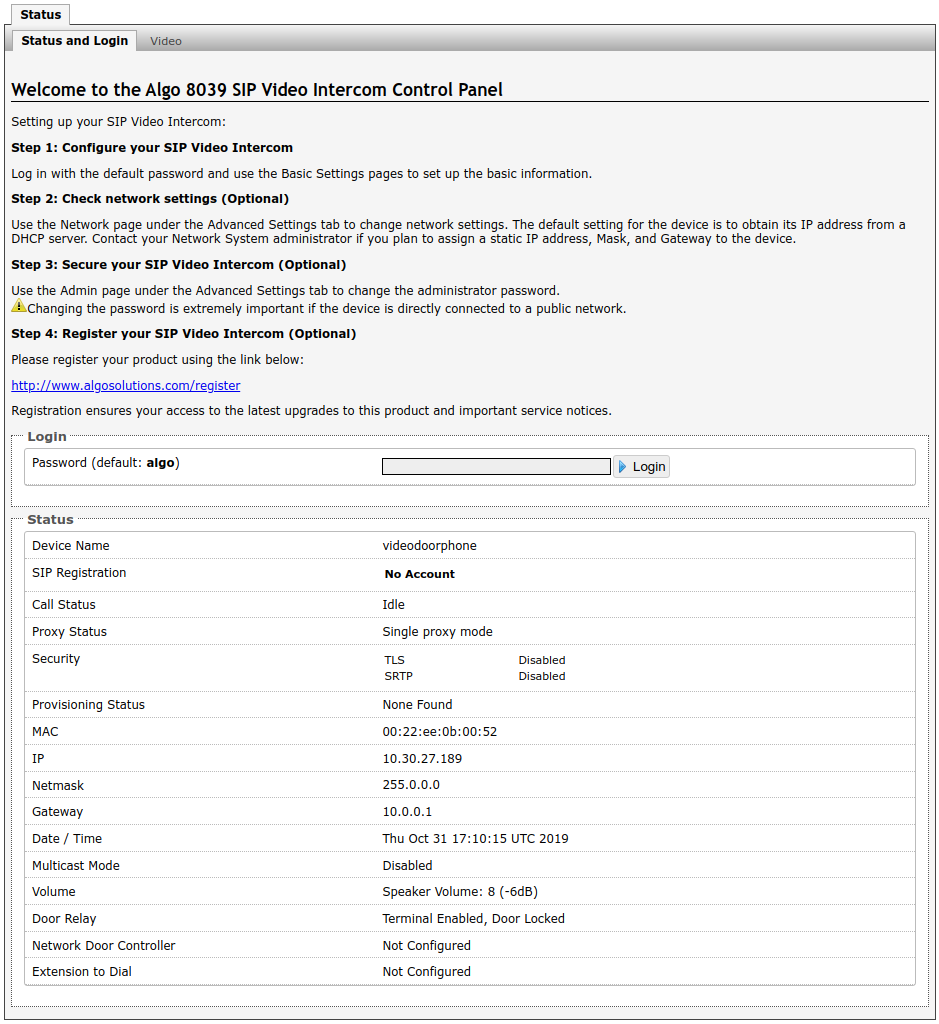 The web interface requires a password which is ‘algo’ by default. This password can be changed in the Admin tab after logging in the first time.
Note
Web Interface is accessed by entering 8039’s IP Address into the web browser.
It is highly recommended to change the default password if the device is directly connected to a public network.
Status
The device's Status page will be available before and after logon. The section can be used to check the device's SIP Registration status of the SIP Extension, Call Status, Proxy Status, and general MAC, IP, Netmask, Date/Time information.
Note
The Status page can be hidden when logged out for security purposes under the Advanced Settings → Admin tab.
Status Tab – Video
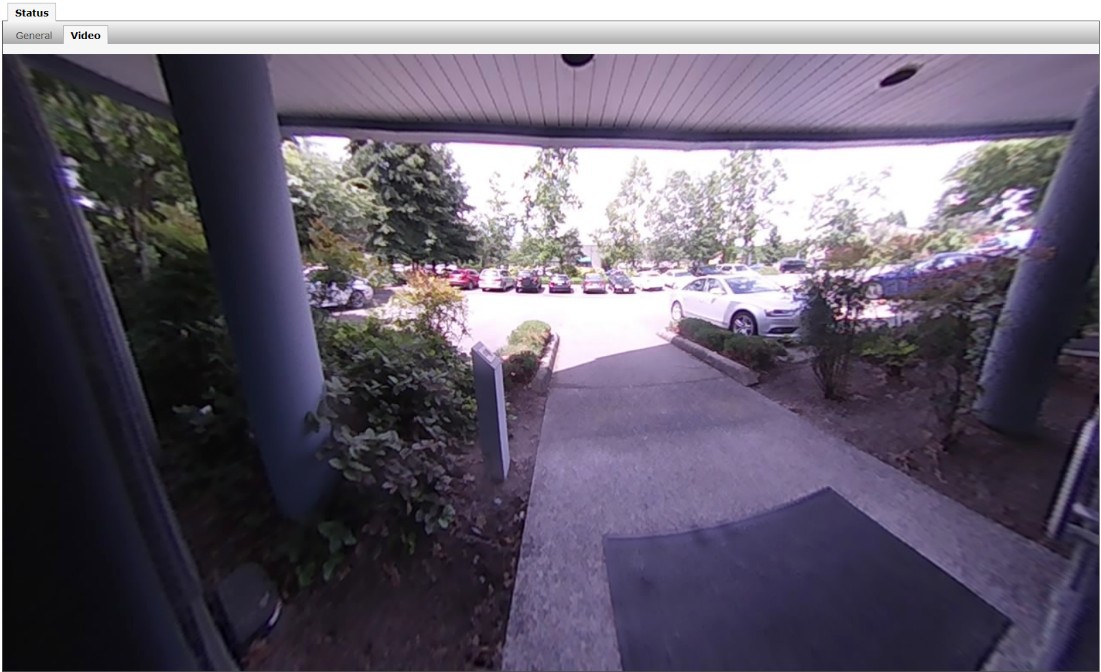
The video can be seen in the Status → Video tab when the user is not logged in. A separate video password can also be enabled, to allow users to access the video, but not the rest of the device settings. This password can be set in Basic Settings → Video tab, “Session Password” field. Video settings like brightness, contrast, view (Dewarped or Fisheye) are also available in the Basic Settings → Video tab.
Web Interface Basic Settings
Basic Settings Tab – SIP
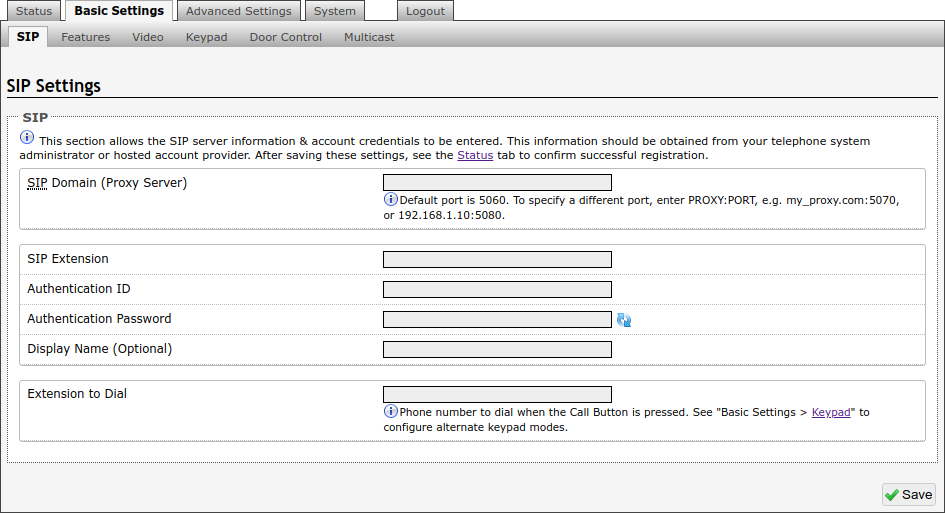
SIP Server information and Credentials should be obtained from your telephone system administrator or hosted account provider. After saving the settings, see the Status tab to confirm the registration was successful.
Note
Any time changes are made to settings in the web interface the ‘Save’button must be clicked to save the changes.
The IP address (e.g. 192.168.1.111) or domain name (e.g. myserver.com) of the SIP Server.
Used to register the 8039 on the SIP Server.
It may also be called Username for some SIP servers, and in some cases, it may be the same as the SIP extension.
SIP password provided by the system administrator for the SIP account.
Enter the phone number that will be dialed when the call button is pressed. This can also be a Hunt Group number. Ensure that voicemail is not reached.
Note
The Basic Settings → Keypad tab offers additional keypad modes like playing a voice prompt when the call button is pressed and using the keypad to dial extensions or listed departments.
Basic Settings Tab – Features
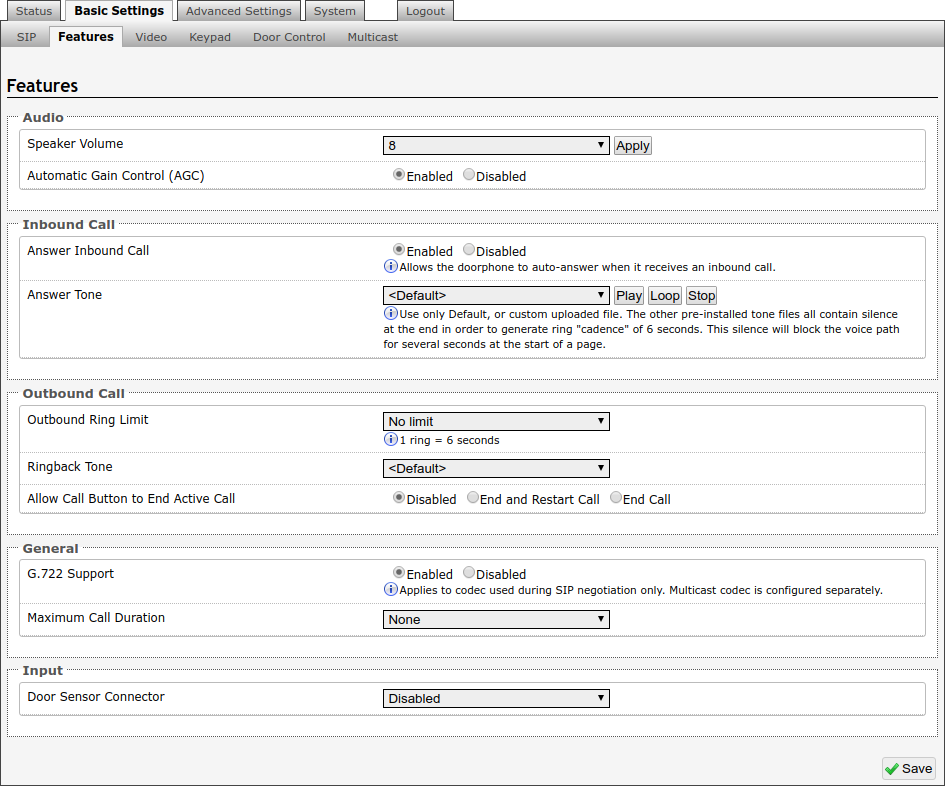
Select the speaker audio level of the 8039 from 1 (lowest) to 10 (highest).
Starting from 10 (0 dB), each step reduces the volume by 3 dB, down to -5 (-45 dB).
Normalizes the audio level. This ensures audio level heard at the speaker is always at a consistent level, independent of the phone that is used to answer the call.
Allow the 8039 to auto-answer an inbound call. By default, this functionality is activated.
Select a tone to be played over the speaker when the intercom answers an inbound call. Use only the Default or a custom uploaded file. The other pre-installed tone files all contain silence at the end in order to generate ring "cadence" of 6 seconds. This silence will block the voice path for several seconds at the start of a call.
This feature can be used to set a limit on how long the intercom will ring before timing out. If the call is not answered within this time period, the 8039 will go back to an idle state.
Select an audible ringback tone to be played on the 8039 speaker until the call is answered.
Allow Call Button to End Active Call
If enabled, allows the visitor to end an active call by pressing the call button.
Enable or disable the G.722 codec.
Select the maximum call length. The call will be terminated once the maximum time is reached. In the event that a call inadvertently reaches voicemail or gets accidentally left on hold, this setting ensures that the 8039 returns on-hook.
External call button can be used as an input to the door sensor connector. External call button will function like the call button on the device.
Basic Settings Tab – Video
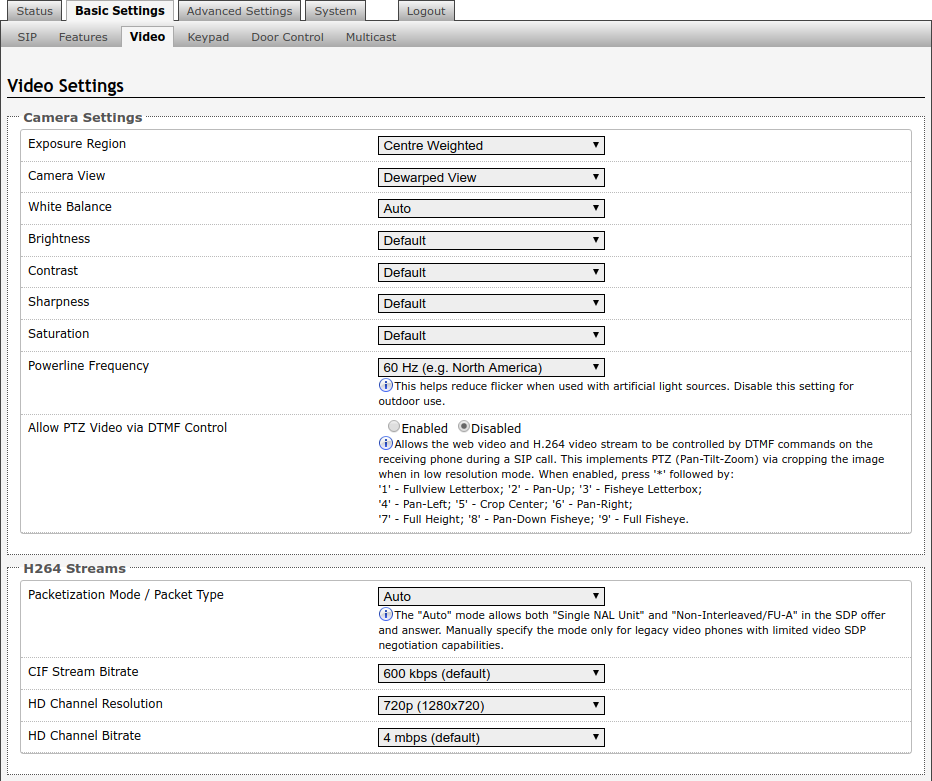
Select an exposure calculation region for optimal image rendering. “Spot” method calculates exposure based on the center area of the image. “Full Frame” method uses the entire image to determine the exposure. “Centre Weighted” uses mainly the center area and a fraction of the remaining frame to compute the exposure.
Camera view can be set to either a “Dewarped” full page view or a circular “Fisheye”.
Select the white balance settings. “Auto” will auto-detect the light levels and auto-balance the video accordingly. Other balance choices include: Daylight 6500K and 5500K, Fluorescent, and Incandescent.
Increase or decrease image brightness either above or below the default value.
Increase or decrease image contrast either above or below the default value.
Increase or decrease image sharpness either above or below the default value.
Increase or decrease image saturation either above or below the default value.
Choose the local powerline frequency. For example, 60 Hz in North America and 50 Hz in Europe. This allows the device to reduce video flicker when used with indoor lighting.
Allow PTZ Video via DTMF Control
Use DTMF command to control the web video and H.264 video stream.
Refer to phone specifications to determine best supported packet type (“Single NAL Unit” or “Fragmentation Unit Type A (FU-A)”). Use ‘Auto’ mode except with legacy video phones with limited Video SDP negotiation capability.
Select the amount of network traffic the device can use.
Select the video resolution as supported by the video phone that will answer the calls, 720p (1280x720) or VGA (640x480).
Select the amount of network traffic the device can use.
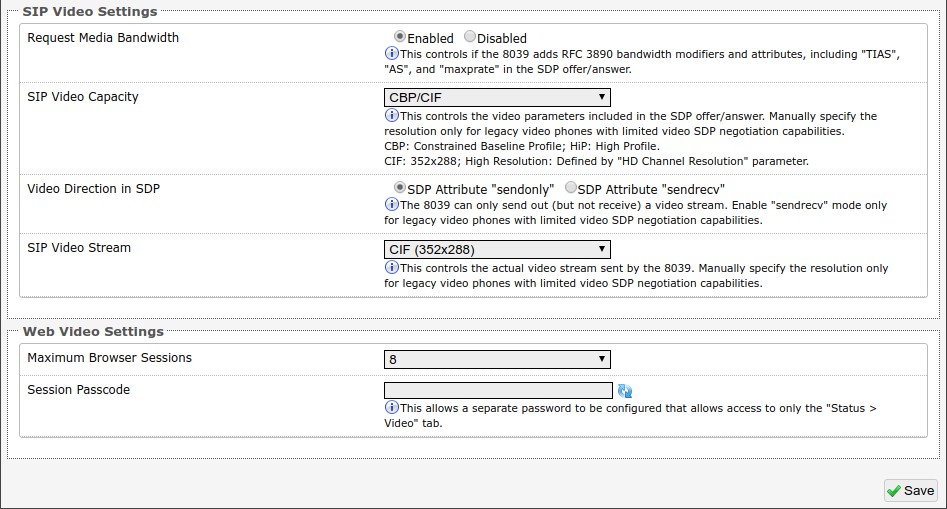
Adds bandwidth modifiers and attributes in the SDP offer/answer.
This controls the video parameters included in the SIP 'Offer' that is sent when the 8039 initiates a call. Select the video capacity as supported by the video phone that will answer the calls.
This controls the actual video stream sent by the 8039. Use ‘Auto’ mode unless a manual override is required for compatibility with legacy video phones.
Allows for a limit to be set on the number of separate browser sessions that can be open simultaneously to show the video. The setting can be “Disabled” to turn off the web video capability.
This allows a separate password to be configured that allows access to only the Status → Video tab.
Basic Settings Tab – Keypad
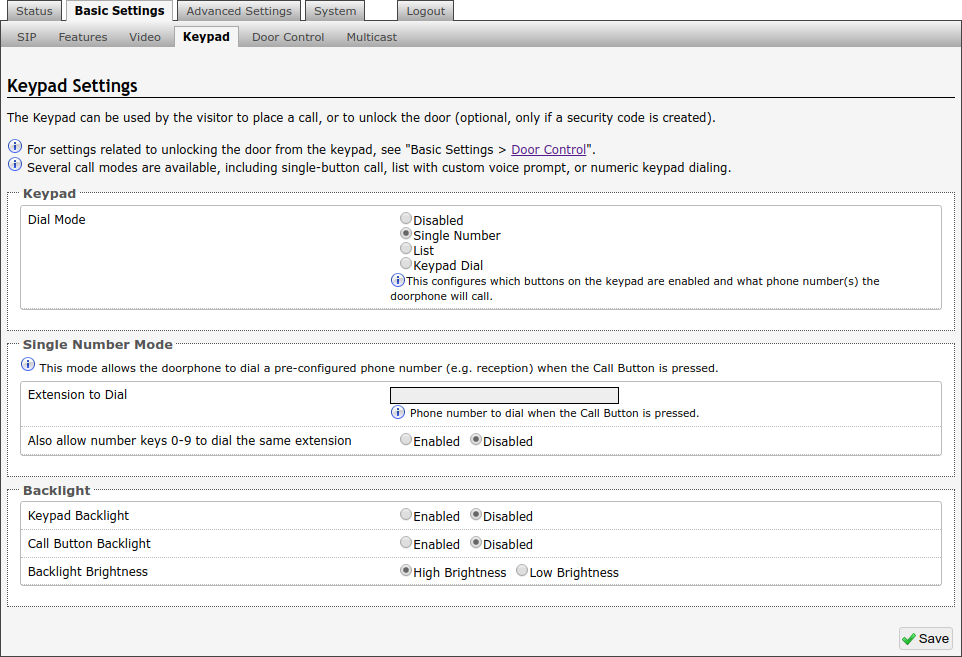
This mode allows the 8039’s “Call” button to dial a pre-configured number, the “Extension to Dial”. There is also an option to allow all the number keys on the keypad to dial this same extension.
This mode allows each of the 10 “number” keys to dial a different preconfigured phone number. For example, 1 for Reception, 2 for Sales, 3 for Shipping, etc.
The Call button can be configured to play a voice prompt detailing the available options to the visitor. The voice prompt can be uploaded via a custom audio file in the Advanced Settings → File Manager tab.
This mode allows the keypad to be used to dial extensions directly. If an incorrect number is dialed by mistake, the “#” key can be pressed to cancel, and the extension can be dialed again.
Set the “Length of Extension to Dial”, correctly to match the extension length of your phone system.
The Call button can be set to “Dial Extension” (e.g., reception) or to “Play Voice Prompt,” giving the visitor instructions and/or a summary of main extensions to dial via the keypad.
Note
Set appropriate permissions on the phone system to ensure that a malicious visitor cannot use the intercom to dial an external number. Also ensure that a visitor will not reach voicemail to prevent the call from getting “stuck”.
Enable or disable the Keypad’s blue backlight.
Enable or disable the Call Button’s blue backlight.
Configures the brightness of the Keypad and Call Button backlight if they are enabled.
Basic Settings Tab – Door Control
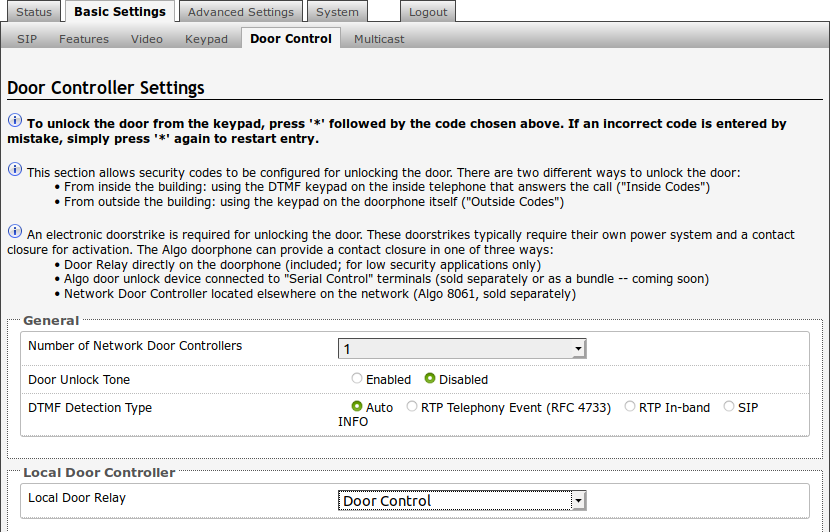
The 8039 contains a relay that can be used for Door Control, or it can be used with the optional 8063 IP Relay Controller (sold separately) for additional door security, as the 8063 can be located inside the building and separate from the public-facing intercom. This section allows you to configure the 8063 settings (if used), or the local door relay. For more information about the 8063, see “8063 IP Relay Controller”.
Number of Network Door Controllers
Set up to 4 network door controllers (8063s) to unlock/lock the doors.
Allow a tone to be played when the door is unlocked to create awareness.
Different DTMF detection options are given. Use the default of ‘Auto’ unless advised by Algo technical support.
Enable or disable the door control relay on the 8039.
Network Door Controller Address
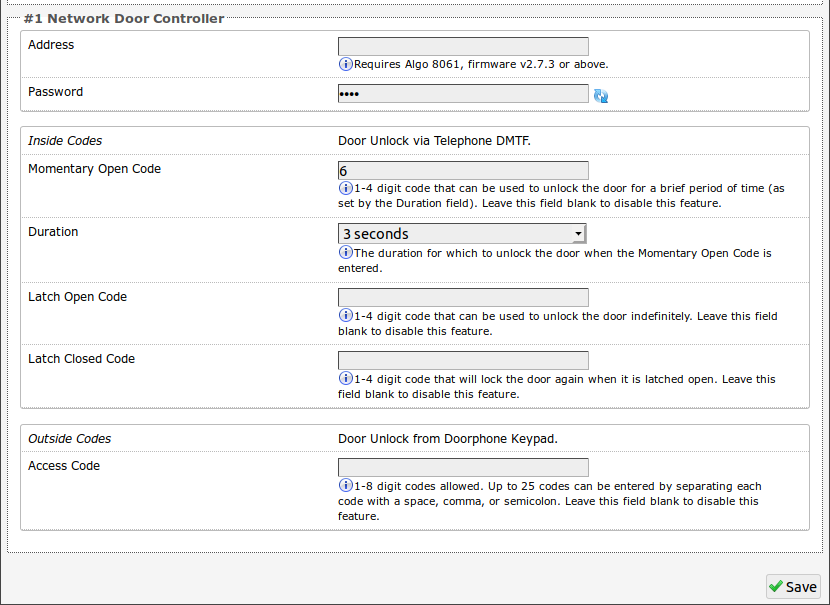
IP address of the optional 8063 IP Relay Controller.
Network Door Controller Password
Used to authenticate the link between the 8039 and the 8063. Ensure that the two devices have matching passwords. Default password is algo.
Note
The Relay Module Password is used solely to secure the link between the 8039 and the 8063. It is not the same as the Momentary Open Code.
1-4 digit DTMF code that can be used to unlock the door for a brief period of time. Leave this field blank to disable this feature.
(Default: 6)
The time period for which to unlock the door when the Momentary Open Code is entered. From ¼ to 30 seconds.
1-4 digit DTMF code that can be used to unlock the door indefinitely. Leave this field blank to disable this feature.
1-4 digit DTMF code that will lock the door again when it is latched open. Leave this field blank to disable this feature.
This is a “secret” code that allows authorized visitors or employees to let themselves in without needing to call someone inside the building.
1-8 digit codes allowed. Up to 25 codes can be entered by separating each code with a space, comma, or semicolon. Leave this field blank to disable this feature.
Basic Settings Tab – Multicast
Each 8039 SIP Video Intercom has its own IP address, and shares a common multicast IP and port number (multicast zone) for multicast packets. The 8039 is able to act as a multicast Receiver, allowing it to multicast messages from a sender device over the intercom speaker.
Note
The 8039 is not meant for voice paging in large areas. Instead we recommend using the 8186 SIP Horn Speaker for outdoor or wide-area applications, and the 8180 SIP Audio Alerter or 8188 SIP Ceiling Speaker for any other indoor paging requirements.
The network switches and router see the packet and deliver it to all the members of the group. The multicast IP and port number must be the same on all the sender and Receiver units of one group. The user may define multiple zones by picking different multicast IP addresses and/or port numbers.
Multicast IP addresses range: 224.0.0.0/4 (from 224.0.0.0 to 239.255.255.255)
Port numbers range: 1 to 65535
By default, the 8039 Video Intercom is set to use the multicast IP address 224.0.2.60 and the port numbers 50000-50008
Make sure that the multicast IP address and port number do not conflict with other services and devices on the same network.
The 8039 Video Intercom supports nine “basic” multicast zones. These zones are defined by the multicast IP addresses.
Somewhat arbitrarily, these zones are defined below but may be used in other ways. The important consideration is that there is a priority hierarchy – streaming activity on a zone higher on the list, will be treated as a higher priority than a zone lower on the list – with music being the lowest priority.
Priority
All Call
Zone 1
Zone 2
Zone 3
Zone 4
Zone 5
Zone 6
Music
“Expanded” zones can also be enabled, in the Basic Settings → Multicast tab, allowing up to 50 zones in total. These have the same behaviors as the basic zones, but are hidden by default to simplify the interface.
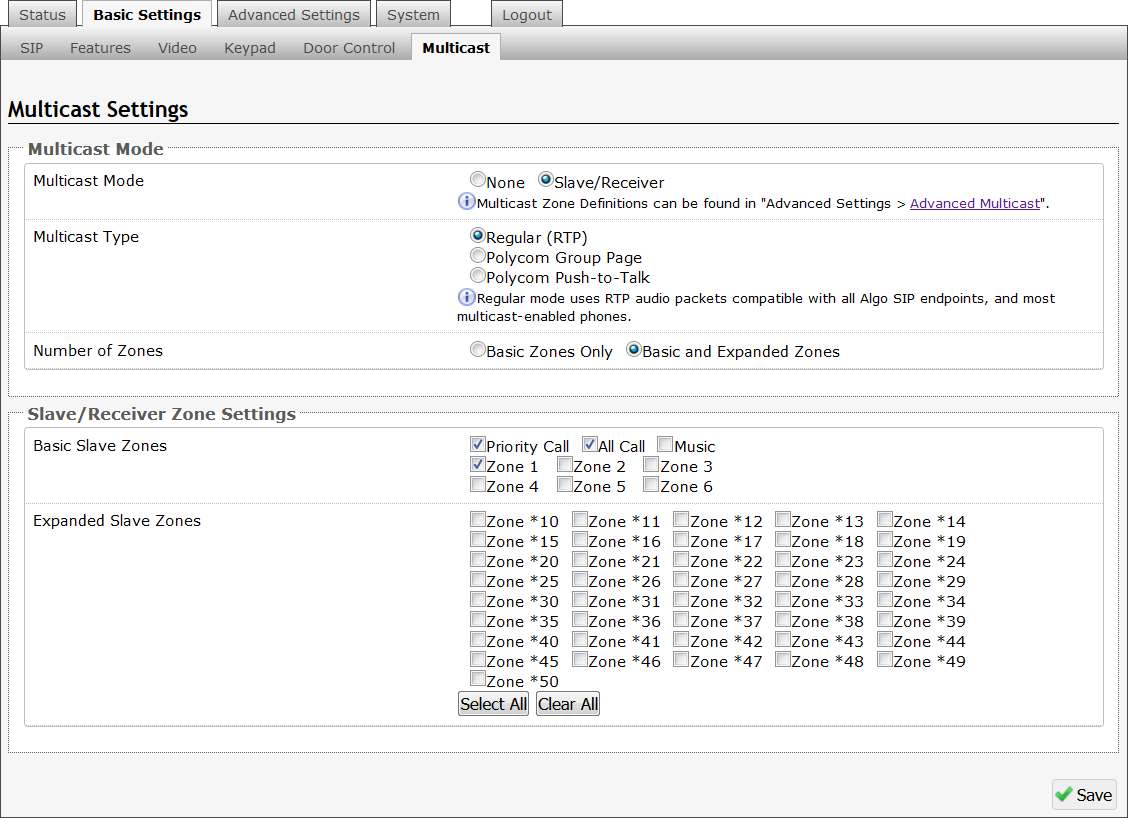
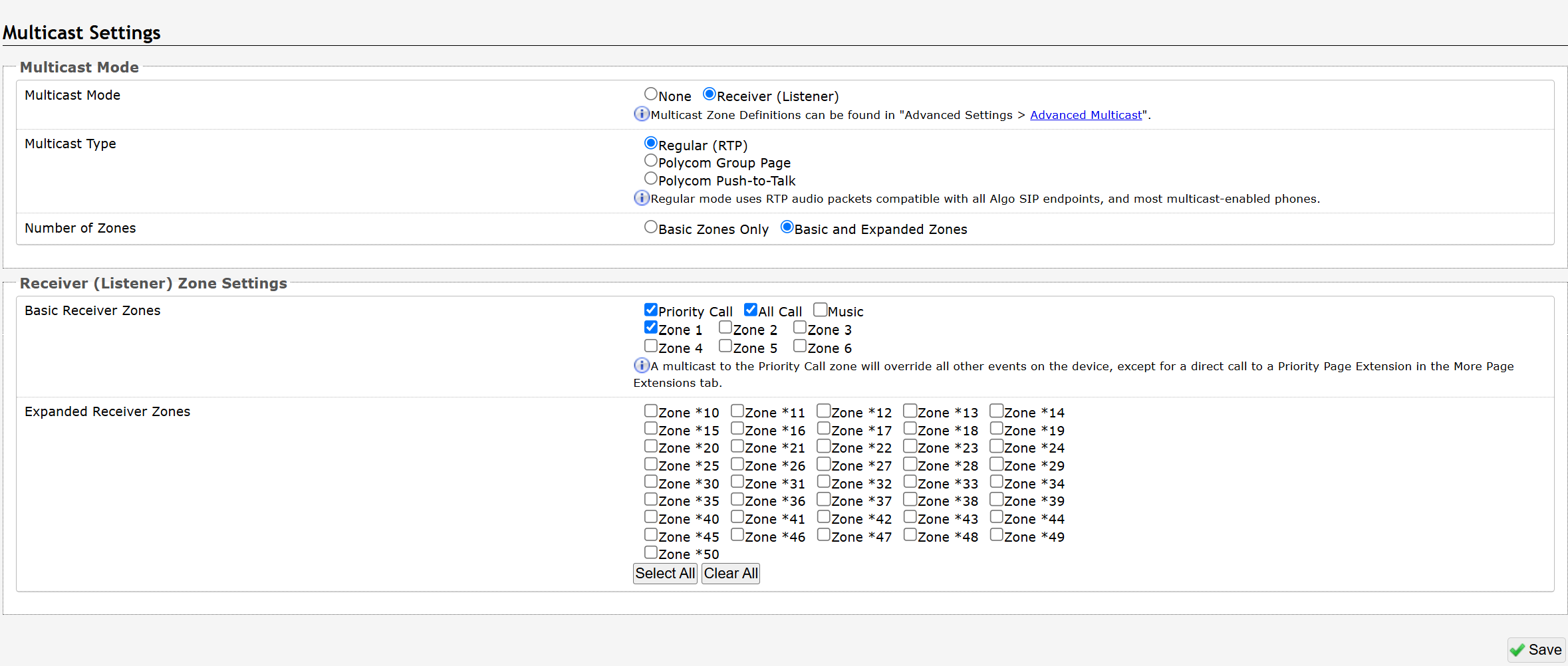
Multicast Mode (Receiver Selected)
If Receiver mode is enabled the 8039 intercom speaker will activate when receiving a multicast message.
Select “Regular” if receiving multicast from other Algo SIP endpoint(s) and/or multicast-enabled phone(s) that use RTP audio packets.
Select “basic” zones if configuring nine or fewer multicast zones or “expanded” to configure up to 50 zones. The expanded zones have the same behaviour as the basic Receiver zones, but are hidden by default to simplify the interface.
Select one or more multicast zones for the 8039 SIP Video Intercom to monitor. Note that multicast zone priority is based on the zone definition list order (top to bottom).
Multicast Type – Poly Group Paging/Push-to-Talk
The 8039 SIP Video Intercom may receive multicast paging compatible with Poly “on premise group paging” protocol.
To configure the 8039 as a Receiver to play Poly page announcements, select “Group Page” or “Push-to-Talk”. Then enter the Poly Zone (IP Address and Port) that matches the configuration of the Poly phones and Channels. The “Default Channel” is the target group in a Poly paging environment.
The Poly phone used as page audio source for the 8039(s), must be configured to use either the G.711 or G.722 audio codec. The Poly phone(s) must also be configured with the “Compatibility” setting (“ptt.compatibilityMode”) disabled in order for this codec setting to be applied.
If using a Poly phone as the Multicast sender, a tone may be set for any of the 25 Poly Groups configured on the Algo device. If an Algo device is used as a Multicast sender, a tone does not have to be set as the Algo sender will provide its own tone. Poly Group Tones can be set in Advanced Settings → Advanced Multicast tab.
Web Interface Advanced Settings
Advanced Settings Tab - Network

DHCP is an IP standard designed to make administration of IP addresses simpler. When selected, DHCP will automatically configure IP addresses for each 8039 on the network. Alternatively the 8039 can be set to a static IP address.
Enables or Disables VLAN Tagging. VLAN Tagging is the networking standard that supports Virtual LANs (VLANs) on an Ethernet network. The standard defines a system of VLAN tagging for Ethernet frames and the accompanying procedures to be used by bridges and switches in handling such frames. The standard also provides provisions for a quality of service prioritization scheme commonly known as IEEE 802.1p and defines the Generic Attribute Registration Protocol.
Specifies the VLAN to which the Ethernet frame belongs. A 12-bit field specifying the VLAN to which the Ethernet frame belongs. The hexadecimal values of 0x000 and 0xFFF are reserved. All other values may be used as VLAN identifiers, allowing up to 4094 VLANs. The reserved value 0x000 indicates that the frame does not belong to any VLAN; in this case, the 802.1Q tag specifies only a priority and is referred to as a priority tag. On bridges, VLAN 1 (the default VLAN ID) is often reserved for a management VLAN; this is vendor-specific.
Sets the frame priority level. Otherwise known as Priority Code Point (PCP), VLAN Priority is a 3-bit field that refers to the IEEE 802.1p priority. It indicates the frame priority level. Values are from 0 (lowest) to 7 (highest).
Credentials to access LAN or WLAN that have 802.1X network access control (NAC) enabled. This information will be available from the IT Administrator.
Differentiated Services (6-bit DSCP value)
Provides quality of service if the DSCP protocol is supported on your network. Can be specified independently for SIP control packets versus RTP audio packets.
In "SIP" mode, only the results of DNS queries for SIP requests will be cached. In "All" mode, the results of all DNS queries will be cached.
Admin
Admin settings allow you to configure device access, security, management, monitoring, and integration features.
From this page, you can change administrator credentials, manage logging and network management settings, enable APIs and external services, and configure device maintenance options.
Note
Available settings may vary depending on your product model and firmware version.
To configure Admin settings:
Go to Advanced Settings → Admin.
Configure the settings.
Refer to the following tables for the setting description.
Admin Password | |
Old Password | Enter the old admin password. The default password when you first get the device is algo. |
Password | Enter a new admin password to log into the device web interface. Make sure the new password is stored safely. If the password is forgotten, you must reset the device entirely with the Reset Button to restore the default password. All other settings will be reset to the original default settings as well. |
Confirmation | Re-enter your new admin password. |
General | |
Device Name (Hostname) | Add a name to identify the device. |
Introduction Section on Status Page | Select On to show the introduction text on the login screen. |
Show Status Section on Status Page when Logged Out | Select On to allow others to view the status page without logging in. Select Off to hide the settings and configurations on the status page unless a user is logged in to ensure only trusted users can view device information. |
Display Switch Port ID on Status Page | Select On to display the Switch Port ID on the Status Page. This option is only possible if the device is connected to a switch that supports LLDP or CDP. |
Web Interface Session Timeout | Set the maximum duration of inactivity to log a user out of the web interface automatically. |
Play Tone at Startup | The device can play a beep tone at startup. This option is available only to Algo IP Speakers, IP Displays, Paging Adapters, and IP Consoles. |
Log Settings | |
Log Level | Select the types of information you want to include in the system log files.
|
Log Method | Select a log method: Local: The log file is saved in RAM on the device. Network: Send the log file to an external SysLog server so settings are not lost if the device is rebooted, or for ease of central access. Both: Use both methods. |
Log Server | Enter the Syslog server address provided by your IT administrator. |
Log Additional Log Events | To be used by support@algosolutions.com if necessary. |
Management | |
Web Interface Protocol | HTTPS is always enabled on the device. HTTP is enabled by default but may be disabled. To do so, select HTTPS Only mode so requests are automatically redirected to HTTPS.
|
Force Strong Password | When Enabled, you can enforce a secure password for the device web interface for additional protection. The password requirements for a strong password are:
|
Allow Secure SIP Passwords | When Enabled, SIP passwords are stored in the configuration file in an encrypted format to prevent viewing and recovery. If enabled, navigate to Basic Settings → SIP and fill out the Realm field. To obtain your SIP Realm information, contact your SIP Server administrator or check the SIP log file for a registration attempt. The Realms may be the same or different for all the extensions used. All the configured Authentication Password(s) must be re-entered here as well as any other locations where SIP extensions have been configured to save the encrypted password(s). If the Realm is changed later, all passwords must be re-entered to save the passwords with the new encryption. |
Simple Network Management Protocol | |
SNMP Support | Disabled by default. The existing setting will respond to a simple status query for automated supervision. |
SNMP Community String | Speak to your IT Administrator for more information. |
SNMPv3 Security | Speak to your IT Administrator for more information. |
API Support | |
RESTful API | Disabled by default. Enable a secure API for remote access and device control via HTTP. For more information, see the Algo RESTful API Guide. |
Authentication Method | Speak to your IT Administrator for more information. |
RESTful API Password | Speak to your IT Administrator for more information. |
System Integrity | |
System Integrity Checking | Enable this feature to verify that installed system packages have not been tampered with by running a check. Enabling this feature may cause reboots and upgrades to take 30 seconds longer. Verification results can be found on the Status tab. |
Time
Network time is used for logging events into memory for troubleshooting.
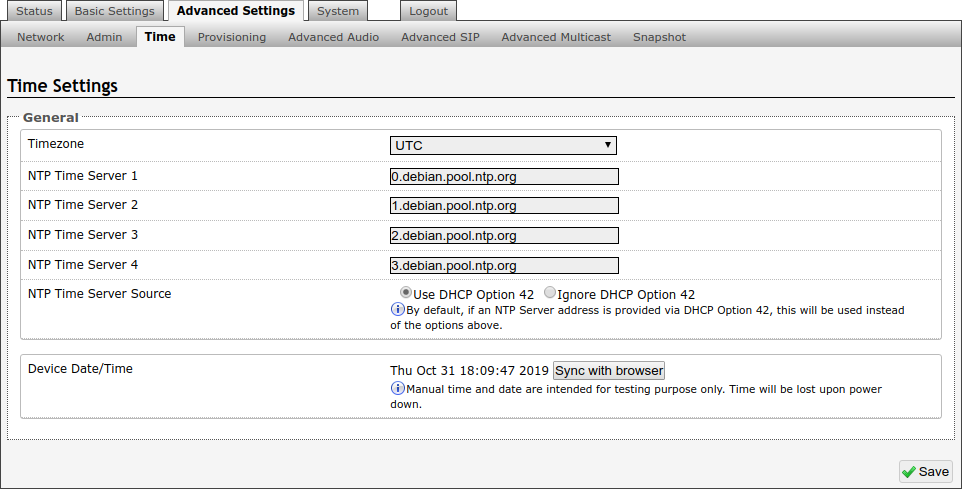
Select time zone.
The interface will attempt to use Timer Server 1 and work down the list if one or more of the time servers become unresponsive.
When “Use DHCP Option 42” is chosen, if an NTP Server address is provided via the DHCP Option 42, that NTP Server will be used instead of the 4 mentioned above. Alternatively, “Ignore DHCP Option 42” can be chosen to only use servers mentioned above.
This field shows the current time and date as set on the device. If testing the device on a lab network that may not have access to an external NTP server, the “Sync with browser” button can be used to temporarily set the time on the device.
Note
This time value will be lost at power down, or overwritten if NTP is currently active. Time and date are used only for logging purposes and are not typically required.
Advanced Settings Tab – Provisioning
Note
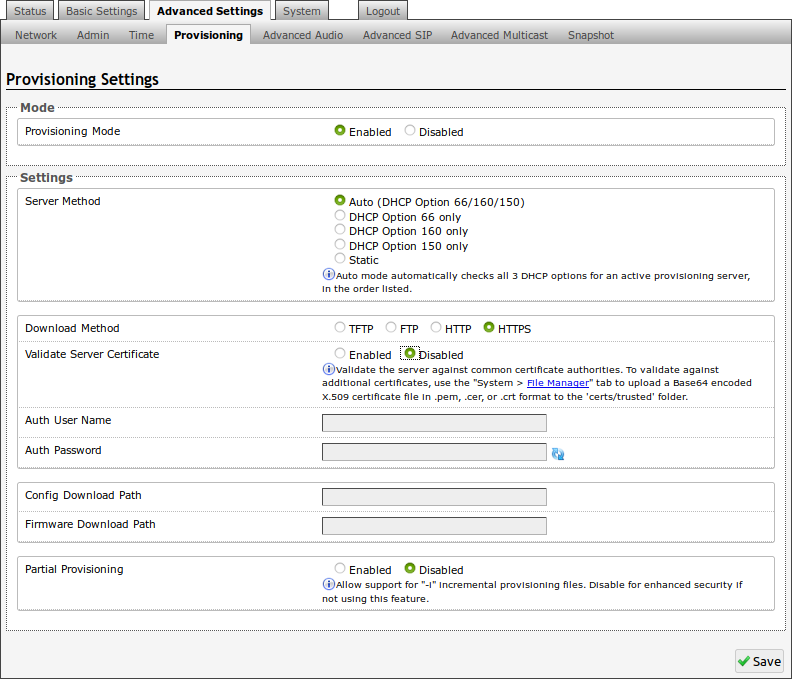
It is recommended that Provisioning Mode be set to Disabled if this feature is not in use. This will prevent unauthorized re-configuration of the device if DHCP is used.
Provisioning allows installers to pre-configure 8039 SIP Video Intercom units prior to installation on a network. It is typically used for large deployments to save time and ensure consistent setups.
The device can be provisioned via the Auto mode (where all three DHCP options (Option 66/160/150) will be automatically checked for an active provisioning server), just one of the three specified DHCP options, or a Static Server. In addition, there are four different ways to download provisioning files from a “Provisioning Server”: TFTP (Trivial File Transfer Protocol), FTP, HTTP, or HTTPS.
For example, 8039 configuration files can be automatically downloaded from a TFTP server using DHCP Option 66. This option code (when set) supplies a TFTP boot server address to the DHCP client to boot from.
Note
DHCP must be enabled if using DHCP Option 66/160/150, in order for Provisioning to work.
One of two files can be uploaded on the Provisioning Server (for access via TFTP, FTP, HTTP, or HTTPS):
Generic (for all Algo 8039 Intercoms) algop8039.conf Specific (for a specific MAC address) algom[MAC].conf Both protocol and path is supported for Option 66, allowing for http://myserver.com/config-path to be used.
In addition to the .conf file, an .md5 checksum file must also be uploaded to the Provisioning server. This checksum file is used to verify that the .conf file is transferred correctly without error.
A tool such as can be found at the website address below may be used to generate this file: http://www.fourmilab.ch/md5
The application doesn’t need an installation. To use the tool, simply unzip and run the application (md5) from a command prompt. The proper .md5 file will be generated in the same directory.
If using the above tool, be sure to use the “-l” parameter to generate lower case letters.
Generating a generic configuration file
Connect 8039 to the network.
Access the 8039 Web Interface Control Panel.
Configure the 8039 with desired options.
Click on the System tab and then Maintenance.
Click “Download” to download the current configuration file.
Save the file settings.txt.
Rename file settings.txt to algop8039.conf.
File algop8039.conf can now be uploaded onto the Provisioning server.
If using a generic configuration file, extensions and credentials have to be entered manually once the 8039 SIP Video Intercom has automatically downloaded the configuration file.
Generating a specific configuration file
Follow steps 1 to 6 as listed in the section “Generating a generic configuration file”.
Rename file settings.txt to algom[MAC address].conf (e.g. algom0022EE020009.conf)
File algom[MAC address].conf can now be uploaded to the Provisioning server.
The specific configuration file will only be downloaded by the 8039 SIP Video Intercom with the MAC address specified in the configuration file name. Since all the necessary settings can be included in this file, the 8039 will be ready to work immediately after the configuration file is downloaded. The MAC address of each 8039 SIP Video Intercom can be found on the back label of the unit.
For more Algo SIP endpoint provisioning information, see: www.algosolutions.com/provision
Using OAuth for Authentication
OAuth (Open Authorization) is an industry-standard protocol that enables secure, delegated access to resources without requiring users to share credentials such as usernames and passwords.
Instead of storing static credentials on a device or application, OAuth allows a trusted third-party service (such as Google, Microsoft, or Slack) to issue time-limited access tokens. These tokens allow an Algo device to interact with the service on behalf of a user or system, without exposing sensitive login information.
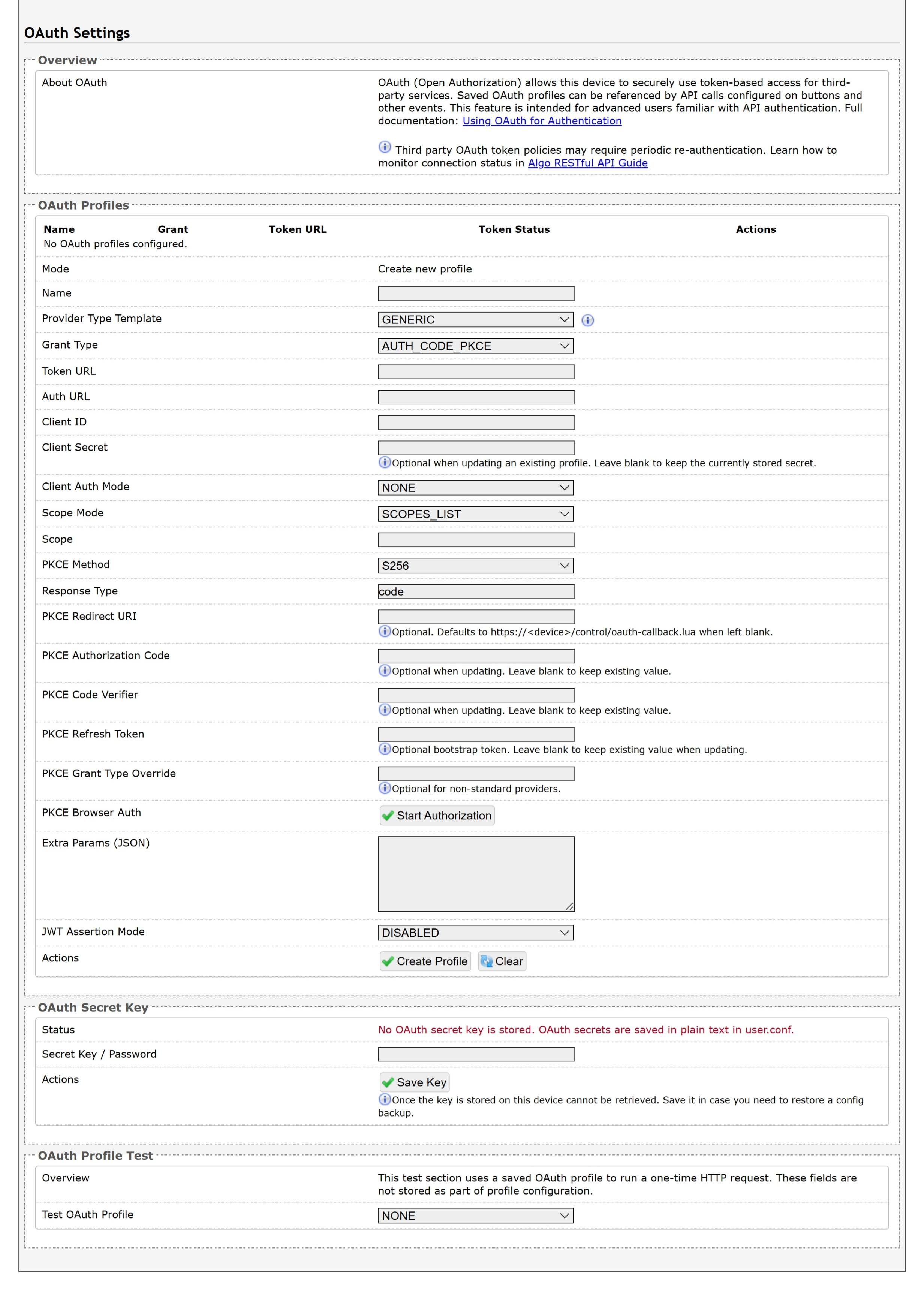
For more information, see Using OAuth for Authentication.
Advanced Settings Tab – Advanced Audio
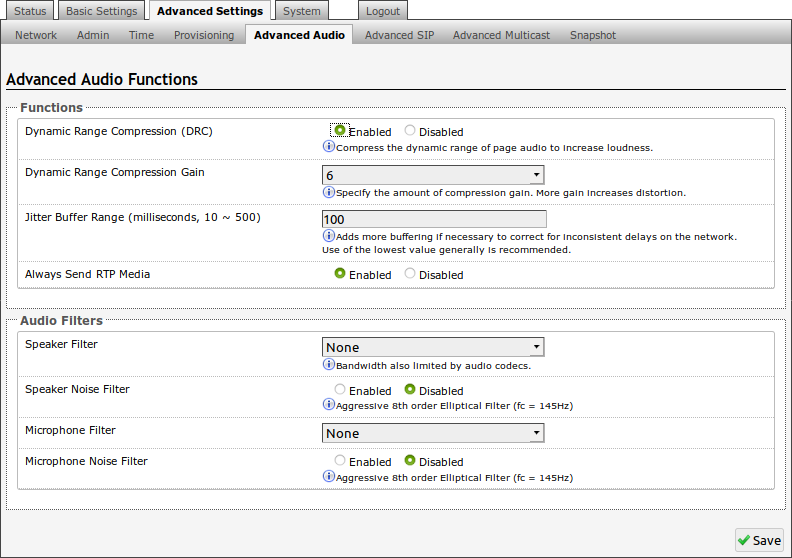
Dynamic Range Compression (DRC)
If enabled, it compresses the dynamic range of page audio to increase loudness.
Dynamic Range Compression Gain
‘Dynamic Range Compression’ must be enabled to display this setting. Higher compression gain increases distortion.
The jitter buffer removes the jitter in arriving network packets by temporarily storing them. This process corrects the inconsistent delays on the network. It is recommended to use the lowest value.
If enabled, audio packets will be sent at all times, even during one-way paging mode. This option is needed in cases when the server expects to see audio packets at all times.
Applies a high-pass filter to the speaker output. Used to reduce audio artifacts like humming or buzzing by filtering out unwanted frequencies.
Enables heavy filtering below 145Hz to reduce mains-induced noise (fans).
Applies a high-pass filter to the microphone input. Used to reduce audio artifacts like humming or buzzing by filtering out unwanted frequencies.
Enables heavy filtering below 145Hz to reduce mains-induced noise (fans).
Advanced Settings Tab – Advanced SIP
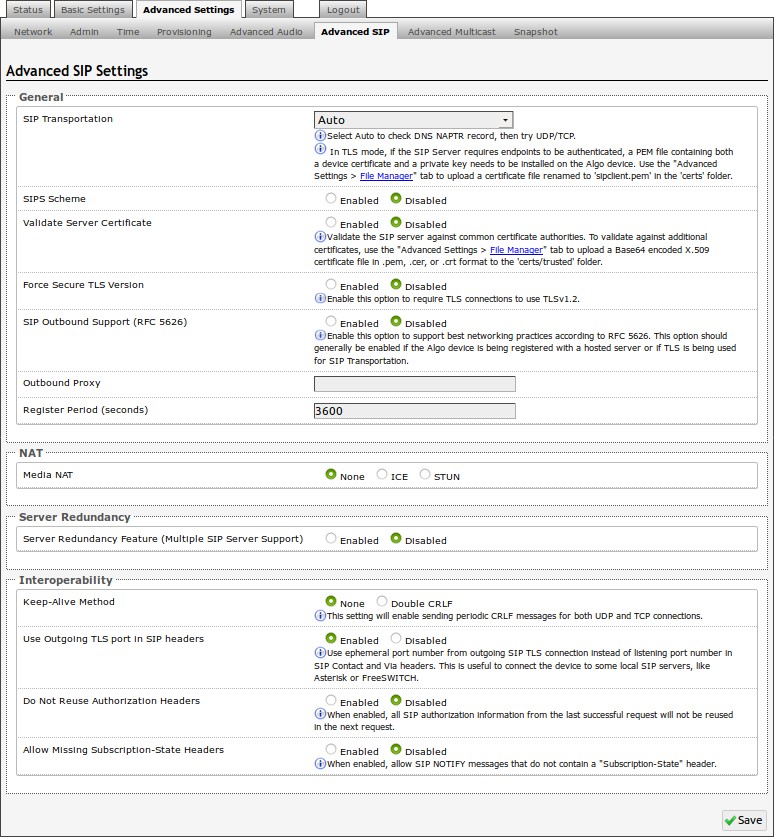
Which transport layer protocol to use for SIP messages. Setting ‘SIP Transportation’ to ‘TLS’, ensures the encryption of SIP traffic.
Only visible when ‘SIP Transportation’ set to ‘TLS’. Enabling SIPS Scheme requires the SIP connection from endpoint to endpoint to be secure.
SIP Outbound Support (RFC 5626)
Enable this option to support best networking practices according to RFC 5626. This option should generally be enabled if the Algo device is being registered with a hosted server or if TLS is being used for SIP Transportation.
IP address for outbound proxy. A proxy (server) stands between a private network and the internet.
Maximum requested period of time where the 8128 SIP Strobe Light will re-register with the SIP server. Default setting is 3600 seconds (1 hour). Only change if instructed otherwise.
IP address for STUN server if present or IP address/credentials for a TURN server.
Two secondary SIP servers may be configured. The 8039 SIP Video Intercom will attempt to register with the primary server but switch to a secondary server when necessary. The configuration allows re-registration to the primary server upon availability or to stay with a server until unresponsive.
If Server Redundancy is selected the web page will expand as shown below.
If primary server is unreachable the 8039 SIP Video Intercom will attempt to register with the backup servers. If enabled, the 8039 SIP Video Intercom will always attempt to register with the highest priority server.
If backup server #1 is unreachable the 8039 SIP Video Intercom will attempt to register with the 2nd backup server. If enabled, the 8039 SIP Video Intercom will always attempt to register with the highest priority server.
Time period between sending monitoring packets to each server. Non-active servers are always polled, and active server may optionally be polled (see below).
Explicitly poll current server to monitor availability. May also be handled automatically by other regular events, so can be disabled to reduce network traffic.
Reconnect with higher priority server once available, even if backup connection is still fine.
SIP message used to poll servers to monitor availability.
If Double CRLF is selected the 8039 SIP Video Intercom will send a packet every 30 seconds (unless changed) to maintain connection with the SIP Server if behind NAT.
Interval in seconds that the CRLF message should be sent.
Use Outgoing TLS port in SIP headers
Use ephemeral port number from outgoing SIP TLS connection instead of listening port number in SIP Contact and Via headers. This is useful to connect the device to some local SIP servers, like Asterisk or FreeSWITCH.
Do Not Reuse Authorization Headers
When enabled, all SIP authorization information from the last successful request will not be reused in the next request.
Advanced Settings Tab – Advanced Multicast
Note
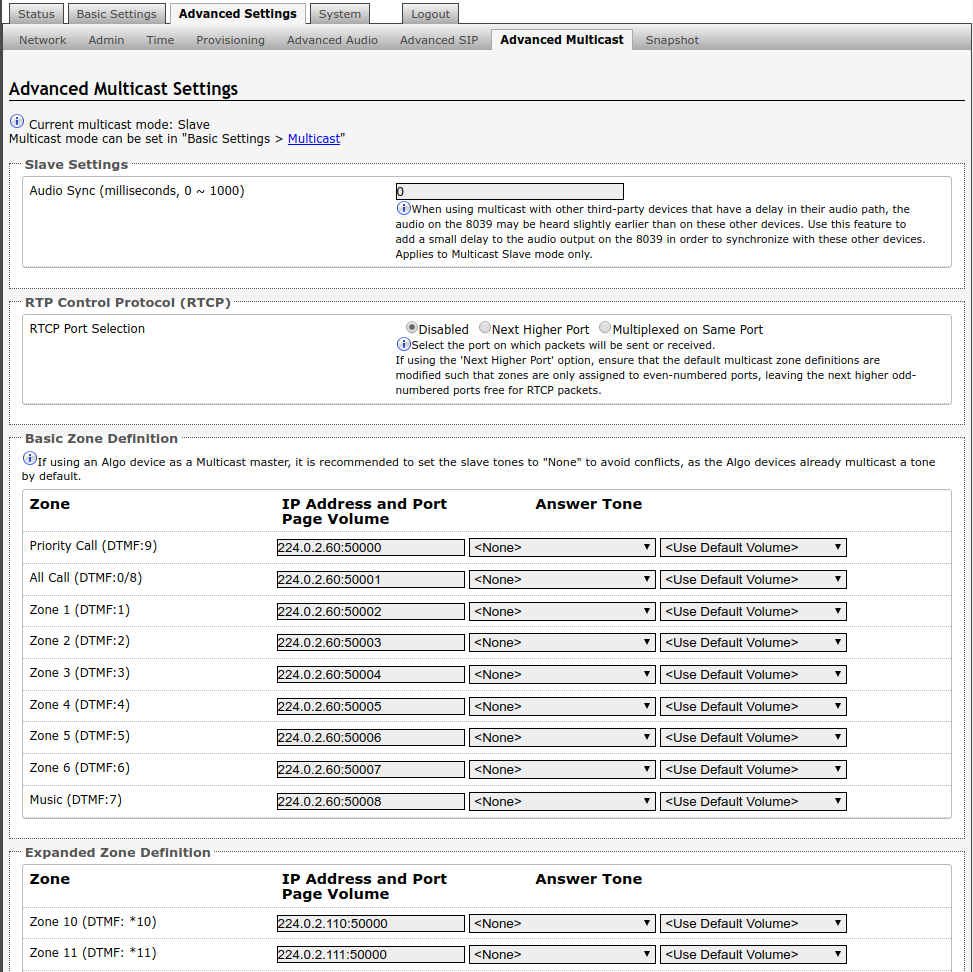
The settings on this tab are only available when in multicast receiver mode.
Select the port on which RTCP packets will be sent or received. If using the 'Next Higher Port' option, ensure that the default multicast zone definitions are modified such that zones are only assigned to even-numbered ports, leaving the next higher odd-numbered ports free for RTCP packets.
When paging to the 8039 SIP Video Intercom as well as other third party devices, the low latency of the 8039 may cause the audio to lead other devices. By adding audio delay up to one second, the 8039 may be synchronized with other endpoints or telephones that have greater latency.
The “Expanded” Receiver zones can be enabled/disabled in Basic Settings → Multicast. Default IP addresses and ports may be revised for any given zone in the table.
Note
Ensure that the Address and Port settings are the same for all sender and receiving devices.
When an Algo device is the multicast sender, a page tone will play on the receiving device, so it is recommended to set the Receiver tone to “None”. If a page is received from a non-Algo device that doesn’t send a tone, a tone can be inserted on the receiving device allowing for a page tone to be played prior to page audio starting.
By default, the same page volume can be set for all Receiver zones in the Basic Settings → Features tab. Unique page volumes may be revised on a per-zone basis in the table above. For instance, emergency pages can be louder on certain Receiver endpoints.
A tone may be set for any of the 25 Poly Groups. If using an Algo device as a Multicast sender, it is recommended to set the Receiver tones to “None” to avoid conflicts, as the Algo devices already multicast a tone by default.
These settings are available only if the 8039 is set as a Multicast Receiver and “Poly Group Page” or “Poly Push-to-Talk” are selected in the Basic Settings → Multicast tab.
Advanced Settings Tab – Snapshot
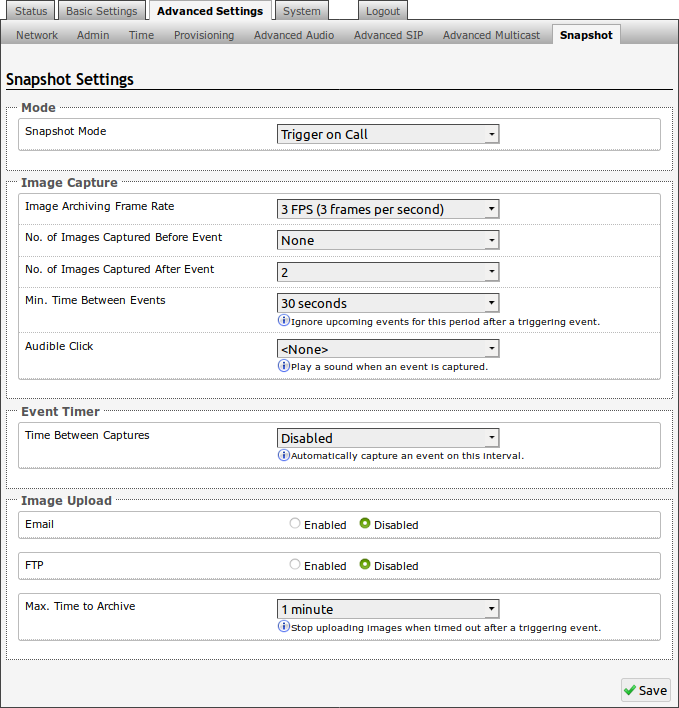
Disable or enable the snapshot to be triggered when the call is made.
Note
Enabling snapshot mode will disable low-power sleep mode.
Choose a frame rate from 1/5 FPS to 5 FPS.
No. of Images Captured Before Event
Number of images to be captured before the call is made.
No. of Images Captured After Event
Number of images to be captured after the call is made.
Ignore upcoming events for the chosen period after a triggering event.
Play a tone when image is captured.
Automatically capture an event on this interval.
Set an email server for the images to be uploaded.
Set an FTP server for the images to be uploaded.
Stop uploading images when timed out after a triggering event.
Web Interface System
System Tab - Maintenance
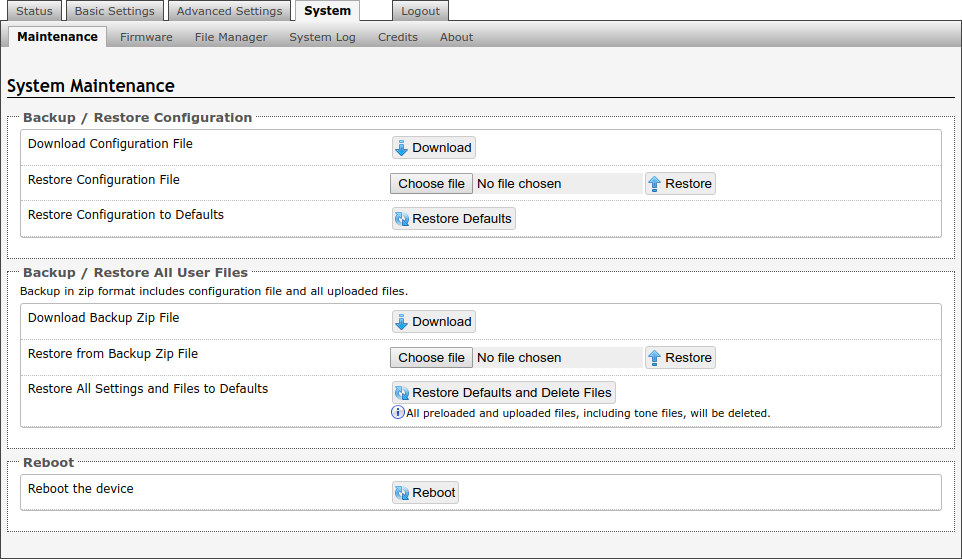
Save the device settings to a text file for backup or to setup a provisioning configuration file.
Restore settings from a backup file.
Restore Configuration to Defaults
Resets all 8039 SIP Video Intercom device settings to factory default values.
Saves the device settings (configuration) and all the files in File Manager: certificates, licenses, and tones to a backup zip file.
Restores the device settings (configuration) and all the files in File Manager: certificates, licenses, and tones from a backup zip file.
Restore All Settings and Files to Defaults
Resets the device settings (configuration) and all the files in File Manager: certificates, licenses, and tones to factory default values.
Reboots the device.
System Tab - Firmware
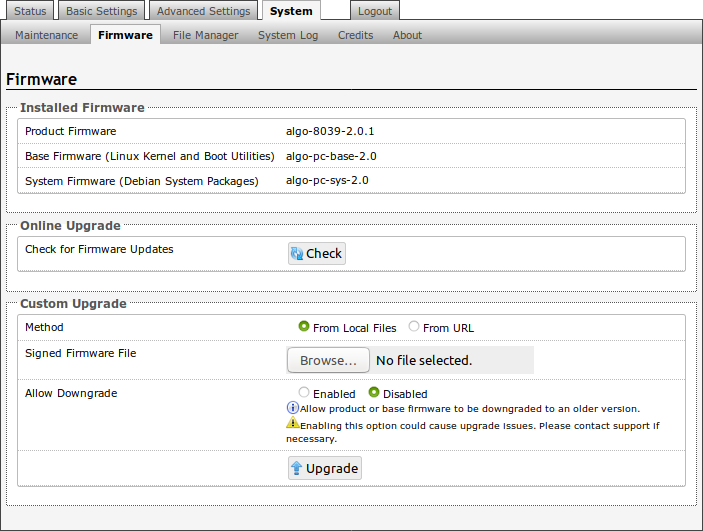
Specify whether the firmware files will be downloaded from the local computer or a remote URL.
Point to the SFW file provided by Algo.
How to upgrade 8039 SIP Video Intercom Firmware
From the top menu, click on System → Maintenance.
In the Upgrade section, click on Choose File and select the 8039 SIP Video Intercom firmware file to upload. Note that an SFW file must be loaded.
Click Upgrade.
After the upgrade is complete, confirm that the firmware version has changed (refer to the top right of the Control Panel).
System Tab - File Manager
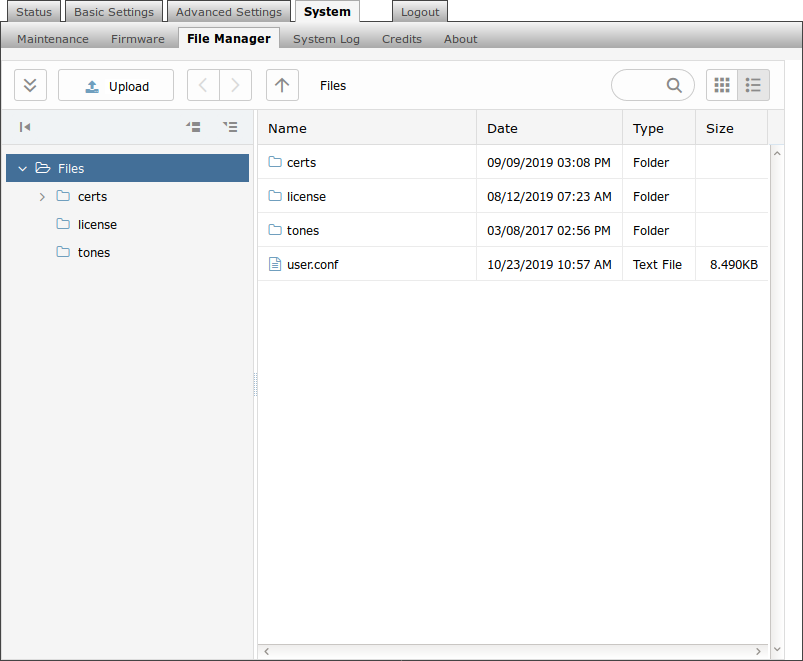
File Formats
When uploading files to the File Manager, refer to this table for supported file formats and requirements.
Folder | Supported Format | Requirements |
|---|---|---|
License | LIC | |
Tones | 8SVX, AIF, AIFC, AIFF, AIFFC, AL, AMB, AMR-NB, AMR-WB, ANB, AU, AVR, AWB, CAF, CDDA, CDR, CVS, CVSD, CVU, DAT, DVMS, F32, F4, F64, F8, FAP, FLAC, FSSD, GSM, GSRT, HCOM, HTK, IMA, IRCAM, LA, LPC, LPC10, LU, MAT, MAT4, MAT5, MAUD, MP2, MP3, NIST, OGG, PAF, PRC, PVF, RAW, S1, S16, S2, S24, S3, S32, S4, S8, SB, SD2, SDS, SF, SL, SLN, SMP, SND, SNDFILE, SNDR, SNDT, SOU, SOX, SPH, SW, TXW, U1, U16, U2, U24, U3, U32, U4, U8, UB, UL, UW, VMS, VOC, VORBIS, VOX, W64, WAV, WAVPCM, WV, WVE, XA, XI | Audio files must be in the following format:
|
Uploading custom Ring Tones (WAV Files)
Custom WAV files may be uploaded into memory (1 GB) to play on the 8039 speaker.
An existing file may also be modified by downloading the original via the links in the web interface, making the desired changes, and then uploading the new version with a different name. Audio files must be in the following format:
WAV format
8kHz or 16kHz sampling rate
16-bit PCM, or u-law
Mono
Smaller than 200MB
A zip file containing one or more audio files may also be uploaded. File names must be limited to 32 characters, with no spaces.
To use TLS SIP Signaling and provisioning, the certificate is required for a SIP server to validate the Algo device.
The TLS certificate can be uploaded to the certs folder. Rename the certificate to ‘sipclient’ using ‘.pem’ filetype extension before uploading.
For the HTTPS provisioning, a certificate can also be manually uploaded into the certs folder through file manager.
System Tab – System Log
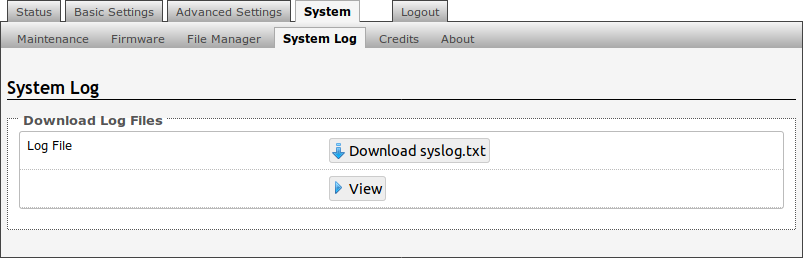
System log files are automatically created and assist with troubleshooting in the event the 8039 SIP Video Intercom does not behave as expected.
8063 IP Door Controller
The 8039 can provide secure door control functionality when used with the optional Algo 8063 IP Relay Controller.
The 8063 serves as a bridge between the 8039 and peripheral hardware such as door strike.
As a door opening controller, the 8063 can be located in a secure environment to prevent tampering of the public-facing intercom, as compared to using the local Door control relay on the 8039 which would require the door strike wires to be run outside the building.
The door control feature is activated by a command from the answering telephone keypad, or entry of the door release code by a visitor via the 8039 itself.
Typical 8039/8063 Setup
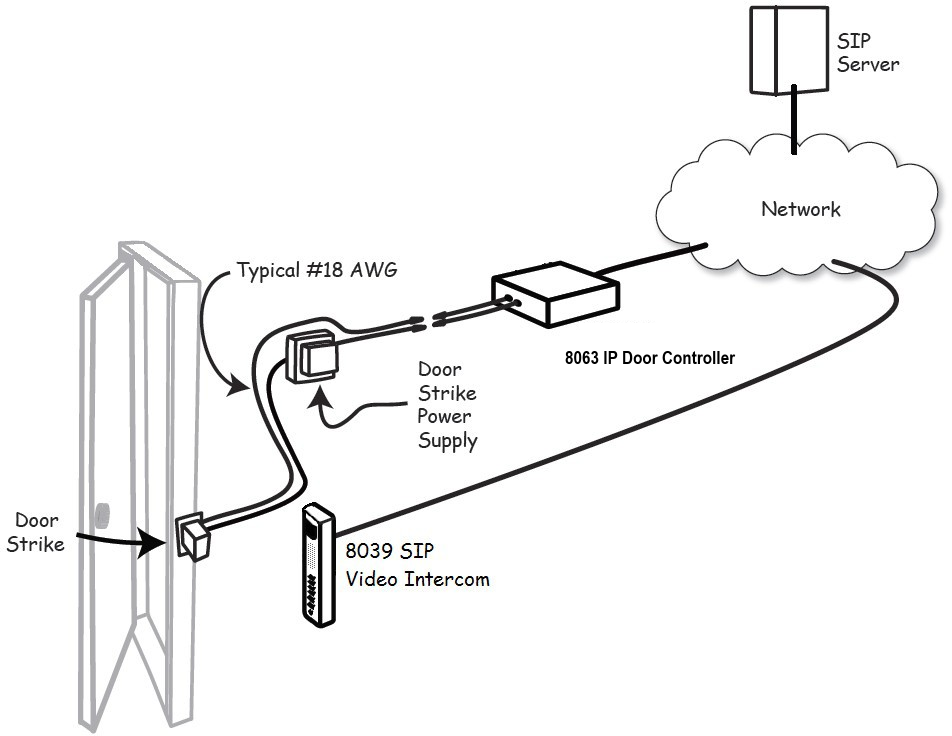
PoE and Relay Connections on the back of 8063 IP Relay Controller:
Connect the wiring from your door strike (not included), to the Door Control relay output terminal block on the 8063 (either “Normally Open” [‘NO’] and “Common” [‘C’], or “Normally Closed” [‘NC’] and “Common” [‘C’], as appropriate for the door strike).
For more wiring information, please visit: www.algosolutions.com/doorstrike.
Connect the 8063 IP Door Controller to a PoE or PoE+ network switch. The blue lights on the front will remain on until boot-up is completed, which takes about one minute.
.png)
Find the IP address of the Algo 8063 using the Algo locator tool available from the Algo website www.algosolutions.com/locator). This tool displays all of the Algo devices available on the network, and their corresponding IP addresses. Note this address down as you will need it when you configure the 8039 for use with this device.
Point your browser to the above IP address. The 8063 Control Panel will be displayed.
Log in. The default password is algo.
Go to the Basic Settings → Door Control tab.
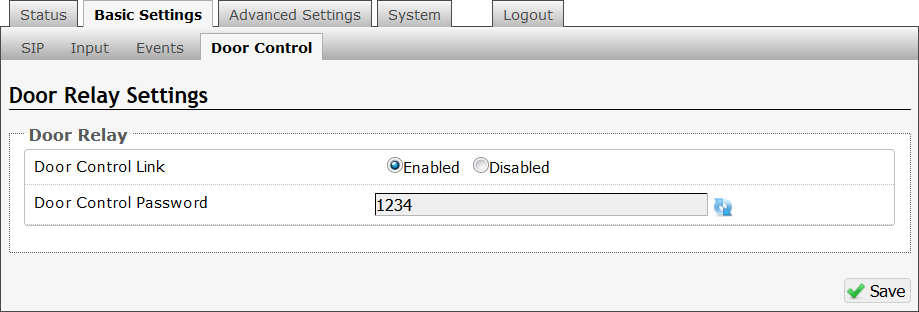
Set the Door Control Link to Enabled.
In the Door Control Password field, set a password that will be used for configuring the intercom for door control.
Note
This password down as you will be reusing it when configuring the 8039 with this device.
FCC Compliance Statement
This equipment has been tested and found to comply with the limits for a Class A digital device, pursuant to Part 15 of the FCC Rules. These limits are designed to provide reasonable protection against harmful interference when the equipment is operated in a commercial environment. This equipment generates, uses, and can radiate radio frequency energy, and if it is not installed and used in accordance with the instruction manual, it may cause harmful interference to radio communications. Operation of this equipment in a residential area is likely to cause harmful interference, in which case the user will be required to correct the interference at their own expense.