Disclaimer
The information contained in this document is believed to be accurate in all respects but is not warranted by Algo. The information is subject to change without notice and should not be construed in any way as a commitment by Algo or any of its affiliates or subsidiaries. Algo and its affiliates and subsidiaries assume no responsibility for any errors or omissions in this document. Revisions of this document or new editions of it may be issued to incorporate such changes. Algo assumes no liability for damages or claims resulting from any use of this manual or such products, software, firmware, and/or hardware.
No part of this document can be reproduced or transmitted in any form or by any means – electronic or mechanical – for any purpose without written permission from Algo.
For additional information or technical assistance in North America, please contact Algo’s support team:
1-604-454-3792
support@algosolutions.com
Important Warning and Safety Information

Important Notice
This product is powered by a certified limited power source (LPS), Power over Ethernet (PoE); through CAT5 or CAT6 connection wiring to an IEEE 802.3at / 802.3bt compliant network PoE switch. The product is intended for installation indoors. All wiring connections to the product must be in the same building. If the product is installed beyond the building perimeter or used in an inter-building application, the wiring connections must be protected against overvoltage/transient. Algo recommends that this product is installed by a qualified electrician.
If you are unable to understand the English language safety information, then please contact Algo by email for assistance before attempting an installation support@algosolutions.com.
Consignes de Sécurité Importantes
Ce produit est alimenté par une source d’alimentation limitée certifiée (alimentation par Ethernet); des câbles de catégorie 5 et 6 joignent un commutateur réseau à alimentation par Ethernet homologué IEEE 802.3at / 802.3bt Le produit est conçu pour être installé à l’intérieur. Tout le câblage rattaché au produit doit se trouver dans le même édifice. Si le produit est installé au-delà du périmètre de l’édifice ou utilisé pour plusieurs édifices, le câblage doit être protégé des surtensions transitoires. Algo recommande qu’un électricien qualifié se charge de l’installation de ce produit.
Si vous ne pouvez comprendre les consignes de sécurité en anglais, veuillez communiquer avec Algo par courriel avant d’entreprendre l’installation au support@algosolutions.com.
Información de Seguridad Importante
Este producto funciona con una fuente de alimentación limitada (Limited Power Source, LPS) certificada, Alimentación a través de Ethernet (Power over Ethernet, PoE); mediante un cable de conexión CAT5 o CAT6 a un conmutador de red con PoE en cumplimiento con IEEE 802.3at / 802.3bt. El producto se debe instalar en lugares cerrados. Todas las conexiones cableadas al producto deben estar en el mismo edificio. Si el producto se instala fuera del perímetro del edificio o se utiliza en una aplicación en varios edificios, las conexiones cableadas se deben proteger contra sobretensión o corriente transitoria. Algo recomienda que la instalación de este producto la realice un electricista calificado.
Si usted no puede comprender la información de seguridad en inglés, comuníquese con Algo por correo electrónico para obtener asistencia antes de intentar instalarlo: support@algosolutions.com.
Wichtige Sicherheitsinformationen
Dieses Produkt wird durch eine zertifizierte Stromquelle mit begrenzter Leistung (LPS – Limited Power Source) betrieben. Die Stromversorgung erfolgt über Ethernet (PoE – Power over Ethernet). Dies geschieht durch eine Cat-5-Verbindung oder eine Cat-6- Verbindung zu einer IEEE 802.3at / 802.3bt-konformen Ethernet-Netzwerkweiche. Das Produkt wurde konzipiert für die Installation innerhalb eines Gebäudes. Alle Kabelverbindungen zum Produkt müssen im selben Gebäude bestehen. Wenn das Produkt jenseits des Gebäudes oder für mehrere Gebäude genutzt wird, müssen die Kabelverbindungen vor Überspannung und Spannungssprüngen geschützt werden. Algo empfiehlt das Produkt von einem qualifizierten Elektriker installieren zu lassenv.
Sollten Sie die englischen Sicherheitsinformationen nicht verstehen, kontaktieren Sie bitte Algo per Email bevor Sie mit der Installation beginnen, um Unterstützung zu erhalten. Algo kann unter der folgenden E-Mail-Adresse erreicht werden: support@algosolutions.com.
安全须知
本产品由认证的受限电源(LPS),以太网供电(PoE),通过 CAT5 或 CAT6 线路联接至 IEEE 802.3at / 802.3bt 兼容的 PoE 网络交换机供电。本产品适用于室内或建筑物周边安装。所有联 接本产品的线路必须源自同一建筑物。本产品如需用于超出建筑物周边范围或跨建筑物的安 装,线路联接部分必须有过压和瞬态保护。Algo 建议本产品由专业电工安装。
如果您对理解英文版安全须知有问题,安装前请通过电子邮件和 Algo 联 系. support@algosolutions.com.
INSTALLATION
An improperly installed 8410 IP Display Speaker or 8420 IP Dual-Sided Display Speaker could fall from a wall or ceiling and cause serious injury or death.
Local building code may require one or more additional safety measure(s), particularly in earthquake prone regions.
EMERGENCY COMMUNICATION
If used in an emergency communication application, the 8410 IP Display Speakers and 8420 IP Dual-Sided Display Speaker should be routinely tested. SNMP supervision is recommended for assurance of proper operation. Contact Algo for other methods of operational assurance.
DRY INDOOR LOCATION ONLY
The 8410 IP Display Speaker and 8420 IP Dual-Sided Display Speaker is intended for dry indoor locations only. For outdoor locations, Algo offers weatherproof speakers and strobe lights.
CAT5 or CAT6 connection wiring to an IEEE 802.3at (PoE+) or IEEE 802.3 bt (PoE++) compliant network PoE switch must not leave the building perimeter without adequate lightning protection.
No wiring connected to the 8410 IP Display Speaker and 8420 IP Dual-Sided Display Speaker may leave the building perimeter without adequate lightning protection.
General
Introduction
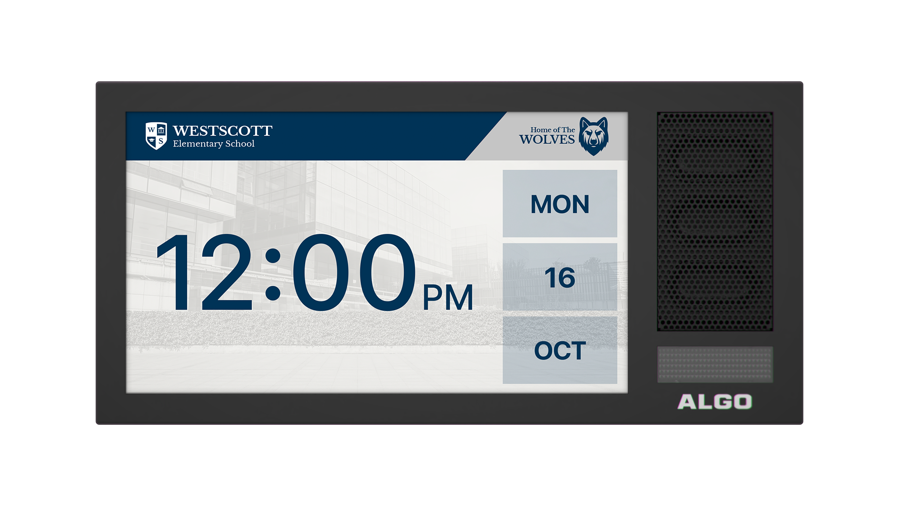
Algo’s 8410 IP Display Speaker is a SIP-compliant notification device that comprises of three core components – LCD screen, Wideband Speakers, and LED flashers – to create highly flexible and effective visual and audible communication. The combined functionality of the LCD display screen, speakers, and flashing LEDs enable voice paging, visual or audible alerting, and informational visual content, such as scrolling text messages, visual paging, images, or wayfinding. Two-way communication can also be established through the embedded microphone so real-time updates can easily be provided to admin staff. When idle, the Display Speakers can display an image, a clock face (shown in analog and/or digital format and synchronized to network time protocol (NTP)), rotating through a variety of announcements, or go to sleep.
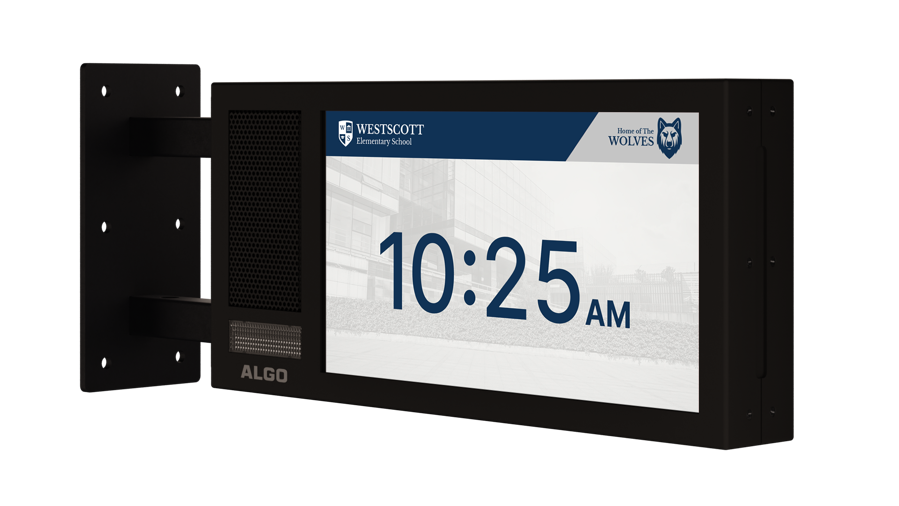
The 8420 IP Dual-Sided IP Display Speaker has all the core components of the 8410 but is double-sided. The two-sided functionality of the 8420 is ideal for installation in corridors, large spaces, or hallways for easy opposite-facing visual and audible communication.
As 3rd-party, SIP-compliant devices, the 8410/8420 is designed to seamlessly integrate into most leading IP-based UC and Mass Notification platforms. The 8410/8420 is easily configured using central provisioning features or by accessing the web interface using your choice of browser.
Key Features
LCD Screen
The primary element of the 8410/8420 is the LCD screen(s). With nearly unlimited visual possibilities, the screen can produce scrolling text, flashing announcements, full-color images, or times and dates. Combined with LED backlighting and wide-angle viewing, the visual display can be seen from anywhere in a room or along a hallway. It can be customized to complement an audio announcement or to bring communication to an audio-less environment.
Speakers
For audible alerting and voice paging, the 8410/8420 offers similar functionality and voice quality to other Algo IP speakers, delivering wideband HD voice for clear voice communication and attention-grabbing audible alerting. An embedded microphone is included to enable ambient noise response and talkback capabilities.
LED Flashers
The LED flashers provide additional awareness for important messages. This can help draw attention to the screen, helping hearing-impaired audiences to notice the screen or bring awareness to audio-less environments.
Setup and Installation for 8410 and 8420
Important
This guide provides important safety information which should be read thoroughly before permanently installing the product.
See the appropriate section below for mounting either the 8410/8420.
8410 Mounting & Installation
Algo’s 8410 IP Display Speaker is a one-sided product intended for mounting on a wall. For the ceiling-mount option more suited to hallways, see the 8420 mounting and installation instructions below.
What is Included The following items are included with the purchase of this device:
| What is Not Included The following items are not included with the purchase of this device:
|
Getting Started – Quick Install and Setup
Connect the 8410 to an IEEE 802.3at / 802.3bt compliant PoE+ or PoE++ network switch or power injector. See section 2.4 Power Requirements.
The green LED flashers will activate and a small blue light on the bottom below the flasher will remain on until boot up is completed – about one minute.
After a few moments, the screen will show the Algo logo.
Warning
PoE++ power is required for optimal operation of this device. Some functionality will be reduced depending on the power connection.
If using a power injector that does not automatically negotiate its power capabilities, go to Advanced Settings → Admin to manually configure Automatic Power Detection versus Forced PoE+ mode.
Attach the snap-on ferrite to the Ethernet cable close to the connector.
Once the unit finishes booting, a configuration message with the IP address will appear on the screen if it is in factory default state. If there is no DHCP server, the 8410 will default to the static IP address 192.168.1.111.
Note
If the IP address does not appear on the screen, press the reset (RST) button to hear the IP address recited over the speakers. The IP address will be repeated over the speakers until the reset button is pressed again to turn off.
Access the 8410 IP Display Speaker web interface by entering the IP address into a browser and login using the default password algo.
Installation
The 8410 IP Display Speaker is designed to fit on a wall bracket. Concealed wiring may enter from the wall into the wiring cavity. Alternatively, surface wiring may enter through a channel from the bottom edge.
To mount the wall bracket securely:
Use four #8 wall bracket screws to hang the wall bracket. The wall-mount bracket should be secured to a stud to prevent the 8410 from falling.
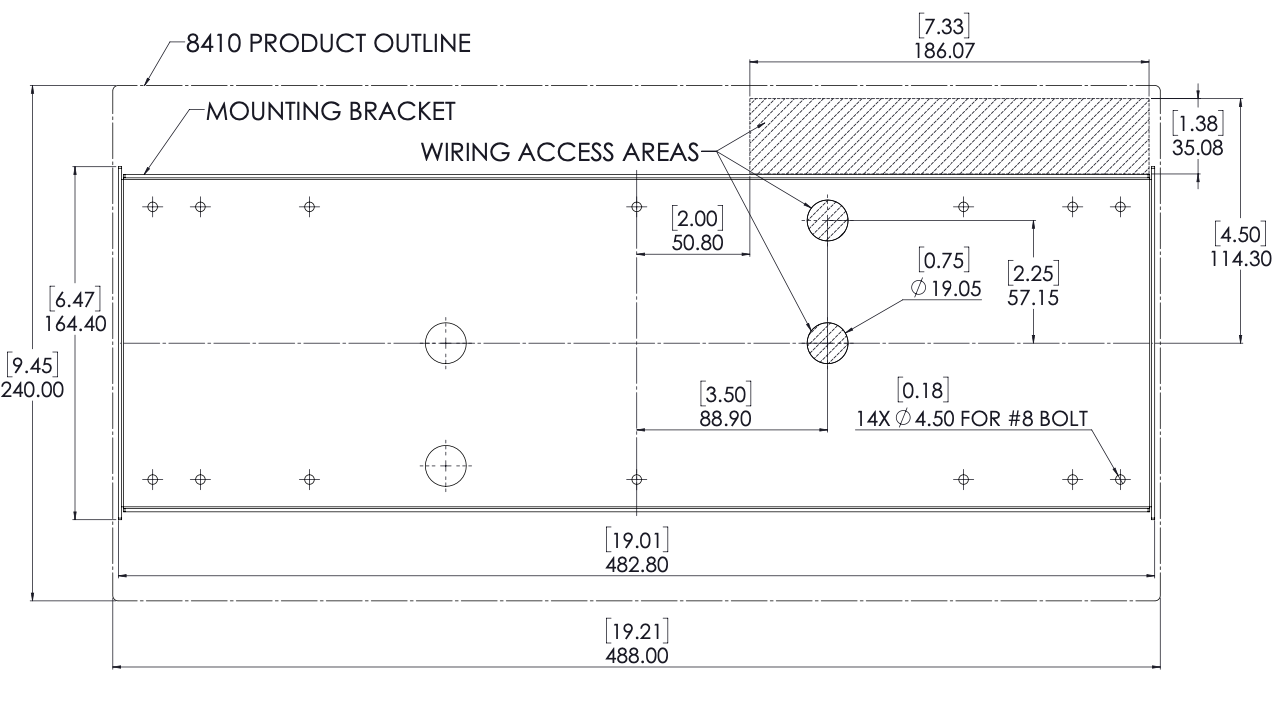
To attach the 8410 to the wall-mount bracket:
Set the 8410 into the wall-mount bracket.
Align the holes on the side of the 8410 to the holes in the wall-mount bracket and tighten the four 6-32 mounting screws securely using the Allen key.
|
|
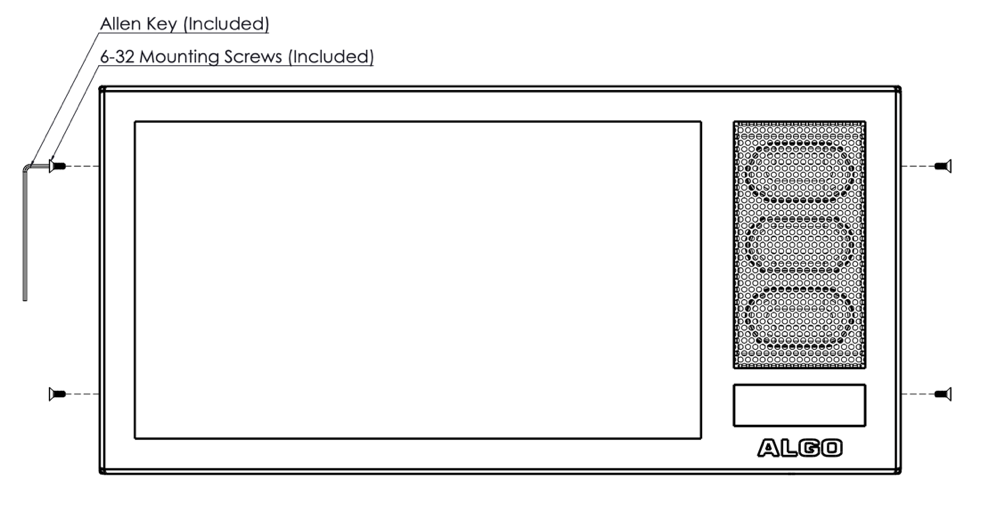
8420 Mounting & Installation
Algo’s 8420 IP Dual-Sided Display Speaker is a two-sided SIP-compliant notification device that can be mounted on the ceiling or wall for two-sided visual communication. This is ideally suited for hallways, corridors, or open spaces.
What is Included The following items are included with the purchase of this device:
| What is Not Included The following items are not included with the purchase of this device:
|
Getting Started – Quick Install & Test
Connect the 8420 to an IEEE 802.3at / 802.3bt compliant PoE+ or PoE++ network switch or power Injector. See section 2.4 Power Requirements.
The green LED flashers will activate and a small blue light on the bottom below the flasher will remain on until boot up is completed – about 30 seconds.
After a few moments, the screens on either side will show the Algo logo.
Attach the snap-on ferrite to the Ethernet cable close to the connector.
Once the unit finishes booting, a configuration message with the IP address will appear on each screen if it is in factory default state. If there is no DHCP server, the 8420 will default to the static IP address 192.168.1.111.
Note
If the IP address does not appear on the screen, press the reset (RST) button to hear the IP address recited over the speakers. The IP address will be repeated over the speakers until the reset button is turned off.
Access the 8420 IP Dual-Sided Display Speaker web interface by entering the IP address into a browser and logging in using the default password algo.
Installation
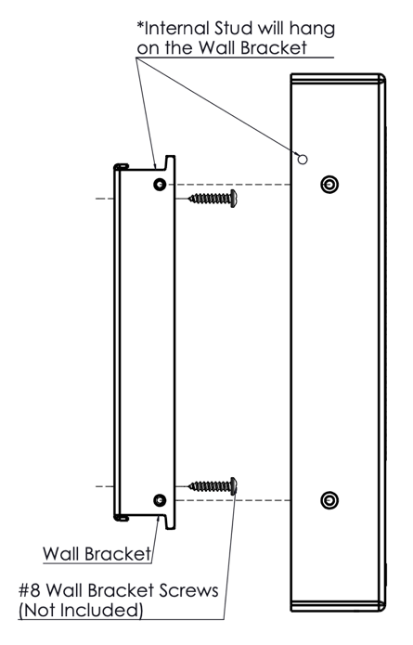
The 8420 IP Dual-Sided Display Speaker is designed to be both ceiling and wall mounted. Wiring enters through an opening in the hollow bracket for this product (see info in the Note after bullet 1 below).
To mount the bracket securely to the wall/ceiling:
Mount the bracket securely to a wall or ceiling. Because the material you mount the device into may differ, see below for specific wall or ceiling mount instructions by material type.
Note
Wires can be routed into the hollow tubes of the bracket from the wall/ceiling or through the wire feed hole outside the tube. Wire must be routed on the same side as the speakers to match the connection area.
Set the 8420 into the mounting bracket by partially threading the screws into the holes next to the connector opening and mount the screws through the larger hole of the keyhole slot. Slide the 8420 into the smaller holes to lock the device in place.
Slide the ceiling- or wall-mount connector cover into place.
Fasten all six mounting screws on the bracket and the two flat mounting screws on the connector cover.
.png)
.png)
8420 Wall Mount
For concrete, brick, or block install, use 6 x 5/16” x 1 5/8” female threaded anchors rated for 200 lbs each or greater pull and install bracket using 6 x 1 ½” grade 5 threaded bolts with flat washer.
For plaster or drywall install, use 6 x 5/16” toggle bolts and washers rated for 60 lbs each or greater. The bolts with a washer should be fed through the bracket prior to attaching toggles. If a wood stud is available and the position is known, use 5/16” x 2 ½” lag bolts in place of toggle bolts on the side of the bracket aligned to the stud.
8420 Ceiling Mount
For concrete install, use 6 x 5/16” x 1 5/8” female threaded anchors rated for 200 lbs each or greater pull and install the bracket using 6 x 1 ½” grade 5 threaded bolts with flat washer.
For plaster or drywall install, use 6 x 5/16” toggle bolts and washers rated for 60 lbs each or greater. The bolts with a washer should be fed through the bracket prior to attaching toggles. If a wood joist is available and the position is known, use 5/16” x 2 ½” lag bolts in place of toggle bolts on the side of the bracket aligned to the joist.
For acoustic tile, cut and lay 3/4” plywood equal in size dimension to the tile and install the bracket using 6 x 5/16” x 2 ½” lag bolt with a washer.
Making Your First Configuration
To enable a clock:
Go to Display → Slides.
Select Add Slide.
Enter a Name and select Digital Clock. Customize your clock preferences. Select Save.
Select Start Test next to the slide to apply a screen display.
Power Requirements
For optimal performance, Algo recommends using an 802.3bt Type 3 (PoE++) switch for the 8410 and 802.3bt Type 4 (PoE++) switch for the 8420. The minimum power required for the 8410 is 802.3at (PoE+) power and the minimum power required for the 8420 is 802.3bt Type 3 power. If optimal switches are not available, a power injector may be used. If using a power injector that does not automatically negotiate its power capabilities, go to Advanced Settings → Admin to manually configure Automatic Power Detection versus Forced PoE++ mode.
Reset
A recessed reset button (RST) is located at the bottom of the device below the speaker and can only be used to reset the 8410 IP Display Speaker and 8420 IP Dual-Sided Display Speaker at time of power up. To return all the settings to the factory default for the 8410/8420, reboot or power cycle the 8410/8420. Wait until the SIP LED flashes and then press and hold the reset button until the single blue LED on the bottom of the device begins a double flash pattern. Release the reset button and allow the unit to complete its boot process.
Note
Do not press the reset button until the blue SIP LED begins flashing.
A reset will set all configuration options to factory default including the login password.
Once booting has completed, pressing the reset button will cause the device to speak its IP address over the speakers.
Applications
Voice Paging
The 8410 and 8420 can be used for direct paging in addition to multicast. This allows direct communication with a single location.
Notification
The 8410 and 8420 provide effective notification alerting for emergency (e.g., lockdown, evacuation, reverse evacuation), safety (e.g., medical, workplace accident), and security (e.g., OSHA or similar workplace regulations) events.
For emergency alerting, the LCD screen, speaker, and LED flashers can be used together for a highly visible, attention-grabbing communication.
Visual Communication
When not used to display an active alert, the LCD screen can be configured to display a chosen image or layout for when in idle mode. This screen display can be a digital or analog clock synchronized to NTP, or an uploaded image. It can also display a series of selected images in a slideshow.
Multicast Receiver
The 8410 and 8420 are ideal for use as multicast receivers. Each alert can be mapped to multicast zones which can be associated with a display on the LCD screens to complement the audio announcements.
Scheduling
The 8410 and 8420 can be paired with the 8301 IP Paging Adapter (sold separately) for scheduling tones and bells for schools, automated announcements for retail and healthcare, and workplace shift changes and breaks in warehouses.
InformaCast Compatible
The 8410 and 8420 are fully compliant with Singlewire InformaCast for telephone, security, and emergency alerting. They can display scrolling text and audible notifications for safety and security communication.
For more information, see Configuring 8410/8420 for Use with InformaCast.
Features
Customizable Display Content
The display on the 8410/8420 is fully customizable. You can create slides from scratch or use built-in templates. You can also combine multiple slides into a slideshow.
SIP Paging: One 8410/8420
The 8410/8420 can be registered as a third-party SIP extension with a hosted or enterprise Communications Server supporting 3rd-party SIP endpoints.
To register the 8410/8420 with the SIP server, use the Basic Settings → SIP tab in the web interface to enter the Communication Server IP address, extension, username, and password. This information will be available from the IT Administrator.
If VLAN is used, navigate to the Advanced Settings → Network tab to set VLAN options.
Note
Once the 8410/8420 is using a VLAN, you will need to be on the same VLAN to access the web interface.
The Display Speaker may now be accessed by dialing its assigned extension from a telephone, device, or client. The adapter will auto-answer, play the default pre-announce tone, and allow voice paging until disconnected.
There are several configurable adapter options, such as:
Increase or Decrease Speaker Volume
Enable AGC (automatic gain control)
Enable Ambient Noise Monitoring (speaker volume adapts to background noise)
Enable Talkback
Customize pre-announce tone file
The best voice paging quality and intelligibility will be obtained using the G.722 wideband audio codec. Most current IP telephones support G.722 which is sometimes referred to as “HD” voice or audio.
Multicast Overview
The 8410/8420 is a multicast receiver and is able to receive IP audio multicast messages over the network to support larger deployment for both paging and notification. This provides a scalable and efficient method of building large scale notification solutions.
An Algo 8301 IP Paging Adapter & Scheduler can be configured with a SIP Page Extension to multicast to the 8410/8420. When called from a phone, the SIP registered 8301 will auto-answer and play the page audio over the 8410/8420 speaker.
Simultaneously, the registered 8301 endpoint broadcasts the audio over the network using RTP multicast to any number/combination of Algo IP display speakers, speakers, visual alerters, and paging adapters as required.
Receiver endpoints require a PoE network connection but do not require registration to the communication server.
Multicasting can also be used to distribute loud ring or other alerting (e.g., safety, security, or emergency events) over multiple Algo endpoints (e.g., 8190, 8196, 8188, 8186, 8128, 8201, 8301, and 8373).
SIP Paging: Multiple 8410/8420 Devices (Using Multicast)
To use the multicast feature, set up an 8410/8420 as the Multicast Transmitter.
The Sender device will page normally while simultaneously streaming audio to the Receiver speakers (such as the 8410/8420). The Receiver speakers do not require SIP extensions and do not need to register with the SIP Communication Server.
To enable multicast streaming from the 8301 IP Paging Adapter & Scheduler:
Go to the web interface of the device and navigate to the Basic Settings → Multicast tab.
Choose multicast mode Sender and zone All Call.
The multicast addresses pre-populated in the table, under Advanced Settings → Advanced Multicast, will work in most cases and should only be altered for rare cases.
To enable multicast monitoring in the 8410/8420:
Go to the web interface for each device and navigate to Basic Settings → Multicast.
Choose multicast mode Receiver.
There is no need to select a zone as the speaker will automatically monitor the All Call zone IP address.
The page pre-announce tone is generated from the Sender. The following options are valid for each multicast Receiver:
Increase or Decrease Speaker Volume
Enable Ambient Noise Monitoring (speaker volume adapts to background noise)
SIP Paging: Multiple Display Speakers (Using Individual SIP extensions)
In some cases, it may be desirable for every speaker to have a SIP extension. Multicast may still be used to page multiple speakers, but each speaker can also be called individually or generate a call when appropriately configured.
A speaker configured as a SIP Multicast receiver will give its highest priority to the Priority Call zone. Other than the Priority Call zone, a page using its SIP extension, has priority over all other multicast zones.
Communication Servers with the capability of dialing many SIP extensions simultaneously for paging may be able to create zones by calling “page groups” and page telephone speakers in conjunction with overhead speakers.
SIP-Activated Visual Notification Alerts
In addition to audible notifications, the 8410/8420 can multicast visual alerting with the LED flashers. When a call is made to the SIP extension, the 8410/8420 will flash the selected light pattern. Often, the flashers for the 8410/8420 will be part of a hunt group or ring group to flash in conjunction with an audio notification.
There are several configurable strobe options:
Flash Pattern
Brightness
Color
TLS for SIP Signaling and Provisioning
Algo devices support Transport Layer Security (TLS). This feature adds security by ensuring that Algo products can trust the hosted SIP server. This is useful for when third-party devices or attackers may try to intercept, replicate, or alter Algo products, and try to connect to the server. TLS protocol will ensure that third parties cannot read/modify any actual data. Previously security was less of a concern because phone systems were on isolated networks, but hosted services are becoming increasingly more common. Using a hosted SIP service requires traffic to be sent over the public internet and thus much more susceptible to attacks. Signed certificates are an important piece in the Algo devices operation, to ensure the security, integrity, and privacy of its communication. Algo components that use TLS are Provisioning and SIP Signaling.
These Algo devices each come pre-loaded with certificates from a list of trusted certificate authorities (CA), which are installed in the hardware at the time of manufacture. Note these pre-installed trusted certificates are not visible to users and are separate from the certs folder.
The TLS handshake happens to make sure that the client and server can trust each other, and once that trust is established, the two parties can freely send encrypted data and decrypt any data that they receive. After the TLS handshake process is complete, a TLS session is established, and the server and client can then exchange messages that are symmetrically encrypted with shared (pre-Sender) secret key.
For further details, reference Algo’s guide for Securing Algo IP Endpoints: TLS and Mutual Authentication.
Uploading Public CA Certificates to Algo SIP Endpoints
To install the public CA certificate on the 8410/8420:
Obtain a public certificate from your Certificate Authority.
Rename the public certificate 'siptrusted.pem' (only .pem format is supported).
In the web interface of the Algo device, navigate to the Advanced Settings → File Manager.
Upload the certificate files into the 'certs' directory. Click the Upload button in the top left corner of the file manager and browse to the certificate.
For SIP TLS, no default public CA certificates are used; only the above .pem file is supported, so this certificate file must be uploaded in order for SIP TLS authentication to occur.
For Provisioning TLS, only the default pre-installed public CA certificates are supported; No .pem file can be uploaded in this case.
HTTPS Provisioning
Provisioning can be secured by setting the Download Method to HTTPS (under the Advanced Settings → Provisioning). This prevents configuration files from being read by an unwanted third-party. This resolves the potential risk of having sensitive data stolen, such as admin passwords and SIP credentials.
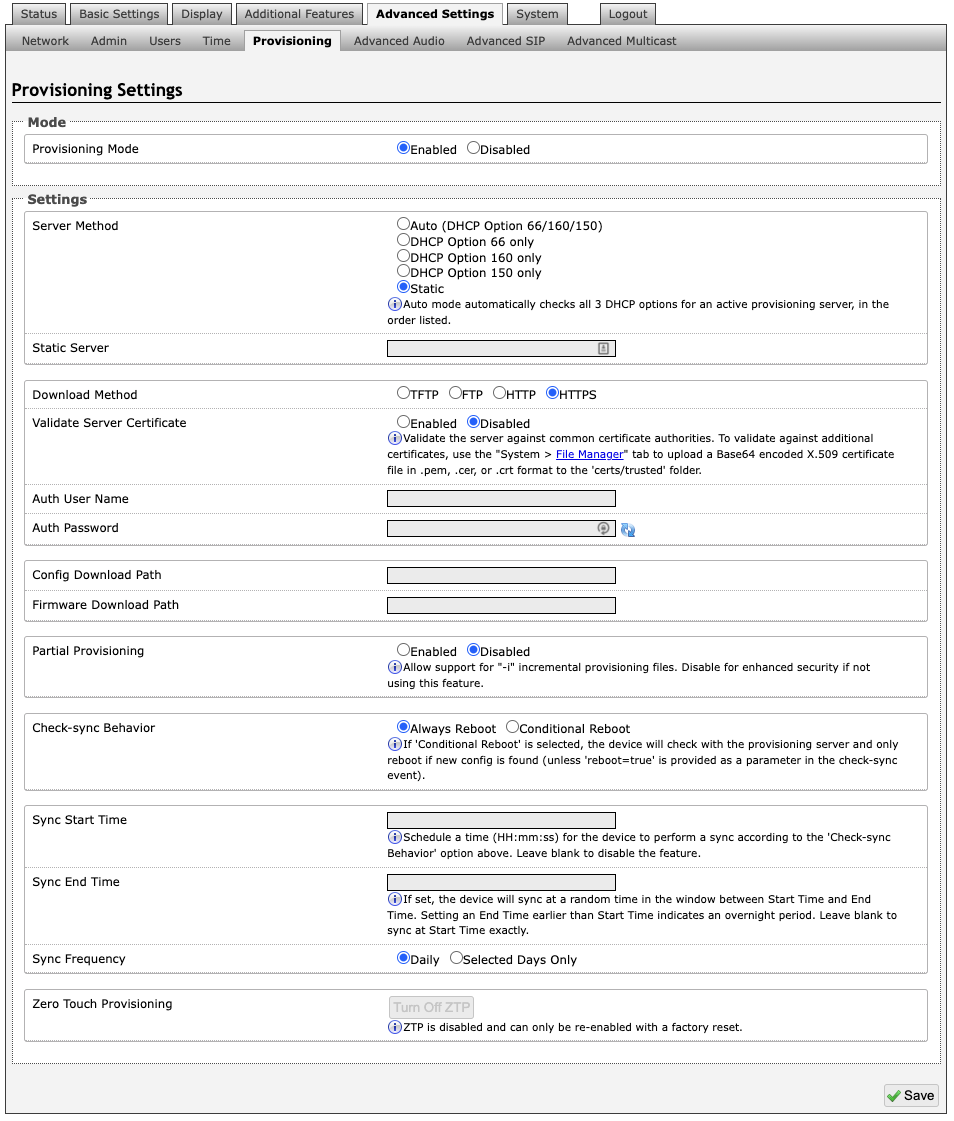
Note
To verify the server, enable the Validate Server Certificate option. This then checks if the certificate that is provided by the server is signed by any of the CAs included in the list of trusted CAs (used by the Debian infrastructure and Mozilla browsers). If we receive a certificate signed by any of these CAs, then that server will be trusted.
The Validate Server Certificate parameter can also be enabled through provisioning:
prov.download.cert = 1Encrypting SIP and RTP Communication
SIP signalling is secured by setting SIP Transportation to TLS (under the Advanced Settings → Advanced SIP tab). Setting it to TLS ensures that the SIP traffic will be encrypted. The SIP signalling is responsible for establishing the call (the control signals to start and end the call with the other party), but it does not contain the audio.
For the audio (voice) path, use the setting SDP SRTP Offer. Setting this to Optional, means the SIP calls RTP audio data will be encrypted (using SRTP) if the other party also supports audio encryption. If the other party does not support SRTP, then the call will still proceed, but with unencrypted audio. To make audio encryption mandatory for all calls, set SDP SRTP Offer to Standard. In this case, if the other party does not support audio encryption, then the call attempt will be rejected.
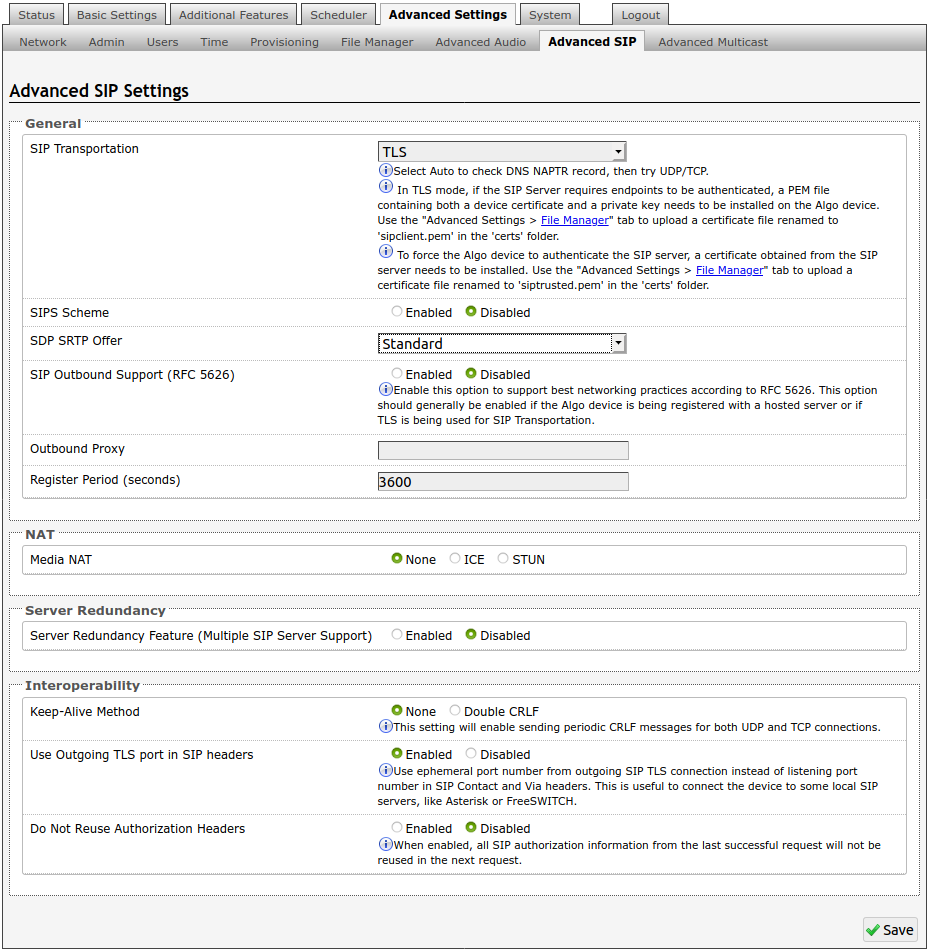
Note
For a SIP server to validate the Algo device, an additional certificate has to be manually installed on the 8410/8420. To add this user certificate file use a ‘.pem’ filetype extension and have the file named ‘sipclient’.
This is done by manually adding a file named ‘sipclient.pem’, which contains a device certificate and private key, to the ‘certs’ folder (under the ‘Advanced Settings’ tab File Manager’). In the future, ‘.crt’, ‘.cer’, and ‘.der’ certificate extensions will also be supported and you will not be restricted to naming the file ‘sipclient.pem’.
Web Interface
Status
Device Status
Web Interface Login
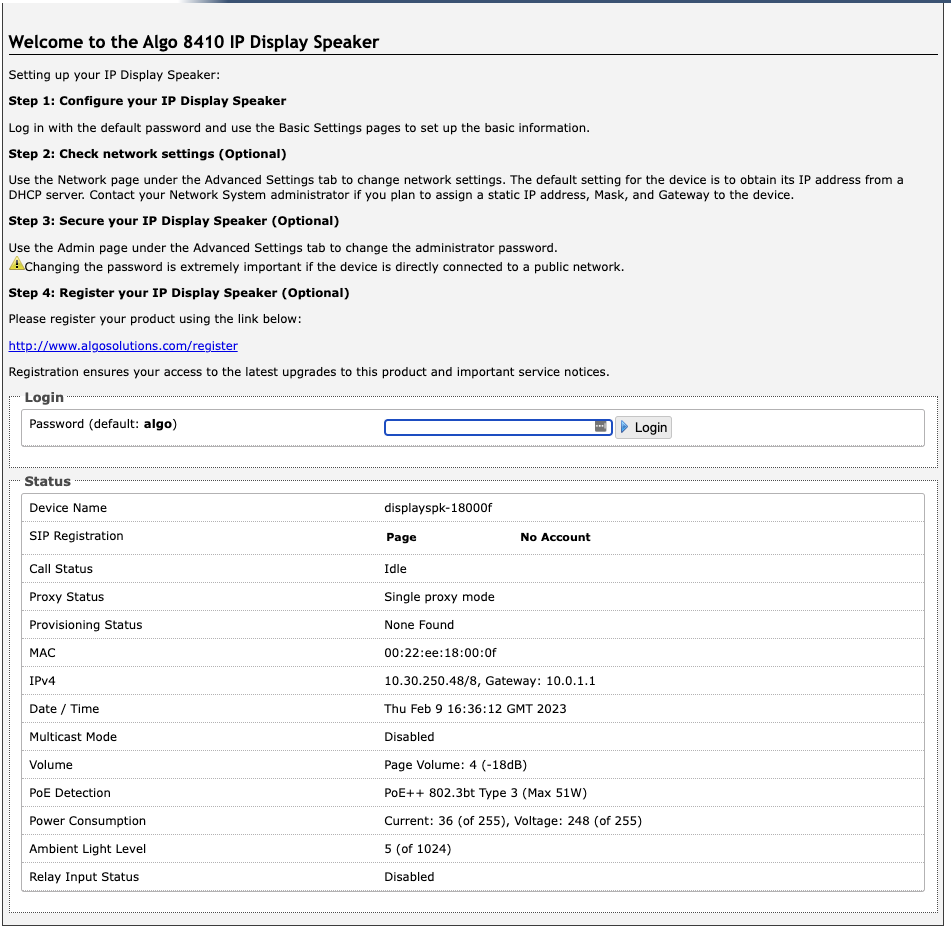
The web interface requires a password to login to see the device settings. The default password is algo. This password can be changed in the Admin tab after logging in the first time.
Note
Web Interface is accessed by entering 8410/8420 IP Address into the web browser.
Status
The Status page of the device will be available before and after logging on. This section can be used to check the status of the 8410/8420 for the following:
SIP Registration
Call Status
Proxy Status
Provisioning Status
MAC
IPv4
Date/Time
Multicast Mode
Volume
PoE Detection
Relay Input Status
Note
Your content goes hereFor security purposes, the Status page can be hidden when logged out through the settings under the Advanced Settings →Admin tab.
These options may change depending on how the device is configured.
Basic Settings
SIP
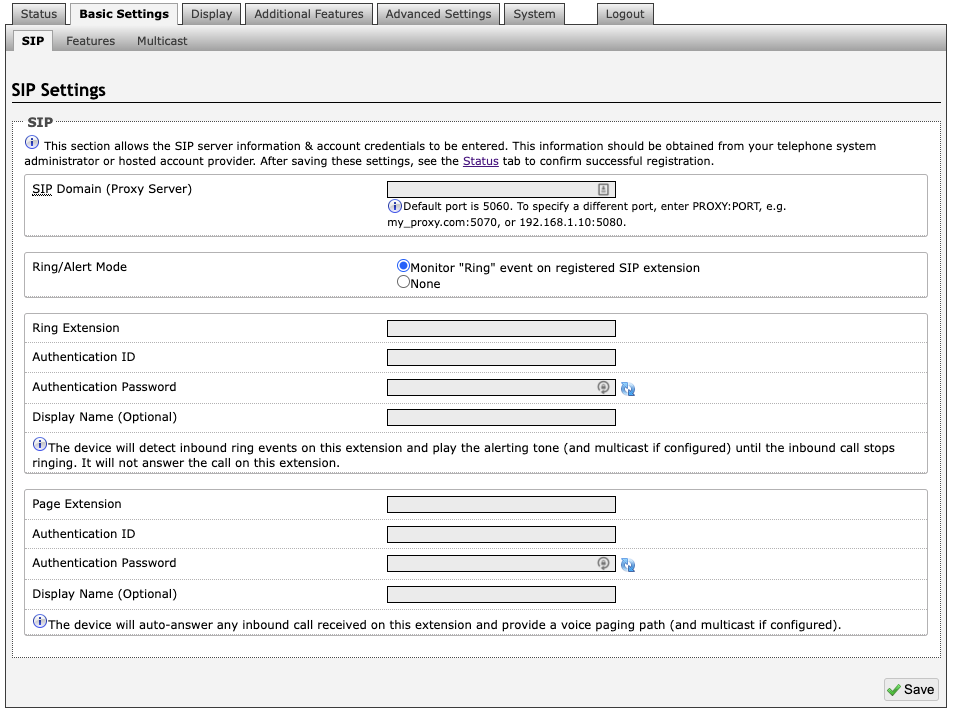
The SIP tab allows for the SIP server information and account credentials to be entered. This information can be obtained from your telephone system administrator or hosted account provider. After entering the information and saving the settings, go to the Status tab to confirm the registration was successful.
Note
Anytime changes are made to settings in the web interface the ‘Save’ button must be clicked to save the changes.
SIP Domain (Proxy Server)
The IP address (e.g., 192.168.1.111) or domain name (e.g., myserver.com) of the SIP Server.
Ring / Alert Mode
This is the option for adding a second SIP extension for a Ring event. If activated (“Monitor” is selected), the screen expands to show blocks for SIP extension parameters for a Ring/Alert Extension to be entered.
The device will detect inbound ring events on this extension and play the alerting tone (and multicast if configured) until the inbound call stops ringing. It will not answer the call on this extension.
Ring Extension
This is the SIP extension for the Ring parameter of the 8410/8420.
Page Extension
This is the SIP extension for the Page parameter of the 8410/8420. The device will auto-answer any inbound call received on this extension and provide a voice paging path (and multicast if configured).
Authentication ID
Also referred to as Username for some SIP servers. This, in some cases, may be the same as the Ring and/or Page extension. The authentication is a name you choose to represent the page extension.
Authentication Password
This is the SIP password provided by the system administrator for the registered SIP account. Up to eight (8) characters can be implemented. The password can be used to authenticate SIP users.
Display Name
The Display Name is shown on a receiving phone to which a SIP call is made. For the display name to be shown, the PBX and phone(s) need to be configured to display this message as the Caller ID.
Features
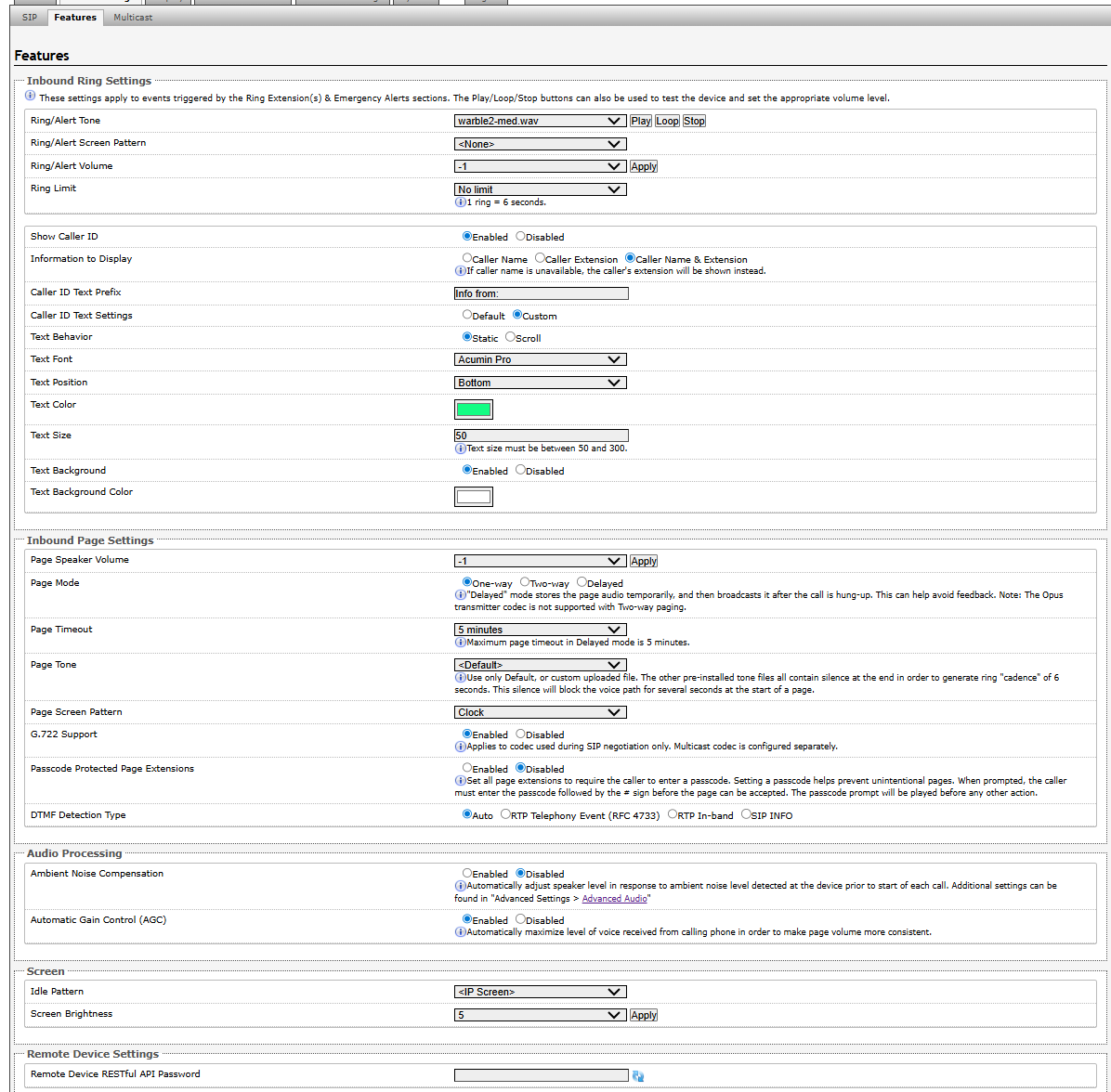
Inbound Ring Settings
Ring settings apply to events triggered by Ring Extensions and Emergency Alerts.
You can configure the incoming ring/alert tone, volume, screen pattern, and caller information display.
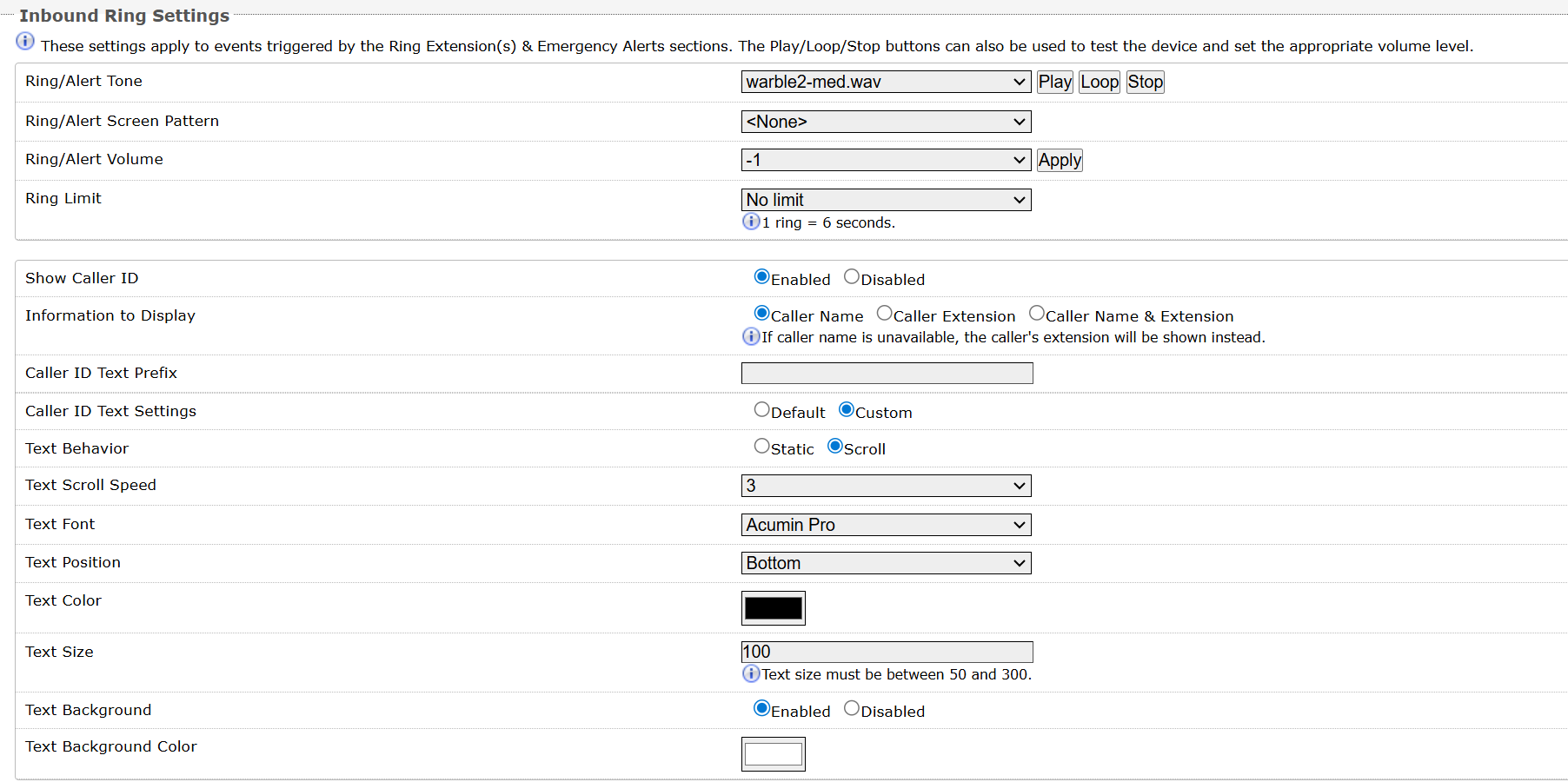
Ring/Alert Tone
Select an audio file to play when a ring event is detected on the SIP Ring Extension. For testing purposes, the audio file can be played immediately from the web interface using the Play, Loop, and Stop buttons.
Note
This is the “Default” tone that will be played if you set:
<Use Default Ring Tone> as the Ring Tone under Additional Features → Additional Ring Extension
<Use Default Page Tone> as the Page Tone under Advanced Settings → Advanced Multicast.
Ring/Alert Screen Pattern
Select a screen pattern to display on the LCD screen on inbound ring events. Screen patterns are configured under Display → Slides.
Ring/Alert Volume
Set the speaker volume for a SIP Ring event. This setting is an amplifier gain control, and the output level will depend on the levels recorded into the source audio file played from memory. This setting is only used for local tones, and not when receiving multicast (see Page Speaker Volume below).
Ring Limit
Typically set to no limit, this feature can be used to set a limit on how long the speaker will ring before timing out. A new ring event is required before the speaker will play the audio file again.
Show Caller ID
Enable displaying the caller information. This feature is available only on the Algo 8410/8420.
Information to Display
Display the Caller Name, Caller Extension, or Caller Name & Extension.
The Caller Name is taken from the SIP From header. For Algo devices, the Caller Name is configured in Basic Settings → SIP → Display Name (Optional).
If this information isn’t available, the caller's extension will be shown instead.
Caller ID Text Prefix
Specify the leading text before the caller information. Caller ID Text Prefix must be 100 characters or less.
Caller ID Text Settings
Specify how the caller information text be displayed on the screen.
Text Behavior
Specify whether the text is static or scrolling.
Text Scroll Speed
Specify the text scroll speed. Speed increases from 1 to 5.
Text Font
Select a text font.
Text Position
Select a text display position.
Text Color
Select a text color.
Text Size
Select a text font size. The text size must be between 50 and 300.
Text Background
Enable or disable the text background color.
Text Background Color
Select a text background color.
Inbound Page Settings
Page Speaker Volume
This is the Page Speaker Volume control for SIP or multicast paging. This is an amplifier gain control and the output level will depend on streaming level. This setting will apply to all inbound multicast streams (for Receiver mode only), regardless of content.
Page Mode
A call to the SIP page extension can be one-way, two-way (using an external microphone), or delayed. In delay mode, the speaker will store the page into memory and then play after disconnecting.
Delayed Page
Delayed Page allows for a user to record a message before it is played over the speakers. To cancel a page while in delay mode, press “*” to while the recording state is in process to prevent it from being sent after hanging up.
Page Timeout
Page Timeout is the maximum duration for a page. The call will be terminated when the timeout occurs whether anyone is speaking or not. This is useful for situations when someone accidentally forgets to hang up, preventing the paging system from getting stuck in the active state. A time limit may be set for an active page.
Page Tone
Select a pre-announce tone for paging. This tone will play to announce a Page is starting. Use only the Default or custom uploaded files. Other pre-installed tone files contain silence at the end to generate ring "cadence" of 6 seconds. This silence will block the voice path for several seconds at the start of a page. The “Default” tone will play the page-notif.wav file.
Note
The “Default Page Tone”, in Advanced Multicast, will play the tone set here.
Page Screen Pattern
Select a screen pattern to display on the LCD screen on inbound page events. Screen patterns are configured under Display → Slides.
G.722 Support
G.722 enables wideband audio for optimum speech intelligibility. Enable or disable the G.722 codec.
Passcode Protected Page Extensions
When enabled, the caller must enter the passcode followed by the # sign before the page can be accepted. Setting a passcode helps prevent unintentional pages. Passcodes can be up to 15 digits and must be numbers only.
Apply to All Page Extensions
Choose to apply a passcode to all page extensions.
Passcode
Only visible when Passcode Protected Page Extensions is set to Enabled. Enter the desired numerical passcode (maximum length of 15 digits).
Passcode Prompt Tone
Only visible when Passcode Protected Page Extensions is set to Enabled. Select the tone to be played to notify the user to enter the passcode before paging.
DTMF Detection Type
Select the preferred dual-tone multi-frequency (DTMF) detection method. DTMF is a technology used with touch tone phones, best known to users as the sound made when pressing a number key. In the 8410/8420, this is used for multi-zone selection, passcode, etc.
Audio Processing
Ambient Noise Compensation
Ambient Noise compensation will allow the speaker level to adjust automatically in response to ambient noise levels detected at the device prior to the start of each call.
Ambient Noise Compensation No Loss
Configure the Ambient Noise Compensation algorithm to only use levels at or above the current volume. The current volume is the minimum speaker volume when this setting is enabled.
Ambient Noise Compensation Max Volume
Based on ambient noise levels, a maximum volume can be set for the speaker.
Automatic Gain Control (AGC)
AGC normalizes the audio level. This ensures the audio level heard near the speaker is always at a consistent level, independent of the phone that is used to answer the call.
Screen
Idle Pattern
Select a pattern to be displayed on the screen for when the 8410/8420 is idle. Patterns can include up to several screen displays and can vary to include a single image, a notification template, a clock display, and other configurations.
Screen Brightness
The screen brightness level can be adjusted according to the placement of the screen within a building to optimize visibility of content. Select a brightness level for the display screen on the 8410/8420.
Remote Device Settings
Remote Device RESTful API Password
When your device sends an API request to a device that requires authentication, enter the API password here. The password must match the RESTful API password configured on the target device.
Multicast
Multicast IP Addresses
Each 8410/8420 has its own IP address and shares a common multicast IP and port number (multicast zone) for multicast packets. The Sender transmits to a configurable multicast zone, and the Receiver units listen to all the multicast zones assigned to them.
The network switches and router see the packet and deliver it to all the members of the group. The multicast IP and port number must be the same on all the Transmitter and Receiver units of one group. The user may define multiple zones by picking different multicast IP addresses and/or port numbers.
Multicast IP addresses range: 224.0.0.0/4 (from 224.0.0.0 to 239.255.255.255)
Port numbers range: 1 to 65535
By default, the 8410/8420 is set to use the multicast IP address 224.0.2.60 and the port numbers 50000-50008
Make sure that the multicast IP address and port number do not conflict with other services and devices on the same network.
Multicast Page Zones
The 8410/8420 supports nine basic multicast zones. These zones are defined by the multicast IP addresses.
Somewhat arbitrarily, these zones are defined below but may be used in other ways. The important consideration is that there is a priority hierarchy – streaming activity on a zone higher on the list, will be treated as a higher priority than a zone lower down on the list – with music being the lowest priority.
Priority
All Call
Zone 1
Zone 2
Zone 3
Zone 4
Zone 5
Zone 6
Music
“Expanded” zones can also be enabled, in Basic Settings → Multicast, allowing up to 50 zones in total. These have the same behaviors as the basic zones but are hidden by default to simplify the interface.
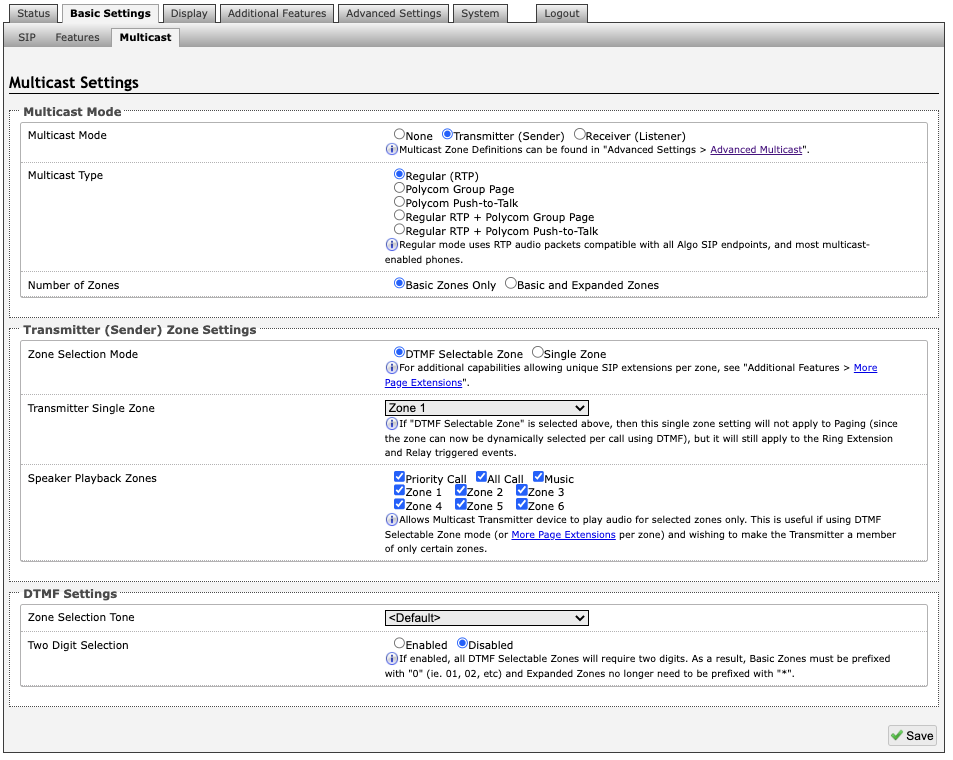
Multicast (Transmitter/Sender Settings)
Note
See (Advanced Settings → Advanced Multicast) section for more information on populated IP values.
Multicast Mode
Multicast Mode (Transmitter/Sender Selected)
If Transmitter mode is enabled the 8410/8420 will broadcast an IP stream when activated in addition to playing the audio. (Note that the 8410/8420 cannot be both a multicast Transmitter and Receiver simultaneously).
Multicast Type
The 8410/8420 may broadcast multicast paging, compatible with Polycom “on premise group paging” protocol and most multicast-enabled phones that use RTP audio packets.
Select Regular if solely multicasting to Algo SIP endpoints and/or multicast-enabled phones.
To multicast page announcements solely to Polycom phones, select Polycom Group Page or Push-to-Talk. Then, configure the 8410/8420 with the Polycom Zone (IP Address and Port) and Polycom Default Channel.
Note
Always ensure that the multicast settings on all Receiver devices match those of the Transmitter
Select Regular RTP + Polycom Group Page/Push-to-Talk to multicast page audio to both Polycom phones, Algo SIP endpoints, and multicast-enabled phones.
Number of Zones
Select Basic Zones Only if configuring nine or fewer multicast zones (shown beside Speaker Playback Zones) or select Basic and Expanded Zones to configure up to 50 zones. The expanded zones have the same behavior as the basic Receiver zones but are hidden by default to simplify the interface.
Transmitter (Sender) Zone Settings
Polycom Group Selection Mode
Single Zone always broadcasts on one pre-configured Polycom Group. In DTMF Selectable Zone mode, the group is determined by the DTMF selection between 1 – 50.
Zone Selection Mode
“Single Zone” mode always broadcasts on one IP address.
Note
Multiple SIP extensions can be registered on the Transmitter device. Each extension is mapped to a unique zone, allowing zones to be called directly (e.g., from speed-dial keys). See Additional Features → More Page Extensions.
DTMF Selectable Zone mode, offers dynamic zone selection and requires only the Transmitter device to have a registered SIP Extension. The zone definitions can be found in the Advanced Settings → Advanced Multicast tab.
In DTMF Selectable Mode, to page, dial the SIP extension of the Transmitter device: ####, then dial the desired DTMF page zone (e.g., 1, 2, etc.) on the keypad when prompted.
Press DTMF Extension 9 for Priority Call
Press DTMF Extension 0 (or 8) for All Call
Press DTMF Extension 1 for Zone 1
Press DTMF Extension *10 for Zone 10
Press DTMF Extension *11 for Zone 11
Note
DTMF codes for zones 10 and higher start with an “*”
All DTMF codes and respective zones are available in Advanced Settings → Advanced Multicast.
Zone Selection Tone
Only visible when “Zone Selection Mode” is set to DTMF Selectable Zone. The tone played over the phone to prompt the user to select a zone to multicast to.
Transmitter Single Zone
The zone that multicast stream will be sent to by default. If DTMF Selectable Zone is chosen above, this setting will not apply to Paging, since the zone now must be dynamically selected per call via DTMF. However, the specified Transmitter Single Zone setting is still used for any multicast events triggered by the Ring, analog input, or the relay input.
Note
The Transmitter Single Zone is the default zone used for any multicast actions unless an option is created for a custom zone with specific parameters.
Speaker Playback Zones
The Speaker Playback Zones allows the Transmitter device to play audio for selected zones only. This is useful if using the DTMF Selectable Zone mode (or More Page Extensions per zone) with the intention of making the Transmitter unit a member of only certain zones. In this case, the Transmitter does not participate in the Zone, but it transmits certain traffic.
Expanded Speaker Playback Zones
Up to 50 zones can be shown and are only visible when Basic and Expanded Zones is selected.
DTMF Settings
Zone Selection Tone
This is the prompt to select a zone. This may be used as an interactive voice response (IVR) menu by uploading a custom audio file through System → File Manager in the Tones folder. Each zone may use a different tone. This can be configured in Advanced Settings → Advanced Multicast.
Two Digit Selection
When enabled, all DTMF Selectable Zones will require two digits. As a result, Basic Zones must be prefixed with 0 and Expanded Zones will no longer need to be prefixed with *.
Multicast (Receiver Settings)
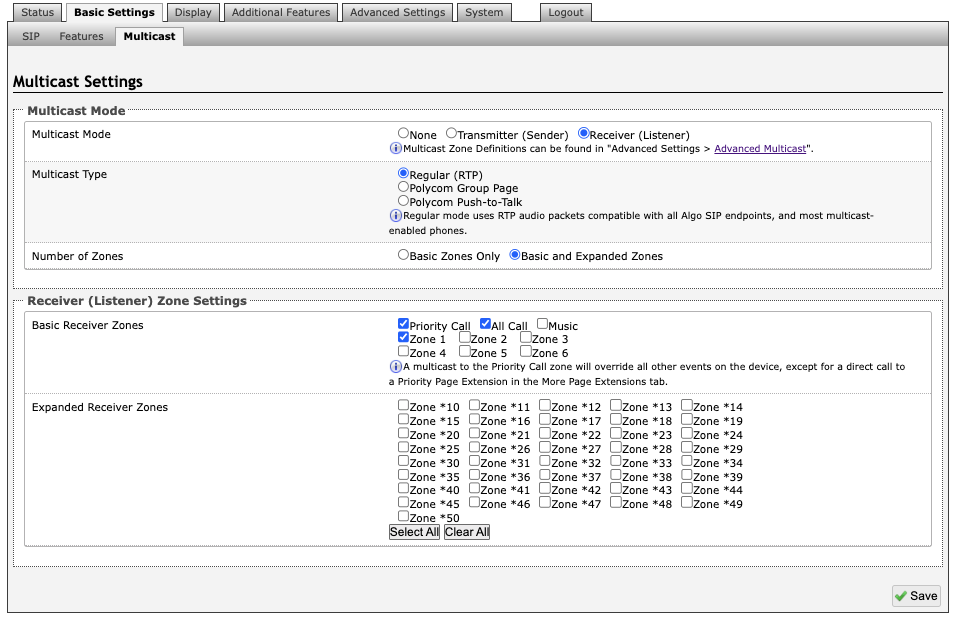
Multicast Mode
Multicast Mode (Receiver Selected)
If Receiver mode is enabled the 8410/8420 will activate when receiving a multicast message. It will mimic the audio stream but use local volume settings (Page Speaker Volume in Basic Settings → Features).
Multicast Type - Regular
Select “Regular” if receiving multicast from other Algo SIP endpoint(s) and/or multicast- enabled phone(s) that use RTP audio packets.
Number of Zones
Select basic zones if configuring nine or fewer multicast zones or expanded to configure up to 50 zones. The expanded zones have the same behaviour as the basic Receiver zones but are hidden by default to simplify the interface.
The 8410/8420 may receive multicast paging compatible with Polycom “on premise group paging” protocol.
To configure the 8410/8420 as a Receiver to play Polycom page announcements:
Select Group Page or Push-to-Talk.
Enter the Polycom Zone (IP Address and Port) that matches the configuration of the Polycom phones and Channels.
The Default Channel is the target group in a Polycom paging environment.
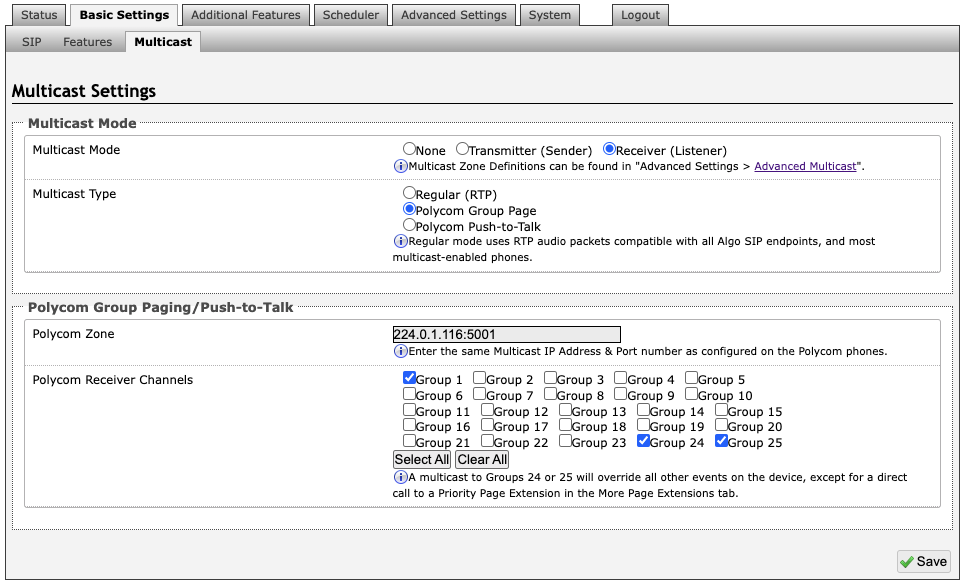
The Polycom phone used as page audio source for the 8410/8420 must be configured to use either the G.711 or G.722 audio codec. The Polycom phone(s) must also be configured with the “Compatibility” setting (“ptt.compatibilityMode”) disabled in order for this codec setting to be applied.
If using a Polycom phone as the Multicast Transmitter, a tone may be set for any of the 25 Polycom Groups configured on the Algo device. If an Algo device is used as a Multicast Transmitter, a tone does not have to be set as the Algo Transmitter will provide its own tone. Polycom Group Tones can be set in Advanced Settings → Advanced Multicast.
Receiver (Listener) Zone Settings
Basic Receiver Zones
Select one or more multicast zones for the 8410/8420 to subscribe to.
Note
Multicast zone priority is based on the zone definition list order (from top to bottom) in Advanced Settings → Advanced Multicast.
Expanded Receiver Zones
Up to 50 zones can be shown, however, they are only visible when Basic and Expanded Zones is selected.
Display
The 8410/8420 allows flexible visual communication via the display. The displays can be configured to deliver a variety of notification messages, such as clocks, scrolling texts, slideshow-style images, flashing announcements or general messages. The power of the device comes down to optimizing the screens for your application. In the next section, we will go through how to configure different slide options.
Within the Display tab, there are three (3) tab options: Slides, Slideshow, and Data.
Slides tab: Allows you to create, edit, delete slides, or test display it on the device screen.
Slideshow tab: Allows you to create, edit, delete slideshows, or test display it on the device screen.
Data tab: Allows you to download images from the Algo server to use in the slides.
Slides
In this tab, you can create new slides and view available slides. Preconfigured templates are provided to customize content.
Edit preconfigured slides or add new slides to customize your experience using the 8410/8420 with your company’s branding.
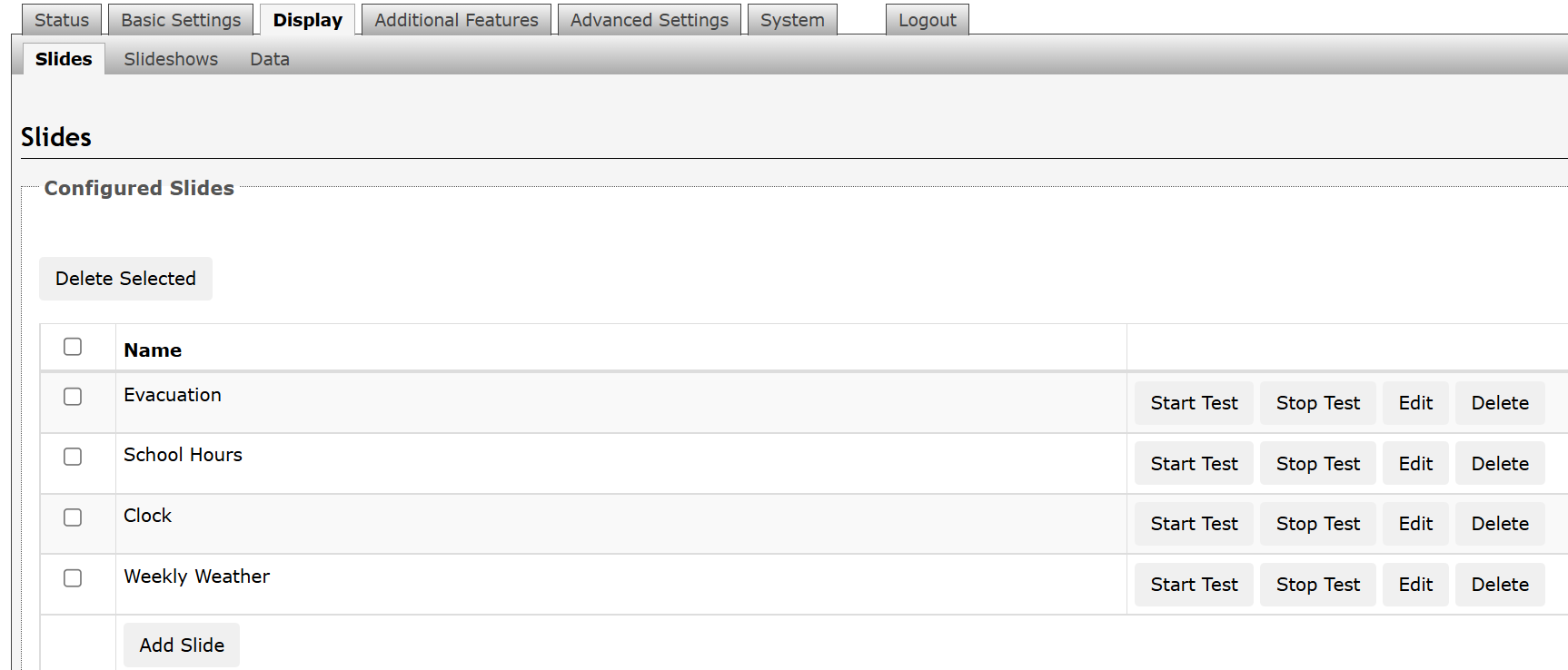
Add Slides
Press Add Slide to create a new slide based on preconfigured templates. Slide types may include an analog or digital clock display, a new template for notifications or alerts.
Clock
The digital clock setting allows you to change background and font colors.
Template
Choose a template for your Slide based on the purpose. This can include emergency alerts, notifications, weather warnings, or event updates.
Slideshows
In this tab, you can create new slideshows and view available slideshows.
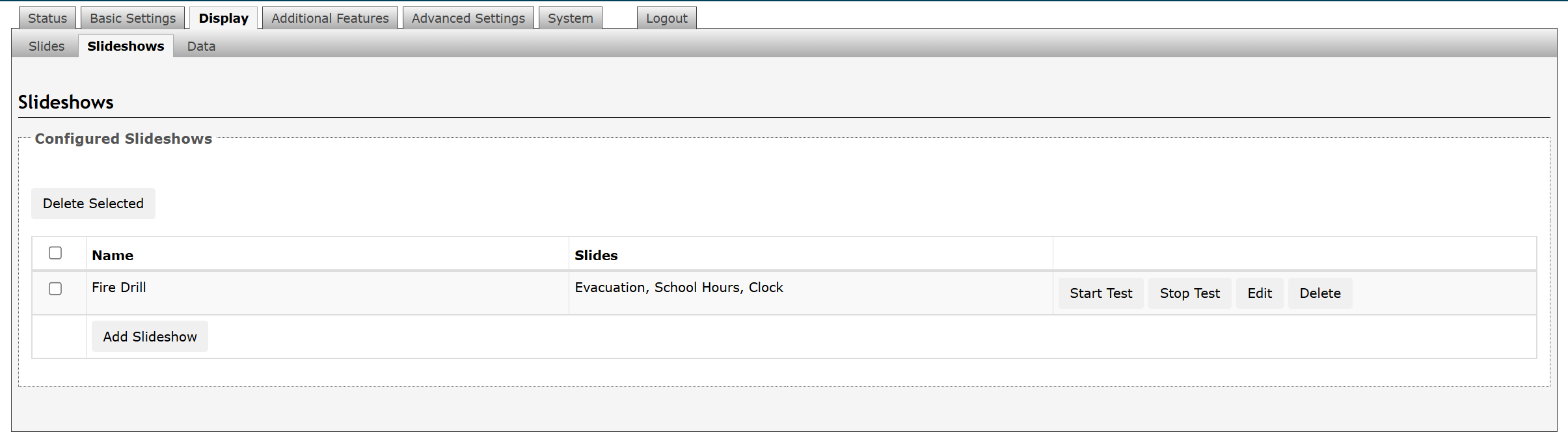
Data
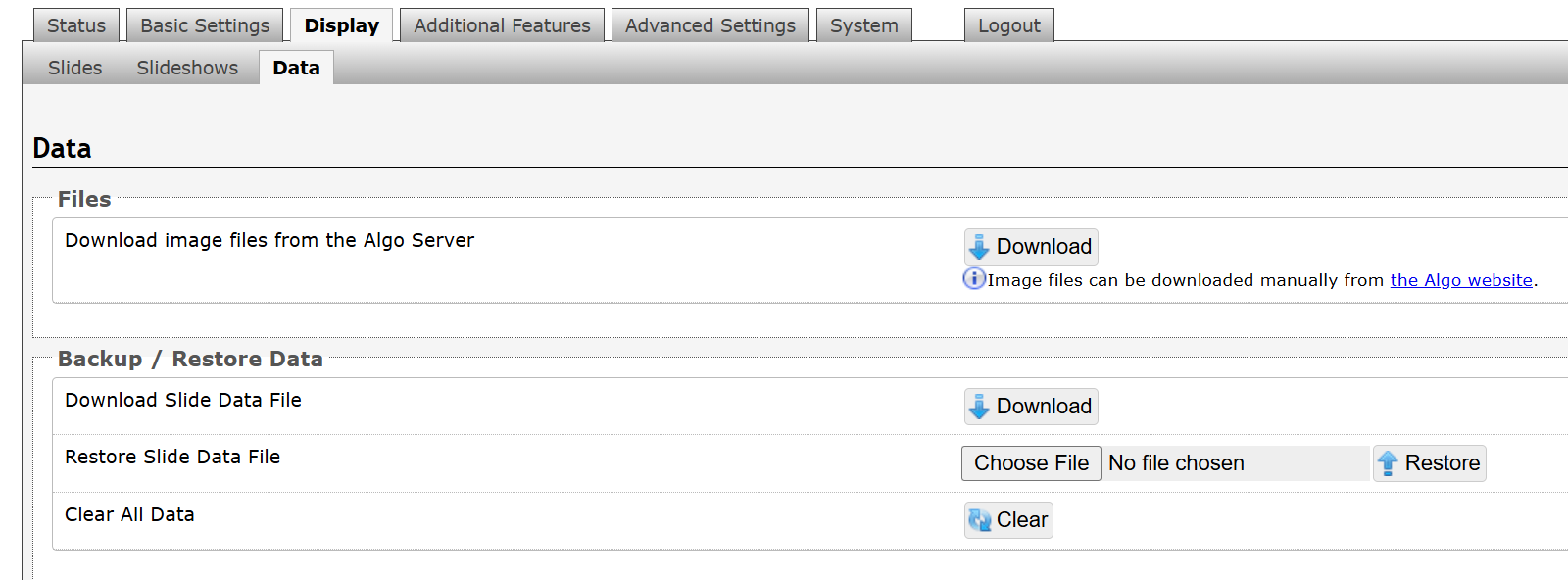
Download Image Files from Algo Server
Downloads the factory images from the Algo Server (internet connection is required).
Download Slide Data File
Allows an image to be downloaded and stored for backup purposes. Note that this backup is independent from the rest of the configuration backup on the device.
Restore Slide Data File
Upload and restore a saved slide data file.
Clear All Data
This clears all the slide data, including saved slides.
Displaying Weather Information
You can display weather information on the 8410/8420 for locations in the United States or Canada.
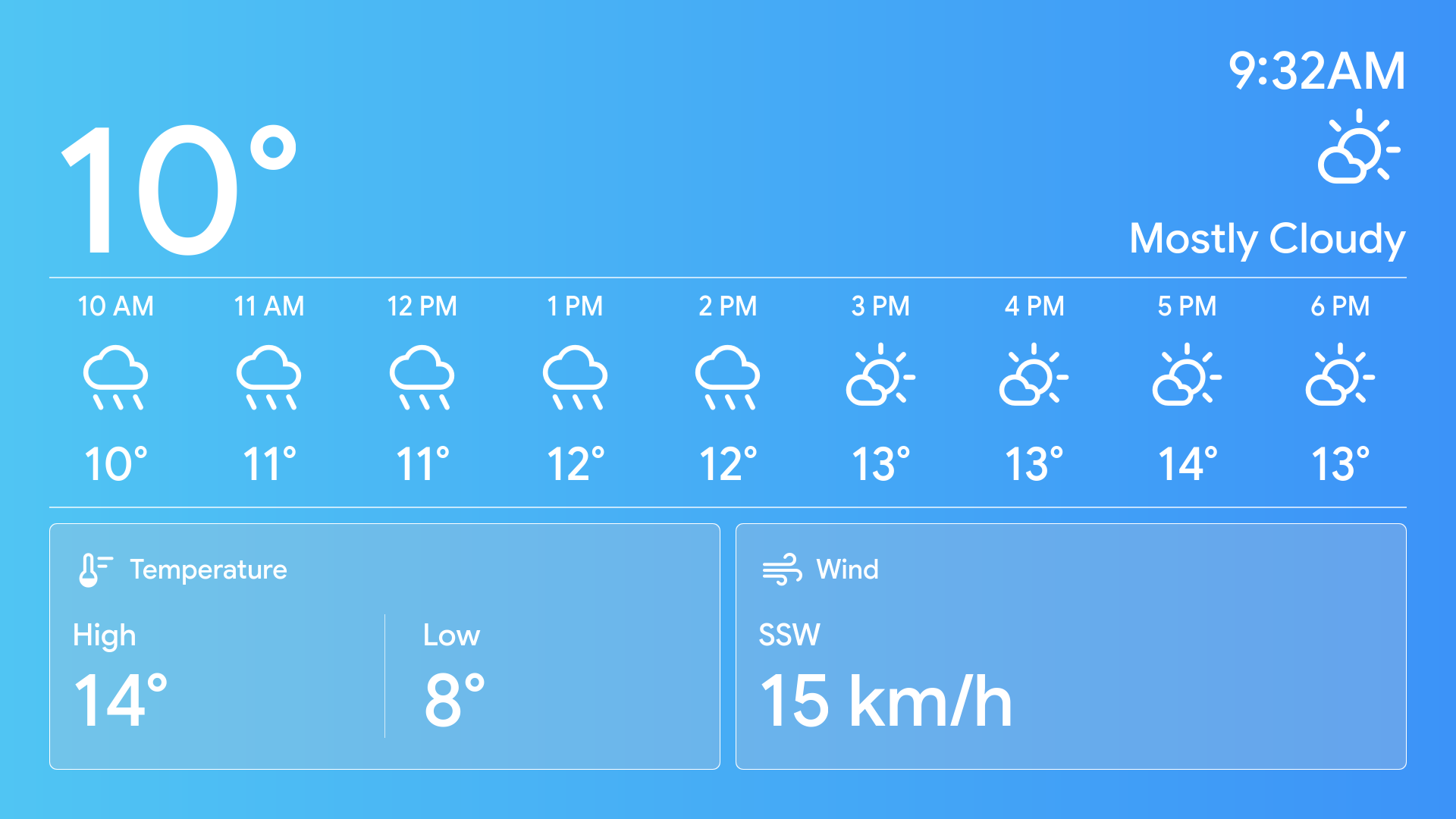
After configuring Weather Settings, you can display weather information using one of the following methods:
Display a full-screen weather forecast slide.
Weather - Current Conditions
Weather - Hourly Forecast
Weather - Weekly Forecast


Display a Weather Widget on top of a slide or within a slideshow.

Configuring Weather Settings
You must configure Weather Settings before you can use them in slide templates or widgets.
Once Show Weather is enabled, you can also view the Weather Status and Last Weather Update on the Status page.
To configure Weather Settings:
Go to Additional Features → Weather.
Configure Weather Settings:
Set Show Weather to Enabled.
Configure the following:
Weather Position: Set where the Weather Widget appears.
Color: Set the color of the Weather Widget.
Country: Select United States or Canada.
Specify the location:
United States: Specify the location’s Latitude and Longitude.
Enter the Latitude and Longitude (up to four decimal places, separated by a comma). For example: 38.8894,-77.0352.
You can obtain the coordinates from Google Maps by right-clicking the desired location. Round the coordinates to no more than four decimal places.
Canada: Select the desired Province and Region.
Select Save.
The resolved city name appears on the screen.
Displaying Full-Screen Weather Forecast
You can use slide templates to display weather information in full-screen mode.
Note
You must enable Weather and configure Weather Settings in Additional Features → Weather before using weather slide templates.
To display a full-screen weather forecast:
Go to Display → Slides → Add Slide.
Set Screen Type to Template.
(1).png)
Select an option for the Template:
Weather - Current Conditions: Displays current weather.
Weather - Hourly Forecast: Displays hourly forecast for the day.
Weather - Weekly Forecast: Displays forecast for the upcoming week.
Configure additional settings:
Time Format: Select 12 Hour or 24 Hour.
Show Clock Seconds: Enable or disable seconds display.
Headline: Show the Date, City, or None in the header.
The City option is available only for weather in the United States.
Show Feels Like: Display the “feels like” temperature.
Strobe Flash Pattern: Enable strobe light during display (if applicable).
Select Save.
Using Weather Widget
You can display current weather information as a widget overlay on slides.
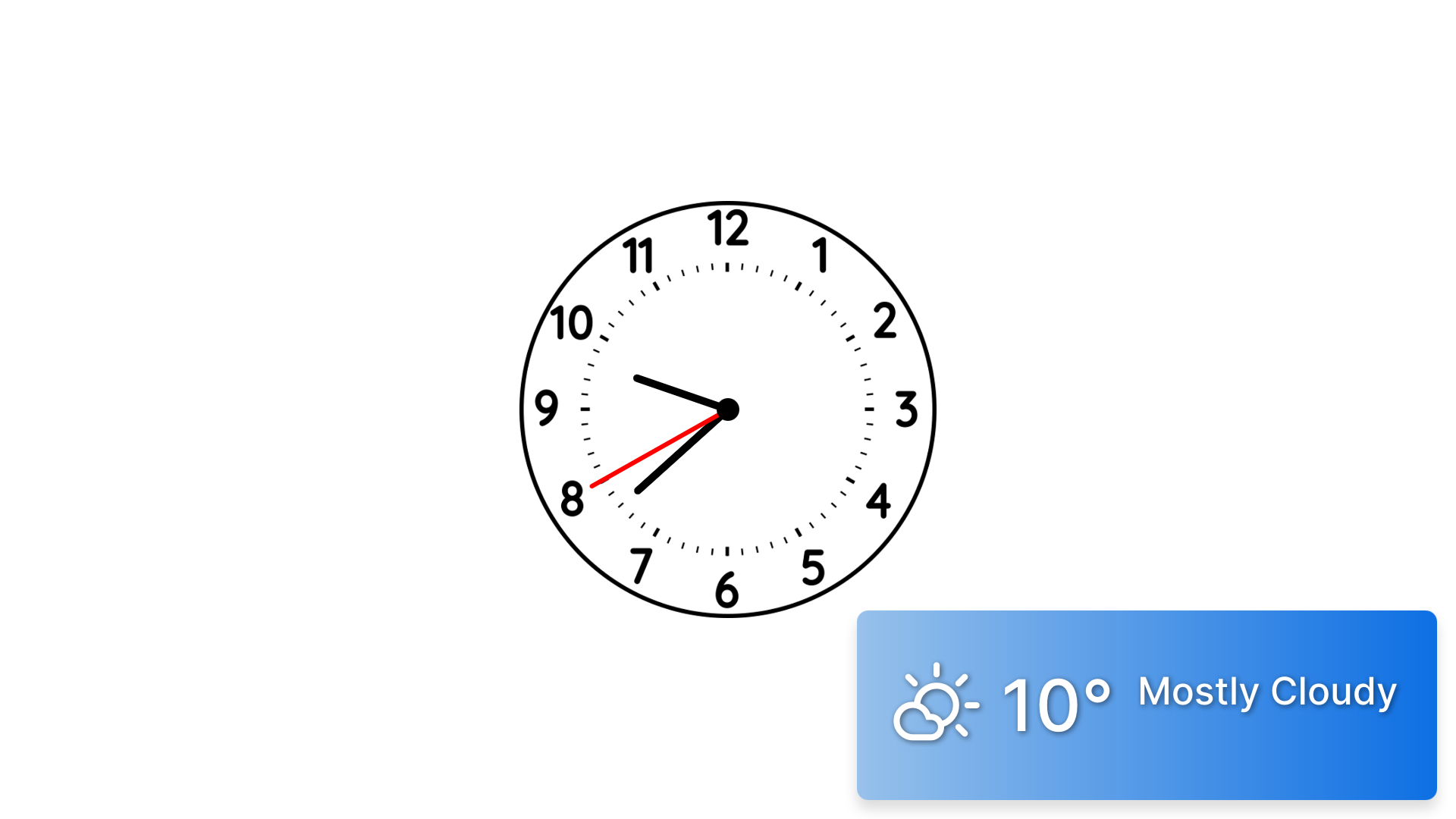
Enabling Weather Widget
You must enable the Weather Widget before using it.
To enable the Weather Widget:
Go to Additional Features → Weather.
Configure Weather Widget:
Weather Widget: Set to Enabled.
Widget Size: Choose a size for the widget window.
Widget Position: Choose the position of the widget.
Widget Shape: Choose an option:
Square: Displays the widget as a rectangle with slightly rounded corners.
The corner radius is 15 px radius for the Small widget size, and 10 px for Medium and Large.
Rounded: Displays the widget as a rectangle with larger rounded corners (60 px radius).
Select Save.
Displaying the Weather Widget on Slides
You can enable the Weather Widget on individual slides to show the current weather information.
Note
To display the Weather Widget, both of the following must be configured under Additional Features → Weather:
Weather Settings
Weather Widget
To display weather information on a slide:
When creating or editing a slide, enable Show Weather.
.png)
Additional Features
Input/Output
The Input tab allows external accessories to be connected to the 8410/8420. This is a dry contact input which can be configured as normally open or normally closed mode. Algo offers accessories, such as the 1202, 1203, 1204, and 2507. Third-party accessories/systems may also be used provided they have a dry contact output.
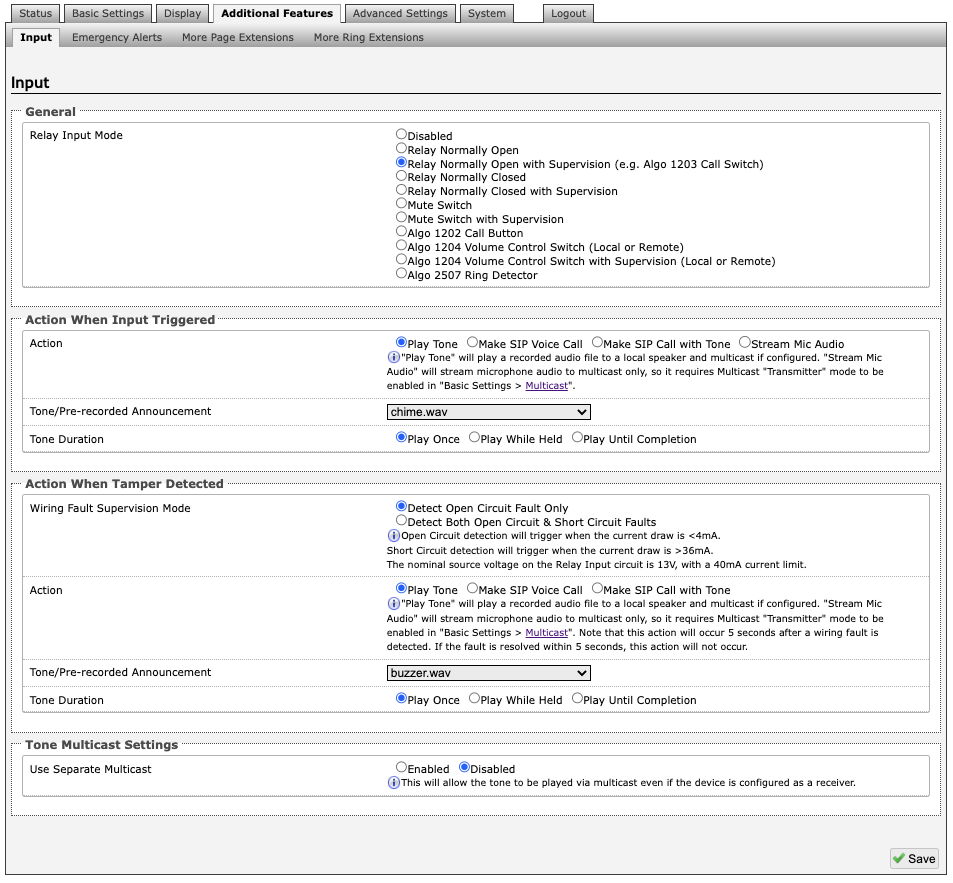
General
Relay Input Mode
The input relay to the 8410/8420 can be activated by any normally open or normally closed switch. Algo offers the 1202 Call Button, the 1203 Call Switch, or 1204 Volume Control Switch. Via supervision settings, notification actions can also be triggered if the input switch is disconnected.
1203 Call Switch The 1203 Call Switch is a simple contact closure switch with an illuminated button and supervision capabilities. When used in conjunction with the 8410, the 1203 can prompt a single action with one-touch, or a continuous action if the button is held. |
|
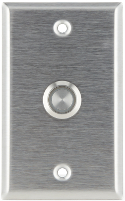
Mute Switch
Apply an external switch (short-circuit) across the Relay Input terminals in order to mute the 8410/8420. This allows a temporary "disable" switch to control the device if desired, for example in a boardroom to block paging during important meetings.
Leave the Relay Input terminals open (no-connect) for regular full-volume operation when in this mode.
Multicast Override
Allow selected multicast zones to override the Mute Switch settings for the selected zones.
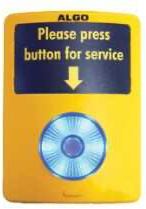
While the 8410/8420 can be configured to play the audio file only once, it can also be enabled to play it continuously with just a press of the 1202 Call Button. The action can then be stopped via the smaller oval cancel button located below the main call button on the 1202 Call Button.
1204 Volume Control The 1204 Volume Control Switch is a simple two terminal potentiometer that will allow attenuation below the maximum volume level (configured under Basic Settings → Features). |
|
.png)
Mute On Lowest Setting
Enabling Mute On Lowest Setting allows audio to be completely muted when volume control switch is turned all the way down.
Wire Length
This allows you to calibrate impedance for 24 AWG.
Multicast Override
Multicast Override allows selected multicast zones to override the 1204 Volume Control settings for the selected zones.
Remote Volume Settings
Configure the device to subscribe to remote 1204 volume input or to notify remote devices of 1204 volume input.
Note
RESTful API must be enabled in the Advanced Settings → Admin tab.
Notify (Local 1204) → remote device RESTful API password
Subscribe (Remote 1204)
IP address
Remote device RESTful API password
Action When Input Triggered
Action
Play Tone
When the 8410/8420 input is triggered, a tone or a pre-recorded audio file will play over the speaker or multicast if enabled. This function can be used to request support/assistance in service or retail environments, notify about an emergency at a specific location in medical or educational facilities, or sound an alarm during an intrusion.
Action When Input Triggered:
Tone/Pre-recorded Announcement
Tone Duration
Make SIP Voice Call
When the 8410/8420 input is triggered, a voice path will open for an intercom-like call via an external microphone to a pre-configured phone extension. This option can be used when a call needs to be made from a public place where a phone would not be practical to use.
Action When Input Triggered:
Extension to Dial
Call Mode
Allow 2nd Button Press
Outbound SIP Call Settings:
Outbound Ring Limit
Ringback Tone
Maximum Call Duration
Make SIP Call with Tone
When the 8410/8420 input is triggered, a private call can be generated to a pre-configured phone extension with a pre-recorded message. For instance, a call to a supervisors phone notifying about an emergency or intrusion at some location.
Action When Input Triggered:
Extension to Dial
Allow 2nd Button Press
Tone/Pre-recorded Announcement
Interval Between Tones (seconds)
Maximum Tone Duration
Outbound SIP Call Settings:
Outbound Ring Limit
Allow 2nd Button Press
If enabled, the 2nd button press will either simply End Call or End and Restart Call. Therefore, if an input is triggered for the second time the SIP call will either simply be terminated or terminated and immediately called again.
Action When Tamper Detected (Supervision)
In addition to the main events, the device can be configured with supervision to also execute one of the above three actions (Play Tone, Make Two-Way SIP Voice Call, Make SIP Call with Tone) in case the device goes offline due to wiring failure or after being tampered with. For example, a tone could sound over the speaker(s), or a private pre-recorded message could be sent to a specified phone extension. The supervision configuration options will appear once a relay option with supervision is selected. See the Electrical Specification section for details on supervision detection circuit.
Wiring Fault Supervision Mode
Short circuit detection will be triggered when the current draw is <4 mA. Short circuit detection will trigger when the current draw is >36 mA. The nominal source voltage on the Relay Input circuit is 13 V, with 40 mA current limit.
Action
“Play Tone” will play a recorded audio file to a local speaker and multicast if configured. “Stream Mic Audio” will stream microphone audio to multicast only, so it requires multicast “Transmitter” mode to be enabled in Basic Settings → Multicast.
Note
This action will occur 5 seconds after a wiring fault is detected. If the fault is resolved within 5 seconds, this action will not occur.
Play Tone
Make SIP Voice Call
Make SIP Call with Tone
Tone/Pre-recorded Announcement (Action – Play Tone / Make SIP call with Tone)
Select a recording or tone to use. Custom audio files may be used and uploaded though System → File Manager.
Extension to Dial (Action – Make SIP Voice Call)
SIP account required in Page Extension fields in order to make a call. Can be configured if Make SIP Voice Call or Make SIP Call with Tone actions are enabled under Call Button Settings.
Interval Between Tones (Action –Make SIP call with Tone)
Specify the time delay (seconds) between tones. Can be configured if Play Tone or Make SIP Call with Tone actions are enabled under Call Button Settings.
Maximum Tone Duration (Action – Play Tone / Make SIP call with Tone)
Select the maximum tone duration. The tone will be terminated once the maximum time is reached. Can be configured if Play Tone or Make SIP Call with Tone actions are enabled.
Tone Multicast Settings
Use Separate Multicast
This allows the tone to be played via multicast even if the 8410/8420 is configured as a receiver. See additional options when enabled.
Multicast Mode
IP Address
Port
Outbound SIP Call Settings
Outbound Ring Limit
Typically set to ensure that a call will not reach voicemail. This feature, under Outbound SIP Call Settings, can be used to set a limit on how long the speaker will ring before timing out.
Ringback Tone
If enabled, under Outbound SIP Call Settings, a ringback tone will play over the speaker during an outbound SIP call, while waiting for the far-end party to answer.
Emergency Alerts
Your device can be used for alerting in the case of emergency (e.g., lockdown, evacuation, reverse evacuation), safety (e.g., medical, workplace accident), and security events (e.g., OSHA or similar workplace regulations).
Emergency alerts notify others of an emergency quickly and efficiently.
Configuring an Emergency Alert
You can dial a pre-configured extension number to trigger and loop an emergency alert or announcement. Up to 10 extensions can be registered, allowing up to 10 different announcements.
A single Call-to-Cancel extension also needs to be registered. Calling this number will cancel an active announcement. Alternatively, DTMF can be used to cancel if the phone system being used does not support multiple extensions on the same device or if paying for multiple extensions is not within budget.
To set emergency alerts:
Go to Additional Features → Emergency Alerts.
Configure general Settings.
Configure how to trigger each announcement:
Direct Extensions: Register a separate extension for each announcement.
DTMF Selectable: Register a single extension that accepts DTMF input to select which announcement to play.
Configure a Call-to-Cancel extension.
To configure an emergency alert extension, select Enabled beside the target announcement and configure it.
Select Save.
Related Links:
Triggering an Emergency Alert
You trigger emergency alerts using the configured extensions.
To trigger an emergency alert
A user dials an announcement extension.
The device answers or detects the call.
The configured announcement plays locally and/or via multicast.
You can also send up to 5 API calls along with the announcement.
The announcement continues until:
The playback completes
Timeout occurs
Call-to-Cancel extension is dialed.
You can also send up to 5 API calls upon the completion of the announcement.
Emergency Alerts Settings
Refer to the following table for general emergency alerts, call-to-cancel, and emergency announcements settings.
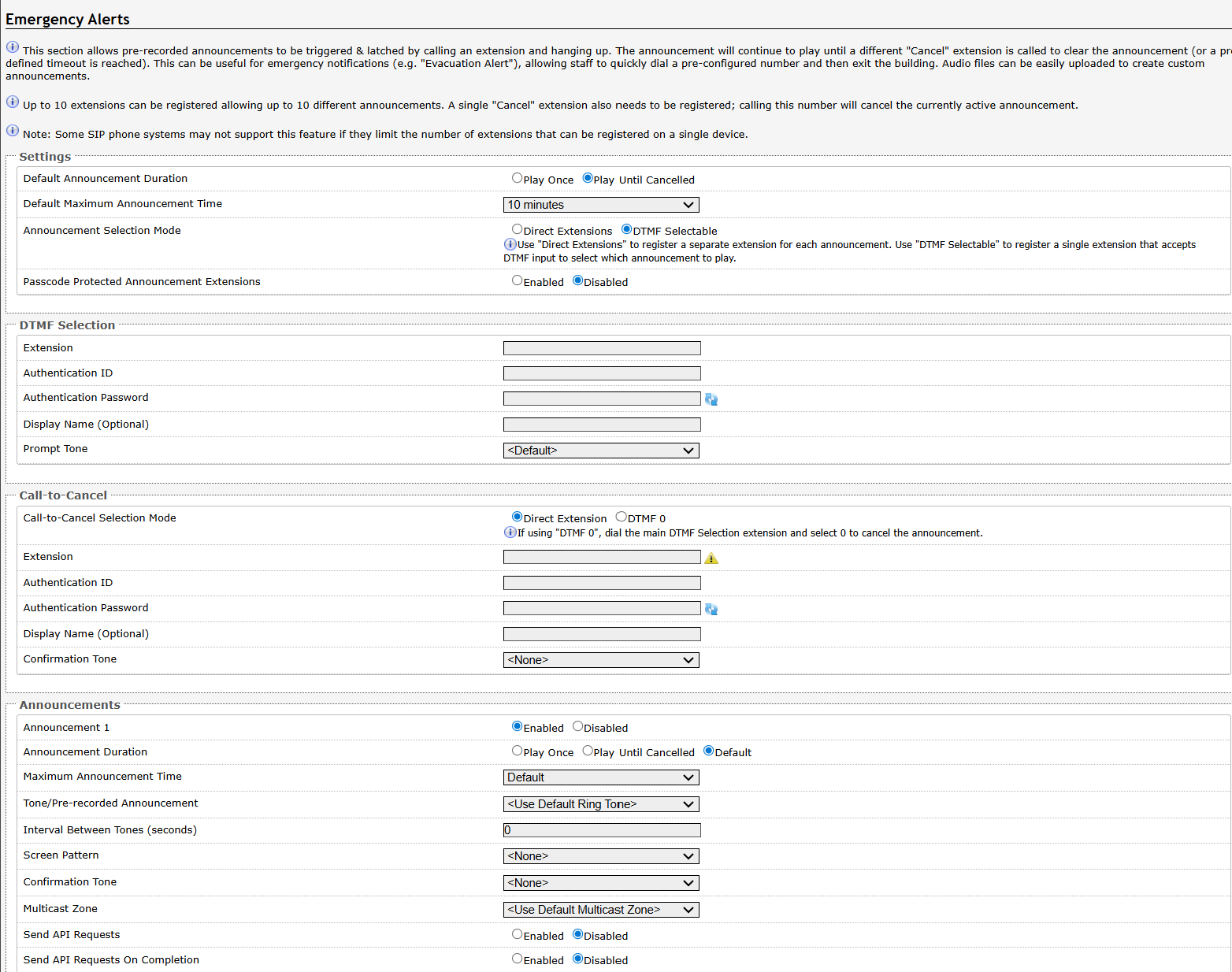
General Settings
General Settings controls how the announcement plays and how to trigger it.
Settings | Description |
Default Announcement Duration | An announcement can be played once or continuously until canceled.
|
Default Maximum Announcement Time | Select the maximum time an announcement will play for. |
Announcement Selection Mode | Select how to trigger the announcement:
|
Answer Inbound Call | This option selects how the Announcement calls are handled. In both cases, the Emergency Announcement is started when the appropriate extension is called and continues until the Cancel Extension is called.
|
Passcode Protected Announcement Extensions | Select Enabled to require the caller to enter a passcode after dialing an announcement or Call-to-Cancel extension. Setting a passcode helps prevent unintentional announcements. |
Announcement Passcode | Enter a passcode that a caller must enter to play or cancel an announcement. When prompted, the caller must enter the passcode followed by the # sign before the announcement will be played or canceled. The passcode prompt will be played before any other action. If the passcode is not correctly entered within 15 seconds, the call will end, and there will be no change to the current announcement state. |
Passcode Prompt Tone | Select a tone to play when the passcode is ready to be entered. |
DTMF Selection
DTMF extension will be used to activate and optionally cancel emergency alerts when Announcement Selection Mode is set to DTMF Selectable. Use the configurations below to register a single extension that will accept DTMF input to play selected announcements.
Settings | Description |
Extension | Enter the SIP extension for the DTMF Selection parameter. The device will auto-answer any inbound call received on this extension and provide a voice paging path (and multicast if configured). |
Authentication ID | Enter the Authentication ID. The Authentication ID may also be called Username for some SIP servers and in some cases may be the same as the ring and/or page extension. |
Authentication Password | Enter the SIP password provided by the system administrator for the SIP account. |
Display Name (Optional) | Enter a Display Name that will be sent when the SIP call is made. The PBX and phone(s) must be configured to display this message as the Caller ID. |
Prompt Tone | Select a tone to play when the passcode is ready to be entered. |
Call-to-Cancel
When your Algo device uses SIP for emergency alerts, both a start trigger (Announcement) and stop trigger (Call-to-Cancel) must be configured.
Settings | Description |
Call-to-Cancel Selection Mode | If using “DTMF 0”, the user should dial the main DTMF Selection extension and select ‘0’ to cancel the announcement. Using DTMF 0 allows emergency alerts to work with only a single SIP registration rather than requiring multiple accounts. |
Extension | Enter the SIP extension for the Call-to-Cancel Selection parameter. The device will auto-answer any inbound call received on this extension and provide a voice paging path (and multicast if configured). |
Authentication ID | Enter the Authentication ID provided by the system administrator. For some SIP servers, it may also be called the Username or the same as the extension. |
Authentication Password | Enter the SIP password provided by the system administrator for the SIP account. |
Display Name (Optional) | Enter a Display Name that will be sent when the SIP call is made. The PBX and phone(s) must be configured to display this message as the Caller ID. |
Confirmation Tone | Select a tone to play to confirm that an alert has been canceled. |
Announcements
Up to 10 extensions can be registered, allowing up to 10 different announcements. Audio files can also be easily uploaded to create custom announcements. Only one Call-to-Cancel extension is needed, despite the number of the alert extensions.
Note
Some SIP phone systems may not support this feature if they limit the number of extensions that can be registered on a single device.
Settings | Description |
Announcement # | To configure an Emergency Alert extension, select Enabled for an announcement number. Up to 10 extensions can be registered, allowing up to 10 different announcements. Audio files can be easily uploaded to create custom announcements. Only one Call-to-Cancel extension is needed. Alternatively, DTMF Selectable Mode can be used if the SIP telephone system limits the number of extensions that can be registered on a single device. |
Announcement Duration | Choose the duration of an announcement:
|
Maximum Announcement Time | Select the maximum announcement time. |
Extension | Enter the SIP extension for the announcement. The device will auto-answer any inbound call received on this extension and provide a voice paging path (and multicast if configured). |
Authentication ID | Enter the Authentication ID provided by the system administrator. For some SIP servers, it may also be called the Username or the same as the extension. |
Authentication Password | Enter the SIP password provided by the system administrator for the SIP account. |
Display Name (Optional) | Enter a Display Name that will be sent when the SIP call is made. The PBX and phone(s) must be configured to display this message as the Caller ID. |
Tone/Pre-recorded Announcement | Select a file to use as the announcement. |
Interval Between Tones (seconds) | Specify an interval between tones (in seconds). |
Screen Pattern | Select a screen to display during the announcement. |
Confirmation Tone | Select a file to use as a confirmation tone. This option is available when Answer Inbound Call is enabled. |
Multicast Zone | Set the RTP multicast zone where announcements will be played. |
Multicast Poly Group | Set the Poly Group where announcements will be played. This option is available only when your Multicast Type is set to one of the following:
|
Send API Requests | When the announcement starts, send up to five REST API requests to external devices or systems to trigger specific functions or behaviors. |
Send API Requests On Completion | When the announcement ends, send up to five REST API requests to external devices or systems to trigger specific functions or behaviors. |
Related Links:
More Page Extensions
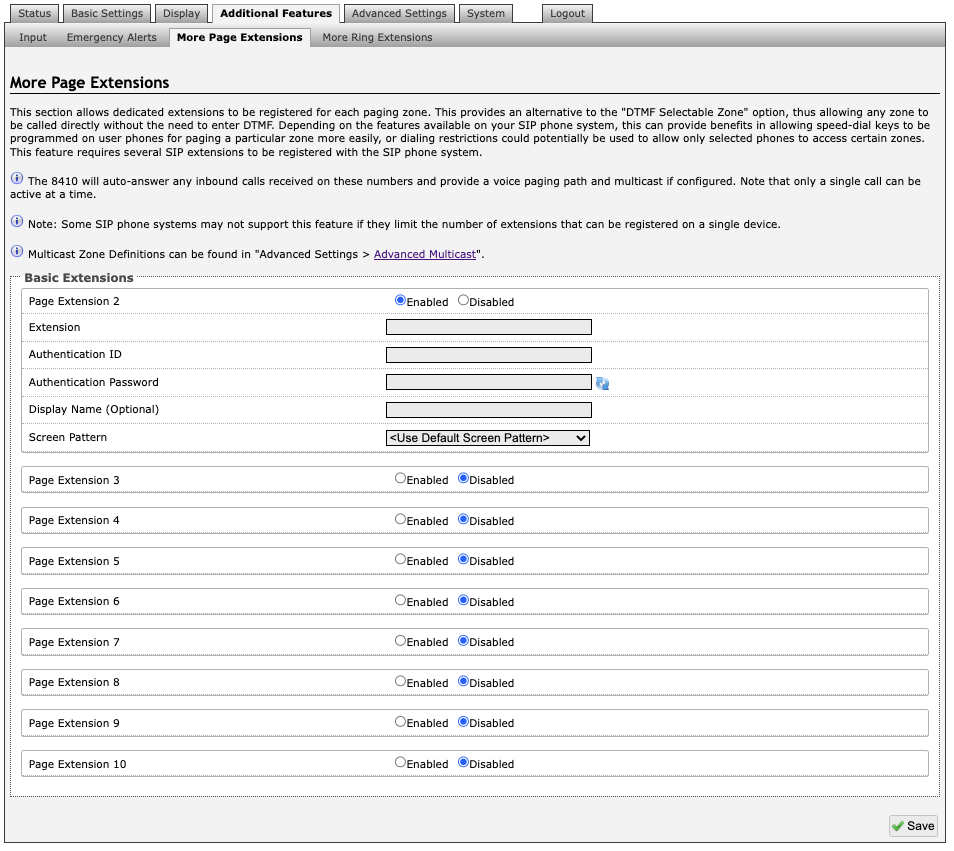
Additional SIP extensions can be registered for each multicast zone that will be used. This allows the advantage of dialing directly to a zone without needing to enter DTMF Codes (e.g., speed-dial keys can be used), but this may require additional SIP licenses depending on the SIP provider.
To configure additional page extensions (up to 50), select Enable beside the target extension and enter the Extension, Authentication ID, and Authentication password.
The 8410/8420 will auto-answer any inbound calls received on these numbers and provide a voice paging path and multicast if configured. Only a single call can be active at a time.
Note
Some SIP phone systems may not support this feature if they limit the number of extensions that can be registered on a single device.
More Ring Extensions
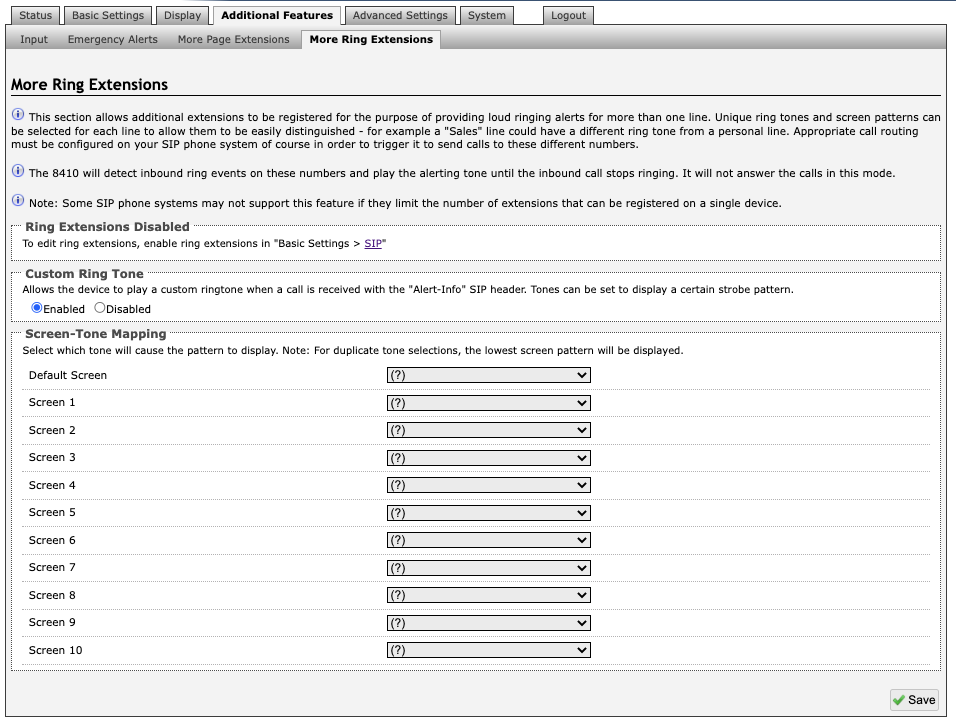
Up to 10 SIP Ring extensions can be registered. To configure additional ring extensions, select Enable beside the target extension and enter the Extension, Authentication ID, and Authentication Password. A unique Ring Tone and Multicast Zone can be assigned to each extension if desired.
Default Screen
Select a default screen to display during a ring.
Advanced Settings
Network
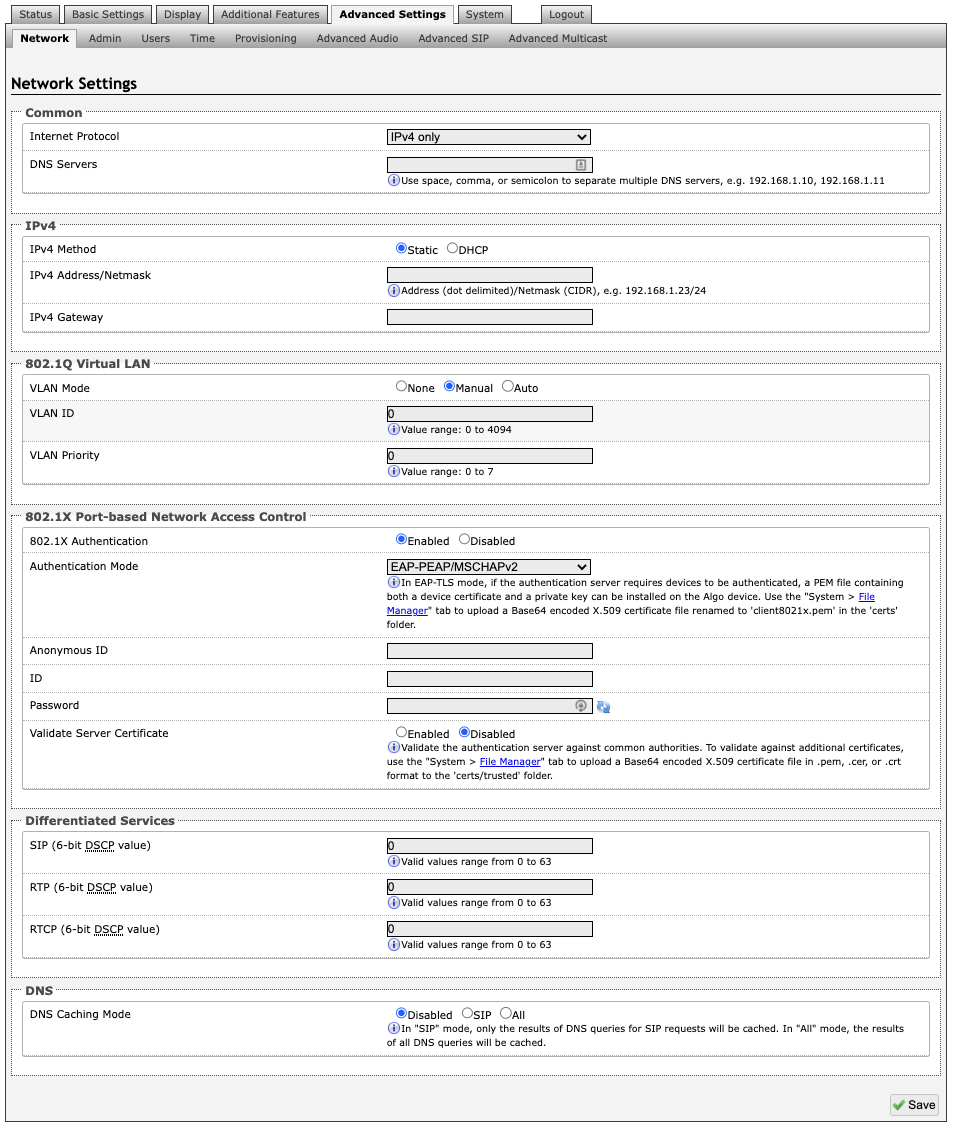
Common
Internet Protocol
DHCP is an IP standard designed to make the administration of IP addresses simpler. When selected, DHCP will automatically configure IP addresses for each 8410/8420 on the network. Alternatively, the 8410/8420 can be set to a static IP address.
DNS Servers
Add one or multiple DNS servers. Separate each server by a space, comma, or semicolon.
IPv4
IPv4 Method
The 8410/8420 can be set to a DHCP or a static IP address. When DHCP is selected, the DHCP will automatically configure IP addresses for each 8410/8420 on the network.
IPv4 Address/Netmask
Enter the static IP address and netmask (CIDR format) for the 8410/8420 (e.g., 192.168.1.23/24).
IPv4 Gateway
Enter the gateway address.
802.1Q Virtual LAN
VLAN Mode
Enables or Disables VLAN Tagging. VLAN Tagging is the networking standard that supports Virtual LANs (VLANs) on an Ethernet network. The standard defines a system of VLAN tagging for Ethernet frames and the accompanying procedures to be used by bridges and switches in handling such frames. The standard also provides provisions for a quality-of-service prioritization scheme commonly known as IEEE 802.1p and defines the Generic Attribute Registration Protocol.
VLAN ID
Specifies the VLAN to which the Ethernet frame belongs. A 12-bit field specifying the VLAN to which the Ethernet frame belongs. The hexadecimal values of 0x000 and 0xFFF are reserved. All other values may be used as VLAN identifiers, allowing up to 4094 VLANs. The reserved value 0x000 indicates that the frame does not belong to any VLAN; in this case, the 802.1Q tag specifies only a priority and is referred to as a priority tag. On bridges, VLAN 1 (the default VLAN ID) is often reserved for a management VLAN; this is vendor specific.
VLAN Priority
Sets the frame priority level. Otherwise known as Priority Code Point (PCP), VLAN Priority is a 3-bit field which refers to the IEEE 802.1p priority. It indicates the frame priority level. Values are from 0 (lowest) to 7 (highest).
802.1X Port-based Network Access Control
802.1x Authentication
Credentials to access LAN or WLAN that have 802.1X network access control (NAC) enabled. This information will be available from the IT Administrator.
Authentication Mode
Select the desired authentication mode.
Anonymous ID
If configured, the 8410/8420 will send the anonymous ID to the authenticator instead of the 802.1X client username.
ID
The ID should contain a string identifying the IEEE 802.1X authenticator originating the request.
Password
Enter the password.
Validate Server Certificate
Validate the authentication server against common authorities. To validate against additional certificates, go to the System → File Manger to upload a Base64 encoded X.509 certificate file in .pem, .cer, or .crt format to the certs/trusted folder.
Differentiated Services
This provides quality of service if the DSCP protocol is supported on your network. The Differentiated Services can be specified independently for SIP control packets versus RTP and RTCP audio packets.
SIP (6-bit DSCP value)
Enter the DSCP value for SIP packets.
RTP (6-bit DSCP value)
Enter the DSCP value for RTP packets.
RTCP (6-bit DSCP value)
Enter the DSCP value for RTCP packets.
DNS
DNS Caching Mode
In "SIP" mode, only the results of DNS queries for SIP requests will be cached. In "All" mode, the results of all DNS queries will be cached.
Admin
Admin settings allow you to configure device access, security, management, monitoring, and integration features.
From this page, you can change administrator credentials, manage logging and network management settings, enable APIs and external services, and configure device maintenance options.
Note
Available settings may vary depending on your product model and firmware version.
To configure Admin settings:
Go to Advanced Settings → Admin.
Configure the settings.
Refer to the following tables for the setting description.
Admin Settings
This section contains settings for administrator credentials, logging and network management, APIs and external services, and device maintenance.
Admin Password | |
Old Password | Enter the old admin password. The default password when you first get the device is algo. |
Password | Enter a new admin password to log into the device web interface. Make sure the new password is stored safely. If the password is forgotten, you must reset the device entirely with the Reset Button to restore the default password. All other settings will be reset to the original default settings as well. |
Confirmation | Re-enter your new admin password. |
General | |
Device Name (Hostname) | Add a name to identify the device. |
Introduction Section on Status Page | Select On to show the introduction text on the login screen. |
Show Status Section on Status Page when Logged Out | Select On to allow others to view the status page without logging in. Select Off to hide the settings and configurations on the status page unless a user is logged in to ensure only trusted users can view device information. |
Display Switch Port ID on Status Page | Select On to display the Switch Port ID on the Status Page. This option is only possible if the device is connected to a switch that supports LLDP or CDP. |
Web Interface Session Timeout | Set the maximum duration of inactivity to log a user out of the web interface automatically. |
Play Tone at Startup | The device can play a beep tone at startup. This option is available only to Algo IP Speakers, IP Displays, Paging Adapters, and IP Consoles. |
Log Settings | |
Log Level | Select the types of information you want to include in the system log files.
|
Log Method | Select a log method: Local: The log file is saved in RAM on the device. Network: Send the log file to an external SysLog server so settings are not lost if the device is rebooted, or for ease of central access. Both: Use both methods. |
Log Server | Enter the Syslog server address provided by your IT administrator. |
Log Additional Log Events | To be used by support@algosolutions.com if necessary. |
Management | |
Web Interface Protocol | HTTPS is always enabled on the device. HTTP is enabled by default but may be disabled. To do so, select HTTPS Only mode so requests are automatically redirected to HTTPS.
|
Force Strong Password | When Enabled, you can enforce a secure password for the device web interface for additional protection. The password requirements for a strong password are:
|
Allow Secure SIP Passwords | When Enabled, SIP passwords are stored in the configuration file in an encrypted format to prevent viewing and recovery. If enabled, navigate to Basic Settings → SIP and fill out the Realm field. To obtain your SIP Realm information, contact your SIP Server administrator or check the SIP log file for a registration attempt. The Realms may be the same or different for all the extensions used. All the configured Authentication Password(s) must be re-entered here as well as any other locations where SIP extensions have been configured to save the encrypted password(s). If the Realm is changed later, all passwords must be re-entered to save the passwords with the new encryption. |
Simple Network Management Protocol | |
SNMP Support | Disabled by default. The existing setting will respond to a simple status query for automated supervision. |
SNMP Community String | Speak to your IT Administrator for more information. |
SNMPv3 Security | Speak to your IT Administrator for more information. |
API Support | |
RESTful API | Disabled by default. Enable a secure API for remote access and device control via HTTP. For more information, see the Algo RESTful API Guide. |
Authentication Method | Speak to your IT Administrator for more information. |
RESTful API Password | Speak to your IT Administrator for more information. |
SCI Support | |
SCI | Disabled by default. Simple Control Interface (SCI) is a separate control interface for certain applications. Its primary purpose is to support phones that may have programmable keys that can only send out HTTP GET requests and allow them to initiate events remotely on an Algo device. |
SCI Password | Enter your SCI password. |
System Integrity | |
System Integrity Checking | Enable this feature to verify that installed system packages have not been tampered with by running a check. Enabling this feature may cause reboots and upgrades to take 30 seconds longer. Verification results can be found on the Status tab. |
Power over Ethernet | |
PoE Power Detection | Use Force PoE+ only when connected to a PoE+ power injector capable of providing 600mA that does not automatically negotiate its power capabilities. Incorrect use of this setting may cause the device to reboot if the power source is not capable of delivering the selected power. |
Note
The Power over Ethernet configuration section is available only on devices that require a PoE+ power source.
LLDP Settings | |
Link Layer Discovery Protocol (LLDP) | Enables LLDP to exchange network configuration information with the connected network switch. |
Use LLDP for Power Negotiation | Determines whether the device uses LLDP to communicate its PoE power requirements to the connected network switch. This setting is available only on devices that require a PoE+ power source. |
Note
Disabling Link Layer Discovery Protocol (LLDP) prevents your device from exchanging network configuration information with the connected network switch. If you are using a VLAN, make sure Link Layer Discovery Protocol (LLDP) is enabled, or that the VLAN Mode (under Advanced Settings → Network Settings) is set to Manual so you can configure VLAN settings manually.
Intrado Revolution (formerly Syn-Apps) | |||
Revolution Support | Enable the device to register with an Intrado Revolution Server and receive audio events from the system. | ||
Revolution Server | Enter the Revolution Server to use the Revolution paging feature. Leave the field blank to use the server provided by the DHCP Option 72 | ||
Local Management Port | Enter the local management port for the Revolution Server. | ||
Note
The Intrado Revolution feature is available only to Algo IP Speakers, IP Paging Adapters, IP Displays, and IP Visual Alerters.
InformaCast IP Speaker Enable your device to register as an InformaCast SIP endpoint. This allows it to initiate and receive SIP calls and receive messages through InformaCast. | |
InformaCast IP Speaker Support | This feature requires a valid InformaCast license to be activated. Please contact sales@algosolutions.com for assistance. |
Configuration Mode | Auto: The device will attempt to configure Informacast using DNS SRV, SLP, and/or via DHCP and TFTP Manual: The device will allow the configuration file location to be manually configured. Direct: The device will register to the list of static server addresses directly, bypassing the Configuration File Server |
Configuration Retry Interval | Set the amount of time to wait before attempting to obtain configuration information after failure. |
SIP Support | Enter the SIP credentials provided by InformaCast during configuration. |
Maximum Broadcast Duration | The maximum length of broadcast. |
Note
The InformaCast IP Speaker feature is available only to Algo IP Speakers, IP Visual Alerters, IP Paging Adapters, IP Displays, and IP Consoles.
For more information, see Singlewire InformaCast Integration Guide.
InformaCast Scenarios API | |
InformaCast Scenario API Support | Enable the device to start an InformaCast Scenario via relay input. This feature can work without an InformaCast license, as only the output device requires a license. |
Security Token | Enter the Security Token used for authenticating API requests with the InformaCast system. |
Include Location | Enable this option to include the device’s location in the scenario trigger request. |
Microsoft | |
Microsoft Teams Support | Enable to allow the device to register with a Microsoft Teams account. The device reboot will take up to 5 minutes to complete, as the device will communicate several times with the Microsoft server. This feature requires a compatible release from Microsoft. After enabling this setting, please return to the Status page to sign into your Teams accounts. This feature requires a compatible release from Microsoft. For more details, please see the Microsoft Teams Configuration Guide. |
ADMP Cloud Monitoring | |
Enable ADMP Cloud Monitoring | The Algo Device Management Platform (ADMP) simplifies the process of managing, monitoring, and maintaining Algo devices from any location. This feature requires a valid Account ID. To learn more about ADMP and how to purchase a license, visit the ADMP webpage. |
Account ID | Enter the account ID listed on the Settings page of your ADMP account. |
Allow Configuration File Sync | Enable ADMP to query and display settings stored on the device. |
Heartbeat Interval | Select how often ADMP should check the status of your device. |
Enable Panic Button Monitoring | Enable to monitor Panic Button status in ADMP, including:
|
Screenshot | |
Take Screenshot | Take a screenshot of your 8450 display. Screenshots are saved in the File Manager in the screenshots folder. |
Note
This feature is available only to IP Displays and IP Consoles.
Users
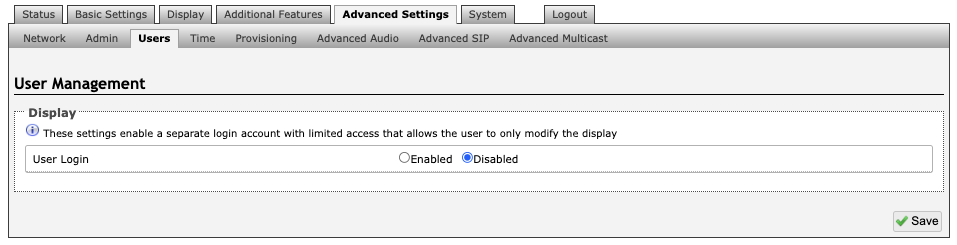
A separate login account with limited access can be set up. The user will only be able to modify the device scheduler.
Time
Network time is used for logging events into memory for troubleshooting.
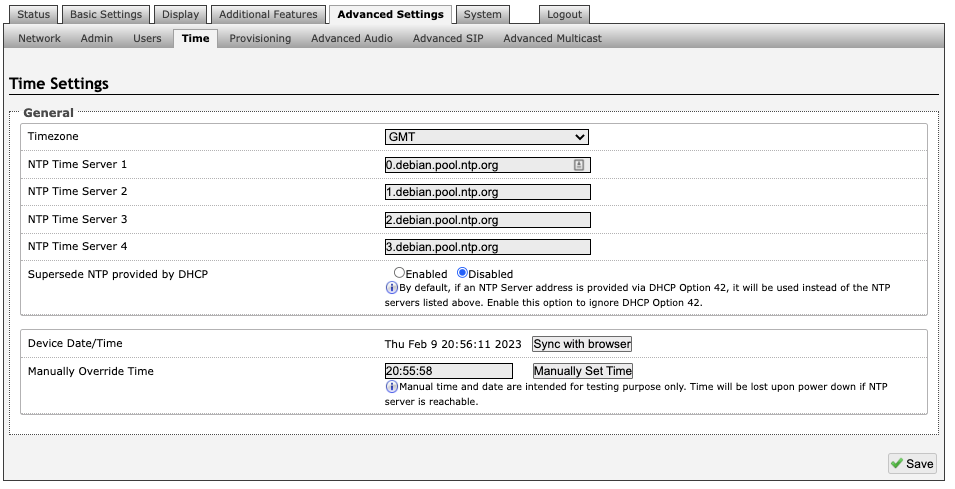
Timezone
Select a time zone to be used.
NTP Time Servers 1/2/3/4
The interface will attempt to use Timer Server 1 and work down the list if one or more of the time servers become unresponsive.
Supersede NTP provided by DHCP
When Use DHCP Option 42 is chosen, if an NTP Server address is provided via the DHCP Option 42, that NTP Server will be used instead of the four (4) mentioned above. Alternatively, Ignore DHCP Option 42 can be chosen to only use servers mentioned above.
Device Date/Time
This field shows the current time and date as set on the device. If testing the device on a lab network that may not have access to an external NTP server, the “Sync with browser” button can be used to temporarily set the time on the device.
Provisioning
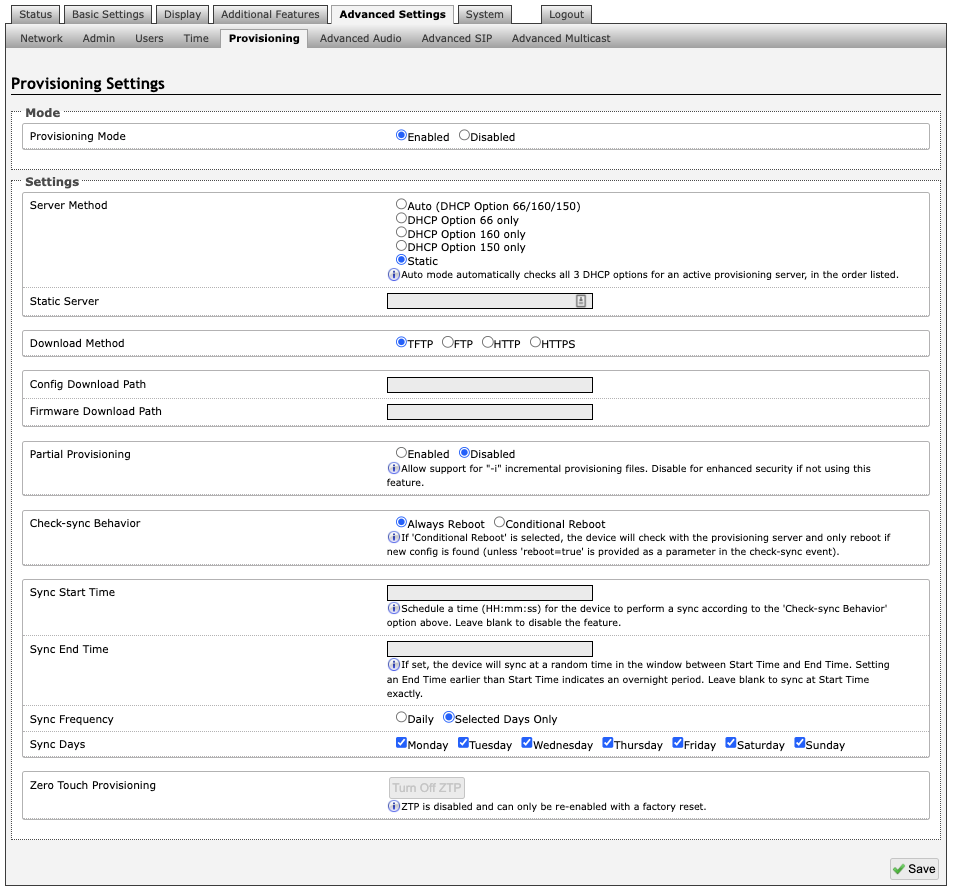
Note
It is recommended that Provisioning Mode be set to Disabled if this feature is not in use. This will prevent unauthorized re-configuration of the device if DHCP is used.
Mode
Provisioning Mode
Provisioning allows installers to pre-configure the 8410/8420 units prior to installation on a network. It is typically used for large deployments to save time and ensure consistent setups.
Settings
Server Method
The device can be provisioned via the Auto mode (where all three DHCP options (Option 66/160/150) will be automatically checked for an active provisioning server), just one of the three specified DHCP options, or a Static Server. In addition, there are four different ways to download provisioning files from a “Provisioning Server”: TFTP (Trivial File Transfer Protocol), FTP, HTTP, or HTTPS.
Static Server
Enter the server address or domain.
Download Method
The 8410/8420 configuration files can be automatically downloaded from a TFTP server using DHCP Option 66. This option code (when set) supplies a TFTP boot server address to the DHCP client to boot from.
Note
DHCP must be enabled if using DHCP Option 66/160/150, in order for Provisioning to work.
One of two files can be uploaded on the Provisioning Server (for access via TFTP, FTP, HTTP, or HTTPS):
Generic (for all Algo 8410/8420) algop8410.conf or algop8420.conf
Specific (for a specific MAC address) algom[MAC].conf
Both protocol and path are supported for Option 66, allowing for http://myserver.com/config-path to be used.
Config Download Path
Enter the path where the configuration file Is located within the provisioning server (e.g. algo/config/8410).
Firmware Download Path
Enter the path where the firmware file Is located within the provisioning server (e.g. algo/firmware/8410).
Partial Provisioning
Allow support for “-i” incremental provisioning files. Disable for enhanced security if not using this feature.
Check-sync Behavior
If Conditional Reboot is selected, the device will check with the provisioning server and only reboot if a new config is found (unless “reboot=true” is provided as a parameter in the check-sync event).
Sync Start Time
Schedule a time (hh:mm:ss) for the device to perform a sync according to the Check-sync Behavior option above. Leave blank to disable the feature.
Sync End Time
If set, the device will sync at a random time in the window between Start Time and End Time. Setting an End Time earlier than the Start Time indicates an overnight period. Leave blank to sync at Start Time exactly.
Sync Frequency
Choose the frequency for which this setting should occur. Select between daily or go to Sync Days to choose specific days of the week.
Sync Days
Select the days of the week to apply this setting for.
MD5 Checksum
In addition to the .conf file, an .md5 checksum file must also be uploaded to the Provisioning server (for TFTP mode only). This checksum file is used to verify that the .conf file is transferred correctly without error.
A tool such as can be found at the website address below and may be used to generate this file: http://www.fourmilab.ch/md5
The application doesn’t need an installation. To use the tool, simply unzip and run the application (md5) from a command prompt. The proper .md5 file will be generated in the same directory.
If using the above tool, be sure to use the “-l” parameter to generate lower-case letters.
Generating a generic configuration file
If using a generic configuration file, extensions and credentials have to be entered manually once the 8410/8420 has automatically downloaded the configuration file.
To see Algo’s SIP endpoint provisioning guide, visit: www.algosolutions.com/provision
Generating a Specific Configuration File
The specific configuration file will only be downloaded by the 8410/8420 with the MAC address specified in the configuration file name. Since all the necessary settings can be included in this file, the 8410/8420 will be ready to work immediately after the configuration file is downloaded. The MAC address of each 8410/8420 can be found on the back label of the unit.
To see Algo’s SIP endpoint provisioning guide, visit: www.algosolutions.com/provision
Using OAuth for Authentication
OAuth (Open Authorization) is an industry-standard protocol that enables secure, delegated access to resources without requiring users to share credentials such as usernames and passwords.
Instead of storing static credentials on a device or application, OAuth allows a trusted third-party service (such as Google, Microsoft, or Slack) to issue time-limited access tokens. These tokens allow an Algo device to interact with the service on behalf of a user or system, without exposing sensitive login information.
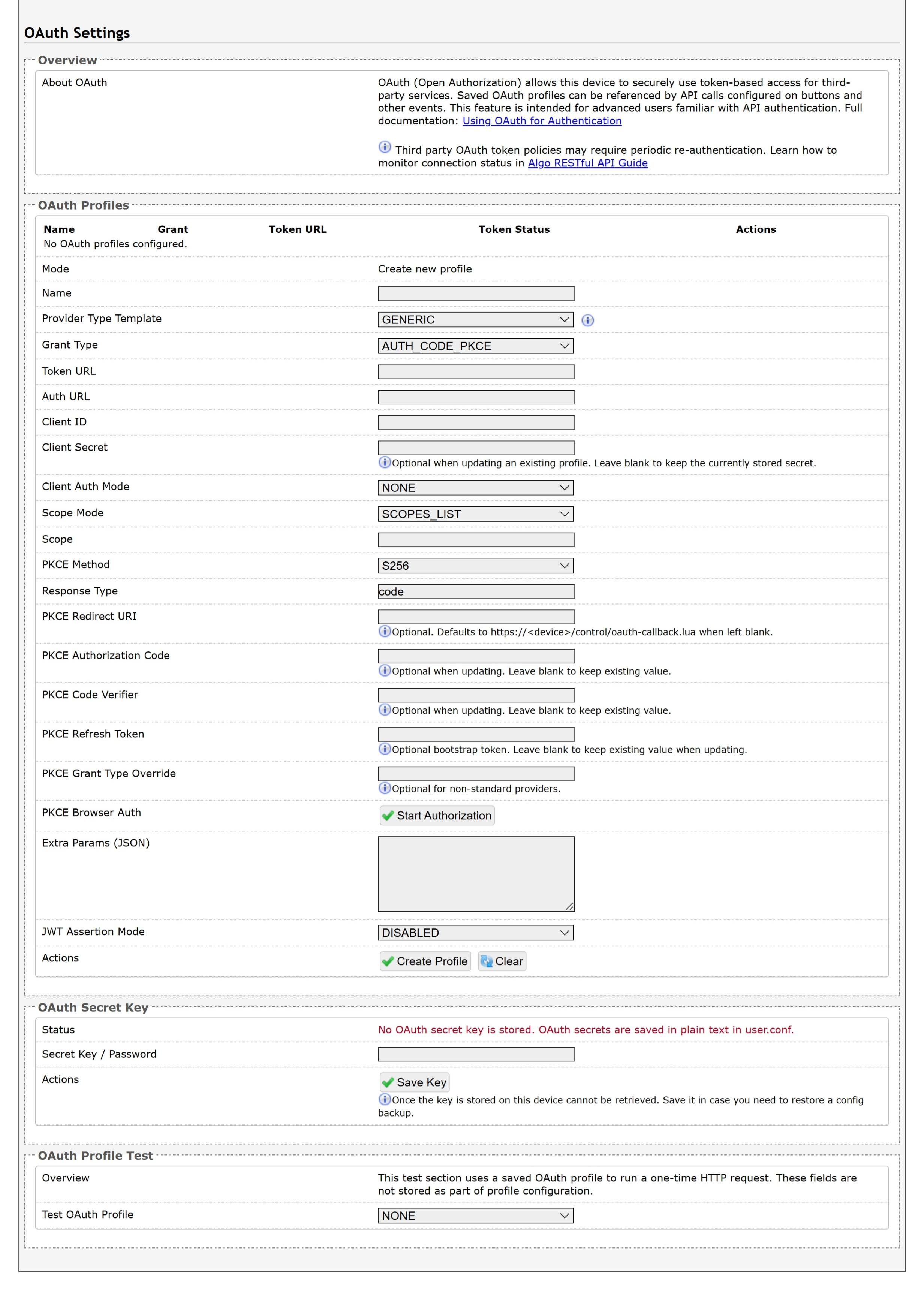
For more information, see Using OAuth for Authentication.
Advanced Audio
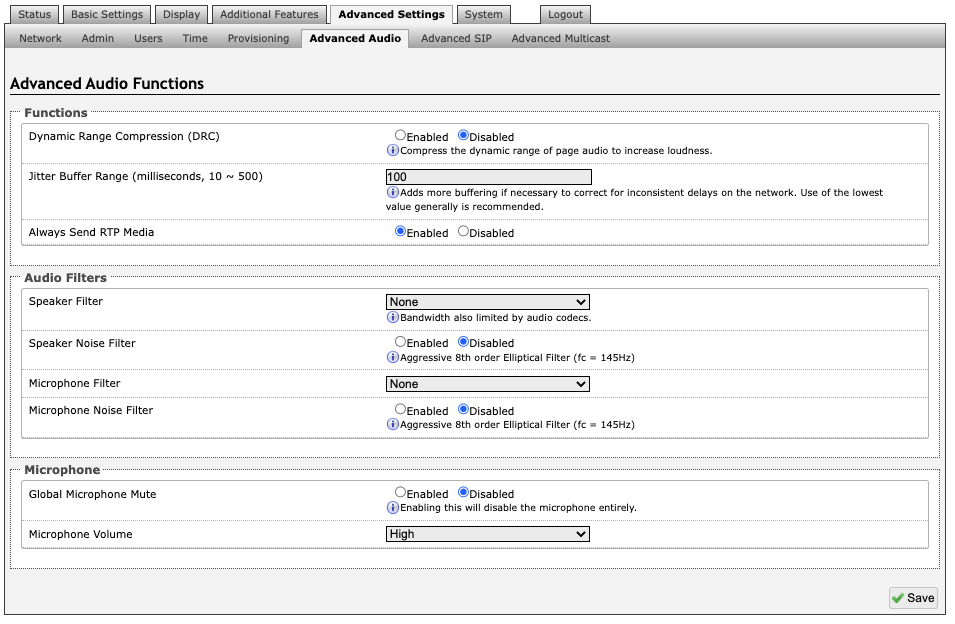
Functions
Dynamic Range Compression (DRC)
If enabled, compresses the dynamic range of page audio to increase loudness.
Dynamic Range Compression Gain
Higher compression gain increases distortion.
Jitter Buffer Range
The jitter buffer removes the jitter in arriving network packets by temporarily storing them. This process corrects the inconsistent delays on the network. It is recommended to use the lowest value.
Always Send RTP Media
If enabled, audio packets will be sent at all times, even during one-way paging mode. This option is needed in cases when the server expects to see audio packets at all times.
Audio Filters
Speaker Filter
Applies a high-pass filter to the speaker output. Used to reduce audio artifacts like humming or buzzing by filtering out unwanted frequencies.
Speaker Noise Filter
Enables heavy filtering below 145 Hz to reduce mains induced noise (fans).
Microphone Filter
Applies a high-pass filter to the microphone input. Used to reduce audio artifacts like humming or buzzing by filtering out unwanted frequencies.
Microphone Noise Filter
Enables heavy filtering below 145 Hz to reduce mains induced noise (fans).
Microphone
Global Microphone Mute
Enabling this will disable the microphone entirely.
Microphone Volume
Select a volume for the microphone.
Advanced SIP
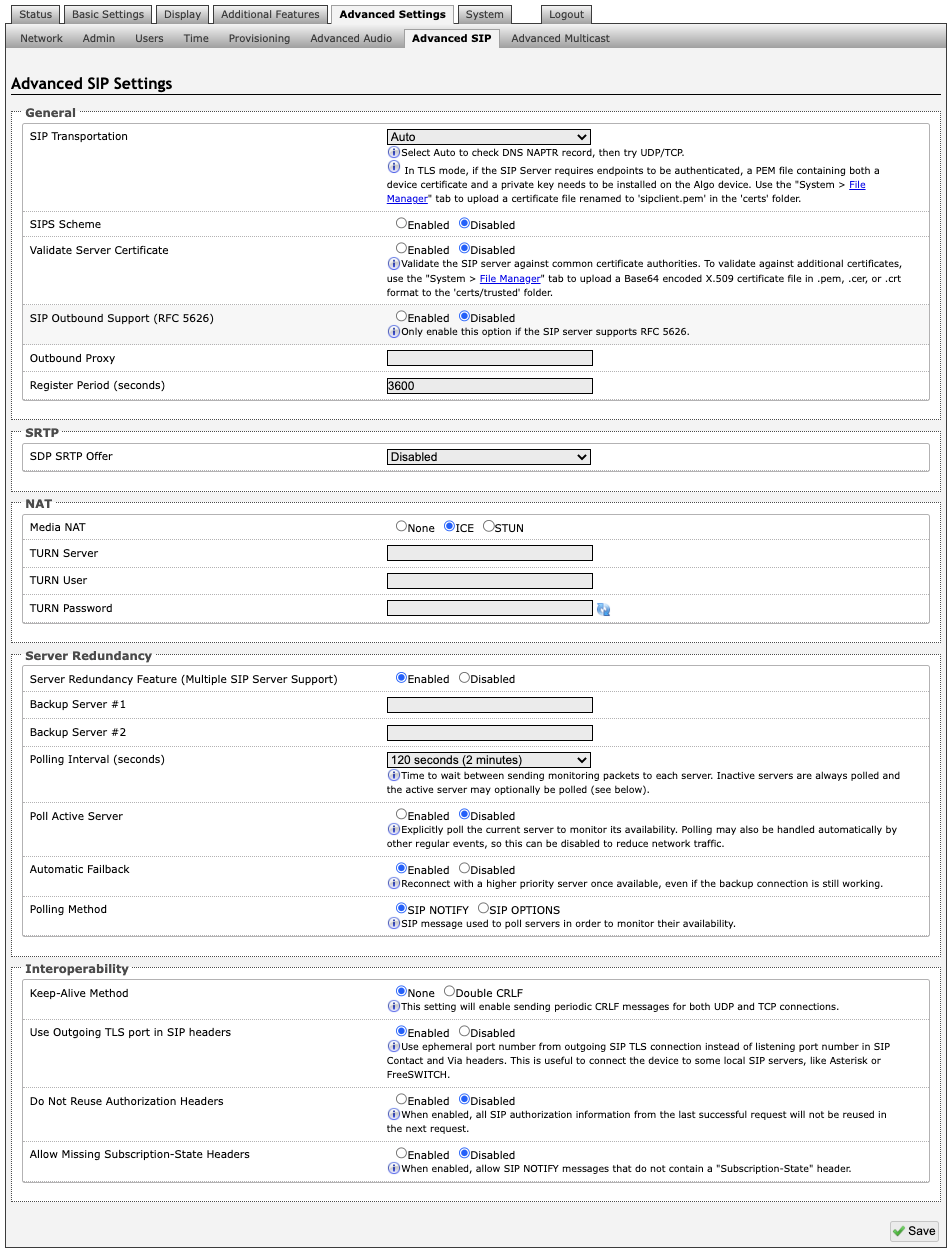
General
SIP Transportation
Which transport layer protocol to use for SIP messages. Setting SIP Transportation to TLS, ensures the encryption of SIP traffic.
SIPS Scheme
Only visible when SIP Transportation set to TLS. Enabling SIPS Scheme requires the SIP connection from endpoint to endpoint to be secure.
Validate Server Certificate
Validate the SIP server against common certificate authorities.
SIP Outbound Support (RFC 5626)
Enable this option to support best networking practices according to RFC 5626. This option should generally be enabled if the Algo device is being registered with a hosted server or if TLS is being used for SIP Transportation.
Outbound Proxy
IP address for outbound proxy. A proxy (server) stands between a private network and the internet.
Register Period (seconds)
Maximum requested period of time where the 8410/8420 will re-register with the SIP server. Default setting is 3600 seconds (1 hour). Only change if instructed otherwise.
SRTP
SDP SRTP Offer
Setting SDP SRTP Offer to Optional, means the SIP calls RTP data will be left unencrypted if the other party does not support SRTP. Setting SDP SRTP Offer to Standard, encrypts RTP voice data, meaning the normal audio RTP packets will now be secure (SRTP). This means SIP calls will be rejected if other party does not support SRTP. The Standard option secures the audio data between parties, by making sure that its not left out in the open for third parties to later reconstruct and listen to.
NAT
Media NAT
IP address for STUN server if present or IP address/credentials for a TURN server.
ICE – TURN Server
Enter the IP address or domain of the ICE server.
ICE – TURN User
Enter the username.
ICE – TURN Password
Enter the password.
STUN - Server
Enter the IP address or domain of the STUN server.
Server Redundancy
Server Redundancy Feature
Two secondary SIP servers may be configured. The 8410/8420 will attempt to register with the primary server but switch to a secondary server when necessary. The configuration allows re-registration to the primary server upon availability or to stay with a server until unresponsive.
If Server Redundancy is selected the web page will expand as shown below.
Backup Server #1
If the primary server is unreachable, the 8410/8420will attempt to register with the backup servers. If enabled, the 8410/8420 will always attempt to register with the highest priority server.
Backup Server #2
If backup server #1 is unreachable, the 8410/8420will attempt to register with the 2nd backup server. If enabled, the 8410/8420 will always attempt to register with the highest priority server.
Polling Intervals (seconds)
The time period between sending monitoring packets to each server. Non-active servers are always polled, and active server may optionally be polled (see below).
Poll Active Server
Explicitly poll current server to monitor availability. This may also be handled automatically by other regular events and can be disabled to reduce network traffic.
Automatic Fallback
This enables device to reconnect with a higher priority server once available, even if the backup connection is still fine.
Polling Method
A SIP message used to poll servers to monitor availability.
Interoperability
Keep-Alive Method
If Double CRLF is selected, the 8410/8420 will send a packet every 30 seconds (recommended value) to maintain connection with the SIP Server if behind NAT.
Keep-Alive Interval
This is the interval in seconds that the CRLF message should be sent.
Use Outgoing TLS port in SIP Headers
Use ephemeral port number from outgoing SIP TLS connection instead of the listening port number in SIP Contact and Via headers. This is useful to connect the device to some local SIP servers, like Asterisk or FreeSWITCH.
Do Not Reuse Authorization Headers
When enabled, all SIP authorization information from the last successful request will not be reused in the next request.
Allow Missing Subscription-State Headers
When enabled, this allows SIP NOTIFY messages that do not contain a Subscription-State header.
Advanced Multicast
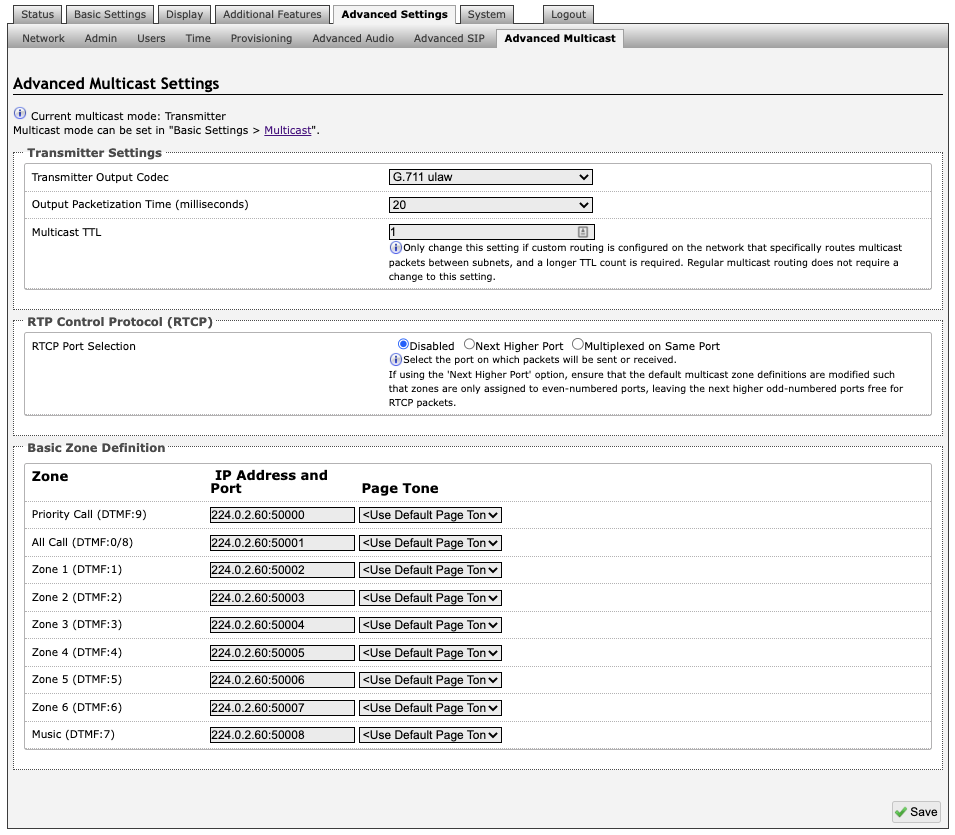
Note
The settings on this tab are only visible when in Sender or Receiver multicast mode.
The default pre-populated multicast addresses above will work in most cases and should only be altered for rare cases.
Transmitter Settings
Transmitter Output Codec
This is the audio encoding format used by the Transmitter device when sending output to the Receivers.
Output Packetization Time (milliseconds)
The size of the audio packets sent by the Transmitter to the Receivers. The default of 20 ms is recommended unless a different value is specifically required for compatibility with other devices.
Multicast TTL
The multicast time to live (TTL) setting should only be changed if custom routing is configured on the network that specifically routes multicast packets between subnets and a longer TTL count is required. This ensures packets are not bounced back and forth in a network identity. When the TTL is reached, the router drops the packet.
Receiver Settings
RTCP Port Selection
Select the port on which RTCP packets will be sent or received. If using the 'Next Higher Port' option, ensure that the default multicast zone definitions are modified such that zones are only assigned to even-numbered ports, leaving the next higher odd-numbered ports free for RTCP packets.
Polycom Receiver Tones
Available if Multicast Receiver and Polycom Group Page or Polycom Push-to-Talk are selected in the Basic Settings → Multicast tab. A tone may be set for any of the 25 Polycom Groups. If using an Algo device as a Multicast Sender, it is recommended to set the Receiver tones to None to avoid conflicts, as the Algo devices already multicast a tone by default.
Basic Zone Definitions
Zones
The Expanded Receiver zones can be enabled/disabled in Basic Settings → Multicast. Default IP addresses and ports may be revised for any given zone in the table.
Note
Ensure that the Address and Port settings are the same for all Sender and Receiver devices.
Page Tone and Page Volume
Sender Mode: By default, the same tone can be set for all Receiver zones in the Basic Settings → Features tab. Unique paging tones may be revised for any given zone in the table above.
Receiver Mode: When an Algo device is the multicast Sender, a page tone will play on the Receiver device, so it is recommended to set the Receiver tone to None. If a page is received from a non-Algo device that doesn’t send a tone, a tone can be inserted on the Receivers (above) each time they detect page audio starting, allowing them to play a tone.
By default, the same page volume can be set for all Receiver zones in the Basic Settings → Features tab. Unique page volumes may be revised on a per-zone basis in the table above. For instance, emergency pages can be louder on certain Receiver speakers.
System
Maintenance
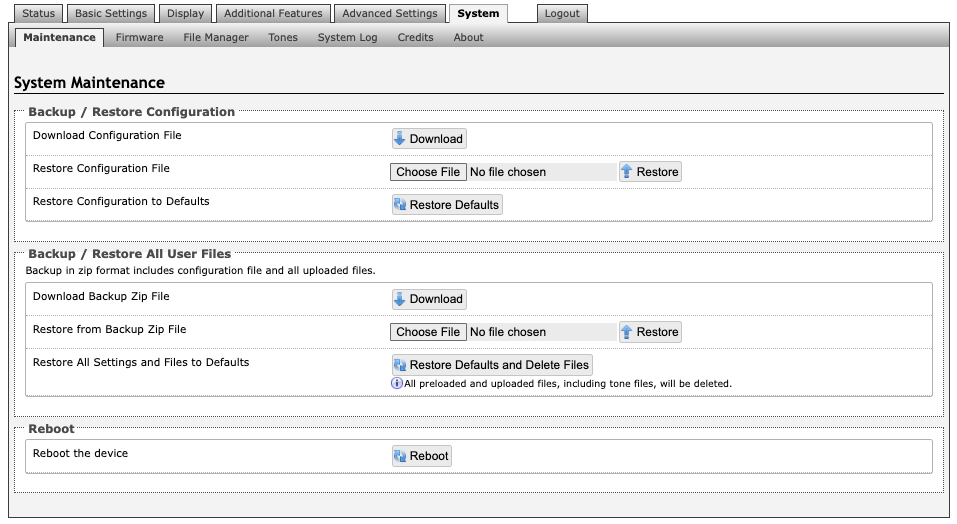
Backup / Restore Configuration
Download Configuration File
Save the device settings to a text file for backup or to set up a provisioning configuration file.
Restore Configuration File
Restore settings from a backup file.
Restore Configuration to Defaults
Resets all 8410/8420 settings to factory default values.
Backup / Restore All User Files
Download Backup Zip File
Saves the device settings (configuration) and all the files in File Manager: certificates, licenses, and tones to a backup zip file.
Restore from Backup Zip File
Restores the device settings (configuration) and all the files in File Manager: certificates, licenses, and tones from a backup zip file.
Restore All Settings and Files to Defaults
Resets the device settings (configuration) and all the files in File Manager: certificates, licenses, and tones to factory default values.
Reboot
Reboot the Device
Reboots the device.
Firmware
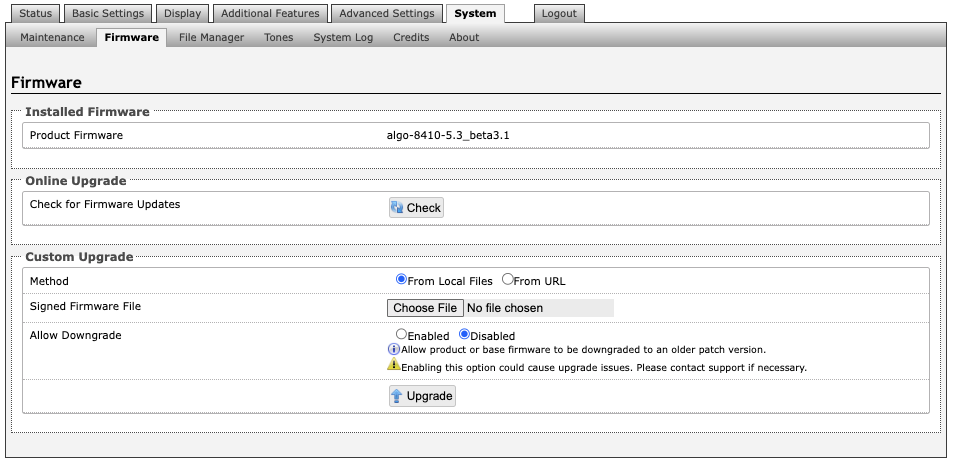
Installed Firmware
Product Firmware
Shows the current firmware on the device.
Online Upgrade
Check for Firmware Updates
Check for the latest firmware. If firmware is current, Latest Firmware will show as Firmware up to date. If firmware needs to be upgraded, the new firmware availability will be listed.
Custom Upgrade
Method
For firmware upgrades. Specify whether the firmware files will be downloaded from the local computer or a remote URL.
Signed Firmware File
To upgrade Firmware:
From the top menu, go to System → Firmware.
In the Upgrade section, press Choose File and select the 8410/8420 firmware file to upload. Note that both FW firmware and MD5 checksum files must be loaded.
Press Upgrade.
After the upgrade is complete, confirm that the firmware version has changed (refer to top right of Control Panel).
Allow Downgrade
Allow product or base firmware to be downgraded to an older patch version. Enabling this option could cause upgrade issues.
File Manager
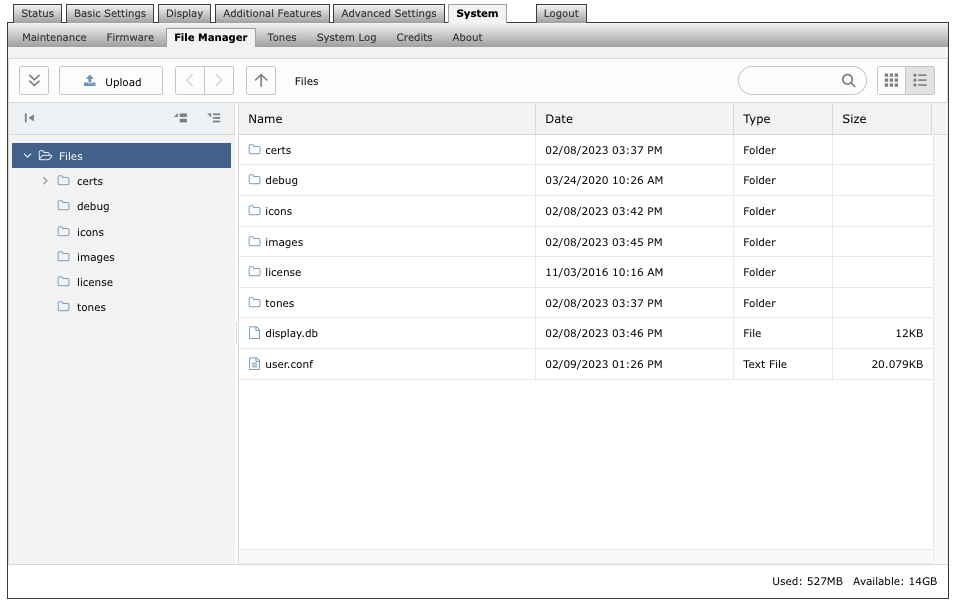
File Formats
When uploading files to the File Manager, refer to this table for supported file formats and requirements.
Folder | Supported Format | Note |
|---|---|---|
certs | CRT | |
icons | BMP, CUR, GIF, ICNS, ICO, JPEG, JPG, PBM, PGM, PNG, PPM, SVG, SVGZ, TGA, TIF, TIFF, WBMP, WEBP, XBM, XPM | Recommended file size: 1200 × 130 pixels. Icons are scaled to fit the icon frame in the selected slide template while preserving their aspect ratio. |
images | BMP, CUR, GIF, ICNS, ICO, JPEG, JPG, PBM, PGM, PNG, PPM, SVG, SVGZ, TGA, TIF, TIFF, WBMP, WEBP, XBM, XPM |
|
license | LIC | |
tones | 8SVX, AIF, AIFC, AIFF, AIFFC, AL, AMB, AMR-NB, AMR-WB, ANB, AU, AVR, AWB, CAF, CDDA, CDR, CVS, CVSD, CVU, DAT, DVMS, F32, F4, F64, F8, FAP, FLAC, FSSD, GSM, GSRT, HCOM, HTK, IMA, IRCAM, LA, LPC, LPC10, LU, MAT, MAT4, MAT5, MAUD, MP2, MP3, NIST, OGG, PAF, PRC, PVF, RAW, S1, S16, S2, S24, S3, S32, S4, S8, SB, SD2, SDS, SF, SL, SLN, SMP, SND, SNDFILE, SNDR, SNDT, SOU, SOX, SPH, SW, TXW, U1, U16, U2, U24, U3, U32, U4, U8, UB, UL, UW, VMS, VOC, VORBIS, VOX, W64, WAV, WAVPCM, WV, WVE, XA, XI | Audio files must be in the following format:
|
Uploading Custom Audio Files
Custom audio files may be uploaded into memory (1 GB) to play for notification applications. Place your audio files into the tones directory.
An existing file may also be modified. Download the original file and right clicking the tone and selecting Download, making the desired changes, and then uploading the new version with a different name.
Certs Folder
If you have enabled Validate Server Certificate under Advanced Settings →Advanced SIP or Advanced Settings → Provisioning and want to validate against additional certificates, you can upload them here.
To install a public CA certificate on the Algo device:
Obtain a public certificate from your Certificate Authority (Base64 encoded X.509 .pem, .cer, or .crt).
Open the certs folder in the web interface by going to System → File Manager.
Upload the certificate files into the certs folder by clicking Upload in the top left corner of the file manager and select the certificate.
Reach out to support@algosolutions.com to get the complete list of pre-loaded trusted certificates.
Debug Folder
If you have any challenges with the device and work with the Algo support team to overcome or fix them, the debug folder will be used. The device will generate files containing information about the device and put them in the debug folder. You do not need to use this folder unless directed to by the Algo support team.
Icons Folder
The Icons folder stores icons that you can use in slide headers.
Images Folder
Upload images to use in your slides.
License Folder
If you would like to use InformaCast on a device that hasn't been bundled with an InformaCast license, you will need to purchase a license and put it into the license folder in the file manager.
Tones Folder
Custom audio files may be uploaded to play notifications. Audio files should be stored in the tones directory.
Existing files may be modified by downloading the original file, making the desired changes, then uploading the updated file with a different name.
Tones
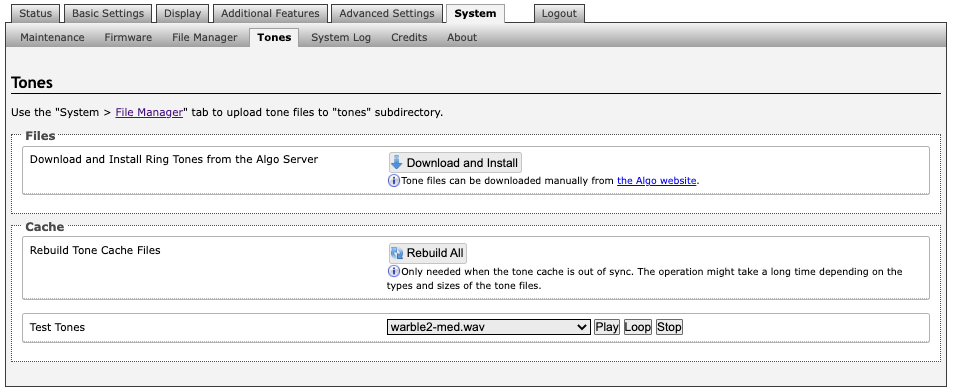
Tone Files Included in Memory
The 8410/8420 includes several pre-loaded audio files that can be selected to play for various events. The web interface allows selection of the file and the ability to play it immediately over the speaker for testing (available in Basic Settings → Features). Files may also be deleted or renamed.
System Log
System log files are automatically created and assist with troubleshooting in the event the 8410/8420 does not behave as expected.
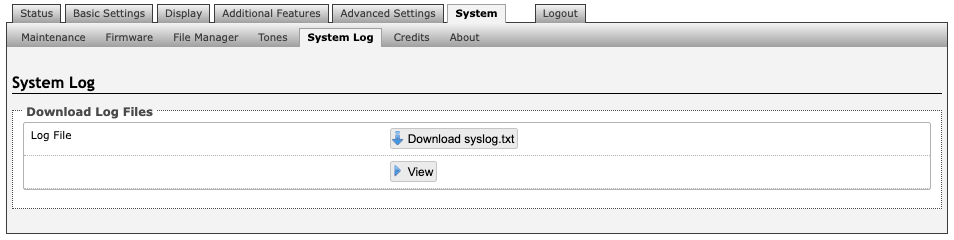
Logout
Log out of the 8410/8420 web interface.
FCC Compliance Statement
This equipment has been tested and found to comply with the limits for a Class A digital device, pursuant to Part 15 of the FCC Rules. These limits are designed to provide reasonable protection against harmful interference when the equipment is operated in a commercial environment. This equipment generates, uses, and can radiate radio frequency energy, and if it is not installed and used in accordance with the instruction manual, it may cause harmful interference to radio communications. Operation of this equipment in a residential area is likely to cause harmful interference, in which case the user will be required to correct the interference at their own expense.